Showing posts with label Marian Price. Show all posts

Friday, August 16, 2013

PUSSY RIOT, Marian Price, Demand RELEASE MARTIN COREY


According to the Belfast Telegraph


"As Marian McGlinchey was returned for trial accused of aiding and abetting at an Easter commemoration event, her lawyers sought reporting restrictions in the case.
They argued that she faced greater threat of being killed by loyalist paramilitaries if her details and any up-to-date photos were published.
But a judge at Belfast Magistrates' Court refused to grant the order due to a lack of evidence that the risk to life is real and immediate.
McGlinchey (59) and of no fixed address, is charged in connection with a demonstration at Derry City Cemetery in April 2011.
It is alleged that she helped another person who addressed the rally in support of an outlawed organisation, namely the Irish Republican Army.
McGlinchey, also known as Marian Price, served a jail sentence along with her late sister Dolours for the 1973 IRA bomb attack on the Old Bailey in London.
She was returned to prison when her licence was revoked following the new charge, spending two years in custody before finally being released earlier this year.  
Along with her late sister Dolours, she distanced herself from mainstream republicanism over Sinn Fein's support for the Northern Ireland peace process.
Plagued by ill-health in recent years, she appeared in court today for a preliminary enquiry to determine whether she has a case to answer on the aiding and abetting a terrorist rally charge.
Wearing a brown duffel coat and glasses, McGlinchey shook her head when asked if she wanted to give evidence or call witnesses at this stage in the case.
District Judge Barney McElholm ruled that there was a prima facie case against her and returned her for trial at Belfast Crown Court on a date to be set.
She was bailed to live at an address in Belfast but banned from applying for a new passport without prior permission.
Seeking the anonymity order, defence counsel Sean Devine produced a doctor's report which stated media attention was likely to cause greater anxiety and worsen her medical condition.
He argued that police had previously informed her that she was under threat.
A newspaper article from June this year claiming loyalist paramilitaries still planned to kill her at the first opportunity was also produced.
Contending that McGlinchey's physical appearance has changed, Mr Devinesaid: "The level of protection being sought is relatively modest - images of her should not be published."
But a prosecution barrister opposed the application, stressing the late notification given by the defence.
He added: "The defendant has on previous occasions sought to use the media in pursuit of her own political and ideological ambitions.
"She was aware of the threats on her."
Dismissing the application, Judge McElholm accepted McGlinchey's appearance had altered but suggested it may be due to her now wearing glasses.
He also pointed to the amount of images and information about her already in the public domain.
After referring to the need for any anonymity application to be notified to police and prosecutors at the earliest opportunity, he ruled: "At the moment we have no objective evidence as to whether or not there is a real and immediate risk to the life and well-being of the applicant.
" ' In those circumstances I refuse to make an anonymity order.' "


Friday, May 31, 2013

Irish Republican News : MARIAN IS HOME : Martin Corey


MARIAN IS HOME

The release of Irish prisoner of conscience Marian Price is being
celebrated as a significant victory for justice campaigners and a key
step in securing the freedom of other prisoners currently interned in
the north of Ireland.

A former political prisoner and republican activist, Marian had been in
custody since May 2011 when her 'release licence' was revoked by then
British Direct Ruler Owen Paterson. A royal pardon which would have
guaranteed her freedom was described as 'missing' from British archives.

Suffering from deteriorating mental and physical health, Marian was
moved from prison to a Belfast hospital on medical advice last June. Her
family described her continued detention as "administrative internment".

She was finally released from hospital yesterday where she was being
treated for depression, arthritis and lung problems.

Her legal team had gone before parole commissioners seeking to have her
freed on licence, with SDLP Assembly member Pat Ramsay and Sinn Fein
politicians speaking on her behalf. During the hearing members of the
British military were closely questioned by Marian's legal team.


Following two months of evidence, the commission yesterday took the
decision that she should be released. It said it had agreed to release
the veteran republican "given her current circumstances". But it refused
to reveal the 'closed material' -- secret allegations -- which have been
presented as evidence to maintain her imprisonment.

Last night Marian Price's husband Jerry McGlinchey said: "I feel a great
sense of elation getting her home but it's a disgrace that closed
material was used to keep her in.

"Although she is now at home she is still very ill and we would ask that
the media respects our privacy at this time."

Arrested and jailed along with her sister Dolours for her part in the
Provisional IRA campaign in 1973, Marian then undertook a hunger-strike
which lasted over 200 days. Prison warders at Belmarsh jail brutally
force-fed both sisters to prevent their deaths. Still haunted by that
experience, Dolours died at her home late last year.

In October, a United Nations medical report found that Marian was be too
ill to follow any evidence presented at court, making her detention all
the more vindictive.

Her lawyer Peter Corrigan welcomed the decision to finally release his
client.

"We are pleased she has been released to return to her family," he said.
"And we are delighted with the decision that she is not a risk to the
public in being released.

"The British secretary of state should not have revoked her licence in
the first place and should not have been relying on closed evidence to
justify that."

REACTION

The decision was also welcomed by the Dublin government. Taoiseach Enda
Kenny, who said he raised the issue during meetings with British Prime
Minister David Cameron, said: "I am pleased to learn of today's news and
I hope that Ms Price will now be able to spend time with her family and
friends."

The SDLP's Pat Ramsey said the case was about human rights and said he
hoped Marian could return to her family and recuperate.

Sinn Fein junior minister Jennifer McCann described the decision to
detain her as "an affront to the justice system. She should never have
been imprisoned in the first place."

Pauline Mellon of the Justice for Marian campaign said her detention had
been "politically motivated, vindictive and in breach of the Human
Rights Act, the European Convention on Human Rights and Common Law".

'END INTERNMENT'

Both Sinn Fein and the various campaign groups, including the Dublin
Justice for Marian Price Committee, the Prison Crisis Group, and others,
pointed to the continued detention of 63-year-old Martin Corey.  After
more than three years, Mr Corey is still interned without charge or
trial on the basis of 'closed material', and there is a renewed belief
that he can also be freed.

Ms Mellon said a number of victims of 'administrative internment'
remained behind bars.

"We would ask that people oppose this terrible injustice meted out
against people because of their beliefs," she said.

“The logic of today’s release is that Martin Corey should also be
freed," Sinn Fein leader Gerry Adams said in a statement.

The Prison Crisis Group said there was more work to do "fighting for
Martin Corey and in solidarity with interned prisoners across the water.

"We will be putting particular emphasis on the case of John Downey. But
we can take time off today to celebrate.

“Everybody should learn the most important lesson to come out of all
this – that grass-roots campaigning can make all the difference.”

Monday, May 27, 2013

free SPIRIT MARIAN price


Interned Irish republican Marian Price will learn this week if she will be be freed after more than two years' imprisonment according to the Parole Commission which will make an announcement by Thursday.

The british SS (secret services) say she no longer represents "a security threat". Marian is seriously ill in a Belfast City Hospital suffering from severe depression and respiratory problems.


The current internment without trial of veteran Irish republicans Marian Price 59, now interned 2 years without trial and Martin Corey 63, interned more than 3 years among others, is causing serious resentment to build in Ireland against the British Tories and their occupation.


Internment without trial is an odious instrument of wartime, to control the general population. It's use in the wake of a supposed Peace Process in Ireland is guaranteed to eventually bring war again to Ireland, as it did, when last introduced forty years ago, igniting the powder keg of injustice, that already exists with British occupation in Ireland.


Below is an article of the sequence of some of the events around the internment of Marian Price. For those who recognize justice as being the foundation for a prevailing peace, and non violent activism, as an alternative to violence, your help is desperately needed, to spread the word by re-sharing on Facebook, re-tweeting on Twitter, organizing pickets and demonstrations, to educate and organize the public with regard to facts of this matter.


There is a general mainstream media blackout on the facts around internment without trial in Ireland and passive silence, is enabling it to happen, in the same way as it did with Nazi internment and the Holocaust of the last world war.


"Bernadette Devlin McAliskey, veteran Irish civil rights leader, said in response to the case of Irish republican Marian Price, who was returned to jail in 2011: “It is a clear signal to everyone who is not 'on board' and who is not of the same mind as the government that no dissent will be tolerated.
“No dissent will be tolerated and you challenge the status quo at your peril.”.
Marian Price, 59, is a long-time Irish republican activist and ex-Irish Republican Army volunteer. She was given two life sentences over bomb blasts in London in March 1973 that targeted a British army recruitment centre and Old Bailey courts. Price was one of nine republicans sentenced, including her sister Dolours and Gerry Kelly, who is now Sinn Fein MLA for North Belfast.
Price was given a “royal pardon” in 1980 and left prison suffering from poor health and weighing only five stone. The Price sisters had spent 200 days on hunger strike demanding to be transferred to a jail in Ireland's north, where republican prisoners had political status.
They were both forcibly restrained and force-fed three times a day over the last 167 days of the hunger strike.
Despite her health issues and prolonged jailing, Marian Price remained politically active after her release. Her outspoken criticism of British rule caused problems for the British administration, who had probably hoped she would quietly fade from the political scene.
Marian’s continued political activism and vocal support for Irish republicanism kept her under scrutiny and made her a target for the British in Occupied Ireland .
Jailed on orders of an unelected British government official
Marian Price was returned to prison in 2011, not on the basis of fresh evidence or any new offence. Rather, then-British Viceroyal for British Occupied Ireland, Owen Paterson from England, ordered her detention and charged her with encouraging support for an illegal organisation.
The basis of this charge is that Marian attended a 1916 traditional, annual, Easter Rising Commemoration held in Derry; one of many held by Irish republicans each year since the Easter Rising in Dublin almost one hundred years ago.. At the event, Marian Price held up a piece of paper for a masked man from the 32-County Sovereignty Movement as he read out a message.
Three days later, Marian was arrested. She was then granted bail by a judge, but arrested again after she left the court on the unelected Viceroyal for Occupied ireland's orders.
This time, the reason was supposedly based on secret information from the British secret services, which claims the supposed evidence from a paid informer cannot be revealed due to national security concerns.
Later, Marian Price was also charged with “providing property for the purposes of terrorism”; this allegedly related to her purchase of a phone, which authorities “think” was later used by attackers who killed two soldiers in 2009.
Marian Price's supporters believe this is simply an attempt by the British to link her with a crime. No evidence or connection whatsoever to the incident was produced and she was again granted bail by a judge inthe court.
Yet Marian Price remains in prison due to Viceroya's order.
Marian Price's real transgression seems to be her critical remarks about conditions in the occupied six Irish counties, still claimed by Britain, and of the Good Friday Agreement, that lead to the power-sharing arrangement between Sinn Fein and parties that support British rule in the north.
Solitary confinement
After her arrest, Marian was held in solitary confinement in the all-male Maghaberry high security prison for more than nine months, despite not being convicted of any crime.
Then in February last year, Price was taken to Hydebank Women’s Prison where she served another nine months in solitary confinement.
In May last year, the so-called charges involving the Easter Commemoration incident were thrown out of court by a judge. Still Price remained interned in prison as her mental and physical health rapidly deteriorated.
Then in June, by now seriously ill, she was transferred to a secure ward at Belfast hospital.
The European Court and former Commission on Human Rights, as well as the European Committee for the Prevention of Torture (CPT), have said the use of solitary confinement can be classified as torture, depending on the circumstances.
The CPT has also said that solitary confinement “can amount to inhuman and degrading treatment” and has on several occasions criticised such practices. It has recommended reforms such as abandoning specific regimes, limiting the use of solitary confinement to exceptional circumstances, and/or securing inmates a higher level of social contact.
Furthermore, the revised European Prison Rules of 2006 have clearly stated that solitary confinement should be an exceptional measure and, when used, should be for as short a time as possible.
The Inter-American Court of Human Rights has also stated that prolonged solitary confinement constitutes a form of cruel, inhuman or degrading treatment prohibited under Article 5 of the American Convention on Human Rights.
The UN’s lead investigator on torture, Juan Mendez, has called for governments to end the use of long spells of solitary confinement in prison. Mendez said such isolation could cause serious mental and physical damage and amounted to torture.
He further said that short term isolation was permissible only for prisoner protection, but all solitary confinement longer than 15 days should be banned.
Support for Marian Price
In a joint statement in November last year appealing to US officials visiting Ireland to support calls for the release of Price, Sinn Fein President Gerry Adams and Sinn Fein deputy first minister of the Northern Ireland Executive Martin McGuinness said: “[Price's treatment is a] serious case of injustice and denial of human rights and judicial rights in the north of Ireland.
“We believe that her detention is unjust and runs contrary to the principles of natural justice. We believe very strongly that Marian Price McGlinchey should be released.
“ Her human rights have been breached. She has been denied justice and due process. She is seriously ill. Her detention undermines the justice system and the political process.
“She clearly presents no threat to anyone.”
The campaign to release Price has encompassed a diverse range of people and political, social and community organisations across Ireland and elsewhere. Calls for her freedom have been backed by the two parliamentary nationalist parties in the north, Sinn Fein and the Social Democratic Labour Party (SDLP).
Adams called for Marian’s release in November, January and again in March. McGuinness has also appealed several times for her release, most recently at Sinn Fein's Ard Fheis (congress). He also attended and gave evidence at the Parole Commissioners hearing a short time ago.
SDLP leader Alistair McDonnell called for her release on March 30. SDLP MLA Pat Ramsey has been a vocal supporter of the release of Price, as has Lisburn independent councillor Angela Nelson.
The campaign is also supported by a wide range of republican and national groups, including the 32 County Sovereignty Movement (of which Price is a member), Irish Republican Socialist Party, Republican Network for Unity, Eirigi, Republican Sinn Fein, Irish Freedom Committee, Friends of Irish Freedom, the Celtic League, the United Celtic Brotherhood and the 1916 Societies.
Calls for Price's freedom have also come from Dublin City Council, Fermanagh Council, Dungannon Council, Galway Council, Derry Council, Sligo Council and Omagh Council.
Among other groups calling for Price’s release are the Scottish Republican Socialist Party and Human Rights Watch UK.
Justice
Devlin McAliskey said: “I think what is very important for people to recognise that what is happening to Marian is not an isolated case. While it's happening here in Northern Ireland and we have had to call upon the UN Rapporteur for Health to exercise his authority to examine it ... [it relfects] the arrogance [of] many of the Western powers ...
“I think Marian's case is symptomatic of those things we see every day ... That people can still be imprisoned without due process and that many countries, particularly in the very powerful Western alliances, feel that UN resolutions and UN protections are for protecting them from their enemies, but not people from powerful states.
“Marian's case is not just something peculiar to the Northern Ireland situation. The increasing confidence with which fundamental human rights and due process and protections are being ignored ― I think is frightening.”
The treatment of Price amounts to a return to the bad days of interment without trial, enforced by the British on the nationalist community in Ireland's north in the early 1970s.
Price is being held purely because of her views and criticisms. She is being selectively targeted because she refuses to remain silent in the face of British coercion and repression.
The British justice system’s mistreatment of Price has again exposed it as the disgraceful, hypocritical and discriminatory structure that it is, a fact that Irish people have experienced throughout the colonial occupation of Ireland.
Price’s case reveals the contempt the British judicial system has for genuine fairness and due process.
Twice she was granted bail by judges, only to be rearrested due to orders signed by the Northern Ireland secretary of state. Price has been illegally imprisoned. The lack of a genuine case against Price and her jailing without due process is a travesty that must be remedied by her unconditional freedom.
Price’s human rights are being grossly violated by her long-term incarceration. She is effectively detained without trial, sentence or release date. This means she could be held for an indefinite time, an illegitimate procedure that allows the British administration to hold her for the rest of her life if it so desires.
On the basis of compassion, legal, civil and political rights, and those of common sense, Marian Price should be released immediately.


Poem by Bobby Sands


As the day crawls out another night crawls in

Time neither moves nor dies

It’s the time of day when the lark sings, 

The black of night when the curlew cries.


There’s rain on the wind, the tears of spirits

The clink of key on iron is near, 

A shuttling train passes by on rail,

There’s more than God for man to fear.


Toward where the evening crow would fly, my thoughts lie, 

And like ships in the night they blindly sail, 

Blown by a thought — that breaks the heart —

Of forty women in Armagh jail.


Oh! and I wish I were with the gentle folk, 

Around a hearthened fire where the fairies dance unseen, 

Away from the black devils of H-Block hell,

Who torture my heart and haunt my dream.


I would gladly rest where the whin bush grow,

Beneath the rocks where the linnets sing

In Carnmoney Graveyard ‘neath its hill

Fearing not what the day may bring! "


Spread the Word

Saturday, May 4, 2013

BLACKOUT MARIAN PRICE


Marian Price Media Blackout

category international | miscellaneous | news report author Saturday May 04, 2013 11:17author by Brian Clarke - AllVoices Report this post to the editors
Two Year British Political Internment
On March 14th, 2013 Provisional Sinn Féin MLAs Jennifer McCann and Sean Lynch, met with Vice royal Theresa Villiers, regarding the continued internment of Marian Price and called for the immediate release of Marian Price according to MLA Jennifer McCann. Since that time there has been a complete media print blackout on the political internment of Marian Price.
Marian Price News Blackout
On March 14th, 2013 Provisional Sinn Féin MLAs Jennifer McCann and Sean Lynch, met with Vice royal Theresa Villiers, regarding the continued internment of Marian Price and called for the immediate release of Marian Price according to MLA Jennifer McCann.

Ms. McCann said, “The meeting followed a visit that Martin McGuinness and myself had recently with Marian Price and the presentation made by Martin at her parole hearing last week.

At the meeting with Theresa Villiers, Martin Guinness made it clear, that Ms Price was not a threat to the public and that she should be released without further delay.

I gave a detailed account of the deteriorating condition of Marian Price's health, which has been added to by the recent death of her sister Dolours Price.

I also challenged the decision to re-imposing her life term licence especially given that she was granted bail and urged Theresa Villiers, to accept that Ms Price is entitled to due legal process. She should be tried in a court of law or released.”

Since this statement was made public, there has been a news blackout with regard to Marian Price, with all written material published censored. A Google search will confirm this. Inter agency communiques on Marian Price are also being manipulated, along with material on both Twitter and Facebook. It is the responsibility of ethical news agencies to investigate this matter immediately and confirm the welfare of Marian Price publicly, as there considerable public concern for Marian's welfare and the exercise may be further punishment to the many people concerned worldwide.

Media Blackouts like political internment are act of war that neither belong ina genuine democracy or in peace time. The Irish peace process has been considerably undermined by the British Tory Government since coming to power.

According to Wikipedia a Media blackout refers to the censorship of news related to a certain topic, particularly in mass media, for any reason. A media blackout may be voluntary, or may in some countries be enforced by the government or state. The latter case is controversial in peacetime, as some regard it as a human rights violation and repression of free speech. Press blackout is a similar phrase, but refers specifically to printed media.
Media blackouts are used, in particular, in times of declared war, to keep useful intelligence from the enemy. In some cases formal censorship is used, in others the news media are usually keen to support their country voluntarily as in the UK system in the Second World War.

Historical Media Blackouts

Some examples of media blackout would include the media bans of southern Japan during the droppings of the atomic bombs on Hiroshima and Nagasaki, and the lack of independent media correspondence from Iraq during the Persian Gulf War.

During World War II, the US Office of Censorship sent messages to newspapers and radio stations, which were acted on by recipients, asking them not to report any sightings or explosions of fire balloons, so the Japanese would have no information on the balloons' effectiveness when planning future actions. As a result the Japanese learned the fate of only one of their bombs, which landed in Wyoming, but failed to explode. The Japanese stopped all launches after less than six months.

The press blackout in the U.S. was lifted after the first deaths from fire balloons, to ensure that the public was warned, though public knowledge of the threat could have possibly prevented the deaths. News of the loss of over 4,000 lives when UK ship RMS Lancastria was sunk during the war was voluntarily suppressed to prevent it affecting civilian morale, but was published after it became known overseas.

Contemporary Media Blackouts

A media blackout was used during the 2005 New York City transit strike to allow for more effective contract negotiation between the two sides of the dispute.[4] Most typically, the more freedom of the press that any particular country has, and the more sensational the story, the more likely it is that at least one news organization will ignore the "blackout" and run the story.

The 2008 abduction of Canadian journalist Mellissa Fung was given a media blackout to assure her safe return. All media sources obliged making the Canadian public unaware of the fate of Fung.

In 2008, the fact that Prince Harry of Wales, third in line to the British throne, was serving on active duty in Afghanistan was subject to a blackout in the British media for his own safety. He was brought home early after the blackout was broken by foreign media.

On June 22, 2009, when news came that New York Times reporter David Rohde had escaped from his Taliban captors, few knew he had even been kidnapped, because for the seven months he and two Afghan colleagues were in the Taliban's hands, The Times kept that information under wraps. Out of concern for the reporter's safety,

The Times asked other major news organizations to do the same;NPR was among dozens of news outlets that did not report on the kidnapping at the urging of Rohde's colleagues. Kelly McBride, who teaches ethics to journalists at the Poynter Institute, says she was "really astounded" by the media blackout. "I find it a little disturbing, because it makes me wonder what else 40 international news organizations have agreed not to tell the public," she tells NPR's Melissa Block. McBride says the blackout could hurt the credibility of news organizations. "I don't think we do ourselves any favors long term for our credibility when we have a total news blackout on something that's clearly of interest to the public," she says.

In 2009, on the 20th anniversary of Tiananmen Square protests of 1989, a number of social media websites were made in accessible and foreign television reception disrupted in China.

Some media critics have questioned whether the 2000 Wichita Massacre received little to no coverage in the mainstream media due to political correctness regarding the race of the perpetrators and the victims. Such critics also cite the 2007 Murders of Channon Christian and Christopher Newsom in Knoxville, Tennessee.

On January 18, 2012, Wikipedia itself participated in a media blackout to protest SOPA."
Related Link: http://irishblog-irelandblog.blogspot.com/

Wednesday, May 1, 2013

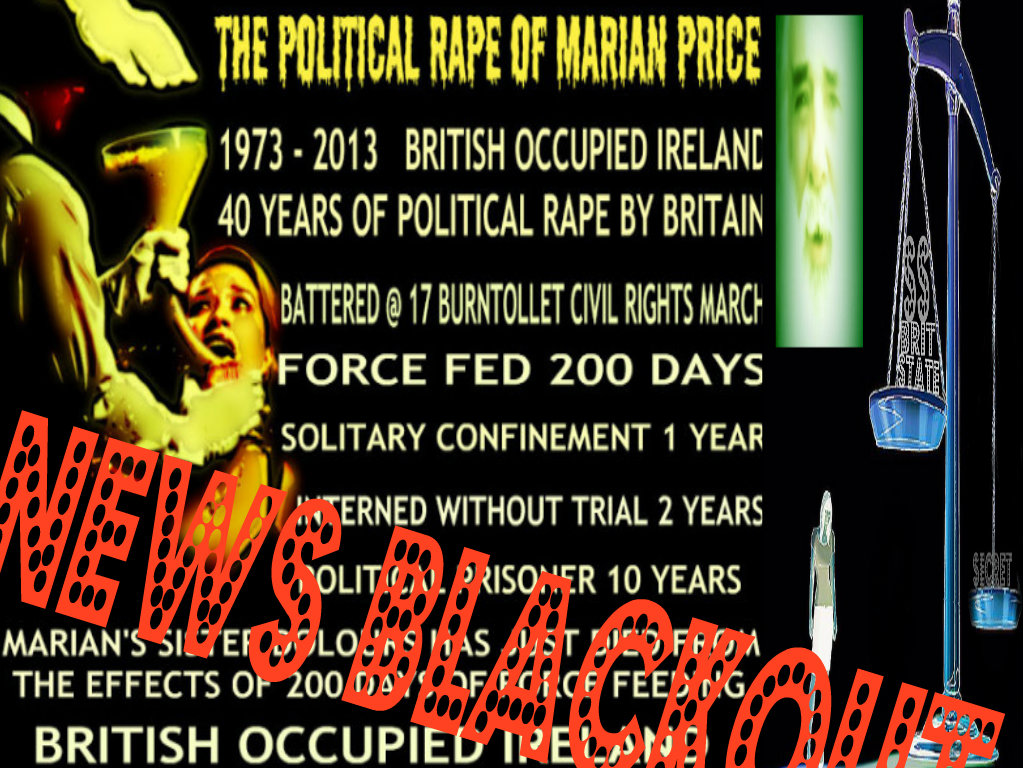
THE BRITISH POLITICAL RAPE OF MARIAN PRICE


"Four male prison officers tie you into the chair so tightly with
sheets you can't struggle," says Price. "You clench your teeth to try
to keep your mouth closed but they push a metal spring device around
your jaw to prise it open.

"They force a wooden clamp with a hole in the middle into your mouth.
Then, they insert a big rubber tube down that. They hold your head
back. You can't move.

"They throw whatever they like into the food mixer - orange juice,
soup, or cartons of cream if they want to beef up the calories. They
take jugs of this gruel from the food mixer and pour it into a funnel
attached to the tube.

"The force-feeding takes 15 minutes but it feels like forever. You're
in control of nothing. You're terrified the food will go down the
wrong way and you won't be able to let them know because you can't
speak or move. You're frightened you'll choke to death."

Price was force-fed 400 times over six months. "I knew nothing about
force-feeding beforehand," says Price. "I thought it was like when
you hold a baby's nose and put a spoon in its mouth. Ignorance was
bliss."

Marian Price still politically interned 40 years later in British Occupied Ireland, in a supposed Peace Process without Due Process.Her sister Dolours died from the effects of 200 days on hunger strike. Please reshare or retweet to overcome censorship.


Wednesday, April 24, 2013

MASS HUNGER STRIKES IN MARIAN PRICE TYPE FORCE FEEDING


Marian Price is currently interned without trial in a British Gulag in Occupied Ireland Other internees like Martin Corey are also being interned without trial on concocted secret service hearsay, to justify their ever expanding budgets and try provoke another lucrative money making racket of 40 years of making war on ordinary Irish people.

The hunger strike of Marian Price lasted over 200 days,being force-fed by prison authorities for 167 of them. In an interview with Suzanne Breen, Marian Price described being force-fed: "Four male prison officers tie you into the chair so tightly with sheets you can't struggle. You clench your teeth to try to keep your mouth closed but they push a metal spring device around your jaw to prise it open. They force a wooden clamp with a hole in the middle into your mouth. Then, they insert a big rubber tube down that. They hold your head back. You can't move. They throw whatever they like into the food mixer – orange juice, soup, or cartons of cream if they want to beef up the calories. They take jugs of this gruel from the food mixer and pour it into a funnel attached to the tube. The force-feeding takes 15 minutes but it feels like forever. You're in control of nothing. You're terrified the food will go down the wrong way and you won't be able to let them know because you can't speak or move. You're frightened you'll choke to death."


Hunger strikes have deep roots in Irish society and in the Irish psyche. Fasting in order to bring attention to an injustice which one felt under his lord, and thus embarrass him into a solution, was a common feature of society in Early Irish society and this tactic was fully incorporated into the Brehon legal system. The tradition is ultimately most likely part of the still older Indo-European tradition of which the Irish were part.[8]
The tactic was used by Irish republicans from 1917 and, subsequently, during the Anglo-Irish War, in the 1920s. Early use of hunger strikes by republicans had been countered by the British with force-feeding, which culminated in 1917 in the death of Thomas Ashe in Mountjoy Prison.
In October 1920, the Lord Mayor of CorkTerence MacSwiney, died on hunger strike in Brixton prison. Two other Cork IRA men, Joe Murphy and Michael Fitzgerald, also died on hunger strike in this protest along with Monaghan native,Conor McElvaney who lasted 79 days before death. TheGuinness Book of Records lists the world record in hunger strike (without forced feeding) as 94 days, which was set from August 11 to November 12, 1920 by John and Peter Crowley, Thomas Donovan, Michael Burke, Michael O’Reilly, Christopher Upton, John Power, Joseph Kenny and Seán Hennessy at the prison of Cork. Arthur Griffith called off the strikes after the deaths of MacSwiney, Murphy and Fitzgerald.
After the end of the Irish Civil War in October 1923, up to 8000 IRA prisoners went on hunger strike to protest their continued detention by the Irish Free State (a total of over 12,000 republicans had been interned by May 1923). Two men, Denny Barry and Andrew O’Sullivan, died on the strike. The strike, however, was called off before any more deaths occurred. The Free State subsequently released the women republican prisoners. Most of the male Republicans were not released until the following year.
Under the de Valera Fianna Fáil government three hunger strikers died in the Republic of Ireland in the 1940s. They wereSean McCaugheyTony d’Arcy and Sean (Jack) McNeela. Hundreds of others carried out shorter hunger strikes during the deValera years with no sympathy from the Government.
The tactic was revived by the Provisional IRA in the early 1970s, when several republicans such as Sean MacStiofainsuccessfully used hunger strikes to get themselves released from custody without charge in the Republic of IrelandMichael Gaughan died after being force-fed in a British prison in 1974.Frank Stagg, an IRA member being held in a British jail, died after a 62-day hunger strike in 1976 which he began as a campaign to be repatriated to Ireland.

Irish hunger strike of 1981

Main article: 1981 Irish hunger strike
In 1980, seven Republican prisoners in the Maze Prisonlaunched a hunger strike as a protest against the revocation by the British government of a prisoner-of-war-like Special Category Status for paramilitary prisoners in Northern Ireland. The strike, led by Brendan Hughes, was called off before any deaths, when Britain seemed to offer to concede their demands; however, the British then reneged on the details of the agreement. The prisoners then called another hunger strike the following year. This time, instead of many prisoners striking at the same time, the hunger strikers started fasting one after the other in order to maximise publicity over the fate of each one.
Bobby Sands was the first of ten Irish republican paramilitaryprisoners to die during a hunger strike in 1981. There was widespread support for the hunger strikers from Irish republicans and the broader nationalist community on both sides of the Irish border. Some of the hunger strikers were elected to both the Irish and British parliaments by an electorate who wished to register their support for the hunger strikers. The ten men survived without food for 46 to 73 days,[9] taking only water and salt. After the deaths of the men and severe public disorder, the British government granted partial concessions to the prisoners, and the strike was called off. 

This article appeared in Campaign for a United Ireland
One Island – One Nation