Friday, August 31, 2012

Olympic Silver Medallist John Joe Nevin an Interview


An exclusive interview for WorldIrish.com

Born in in Mullingar, County Westmeath and a member of the Traveller community, he was born John Joseph Nevin but is now more commonly known as John Joe!

For Irish people, John Joe Nevin is more than a great athlete sprung from our native soil. He is widely thought of as the golden boy of Irish boxing but people also see John Joe as a hero coming from humble beginnings to rise to the top and qualify for not one, but two Olympic Games!

John Joe's road to becoming an Olympic silver medalist began when he won his first fight in the 2012 Olympic Games, defeating Denmark's Dennis Ceylan by a wide margin of 21--6. In his second fight of the games, he saw off Kazakhstan's Kanat Abutalipov by a margin of 15--10.

In his quarter-final bout he beat Oscar Valdez to secure a semi-final place and a guarantee of a bronze medal. He then reached the final after defeating the reigning bantamweight world champion Lázaro Álvarez of Cuba 19--14. He won silver, losing in the final to Luke Campbell of the UK 14--11.

Category:

License:

Standard YouTube License


Thursday, August 30, 2012

‘Romantic Ireland’s Dead and Gone’


The strange death of Romantic Ireland


They are among his most famous lines, but when WB Yeats declared that ‘Romantic Ireland’s dead and gone’, what was he referring to, who killed it – and did it really exist in the first place, asks DAN MULHALL


Heres a virtual movie of the great William Butler Yeats reading his poem of September 1913 "O'Leary in the grave" he poem is an attack by Yeats on the employers and merchants of Dublin. It was provoked by the lockout of September 1913 in which all members of the ITGWU were locked out by their employers, giving rise to a winter of poverty and confrontation in the city of Dublin and resulting in victory for the employers. Yeats was particularly annoyed with the man who led the employers, William Martin Murphy, owner of Independent Newspapers and the Dublin Tram Company. As he had refused to organise the necessary money to purchase an art gallery overlooking the Liffey, to house the Hugh Lane collection of paintings in 1911. The lockout was the third major disappointment for Yeats in the artistic appreciation of Dubliners. The first being the riots in 1907 which greeted the opening night of J.M. Singe's "Playboy of The Western World" at the Abbey Theatre. The second involving a dispute over the Hugh Lane collection. The third being the lockout.

John O'Leary ( born 23 July 1830; died 16 March 1907[1]) was an Irish separatist and a leading Fenian. He studied both law and medicine but did not take a degree and for his involvement in the Irish Republican Brotherhood he was imprisoned in England during the nineteenth century.n his poem, September 1913, the poet W.B.Yeats laments the death of O'Leary with the line:
"Romantic Ireland's dead and gone; it's with O'Leary in the grave

Kind Regards

Jim Clark
All rights are reserved on this video recording copyright Jim Clark 2012

Category:

License:

Standard YouTube License


I FIRST CAME across WB Yeats’s poem September 1913 and its refrain, “Romantic Ireland’s dead and gone, It’s with O’Leary in the grave” during my schooldays and have returned to it many times since. A century after the poem’s composition, it may be time to conduct an inquest into the strange death of Romantic Ireland.
George Dangerfield’s book, The Strange Death of Liberal England, describes the decline of the British Liberal Party, brought on by a combination of the Irish Home Rule crisis, the first World War and the rise of the labour movement. In Ireland, another great political party suffered a calamitous decline. The Irish Party, which had been a major political force at Westminster since the 1880s, effectively ceased to exist after 1918.
That decade, whose centenary we are now marking, was a tragic and violent one in European history. It was scarred by war and revolution. In Ireland, it was a time of conflict and upheaval that culminated in the achievement of independence in 1922.
Those years were also rich in Irish literary achievement. WB Yeats produced three important collections: Responsibilities (1914), The Wild Swans at Coole (1919) and Michael Robartes and the Dancer (1921). James Joyce published Dubliners (1915), A Portrait of the Artist as a Young Man (1916) and Ulysses (1922). Sean O’Casey’s three great plays, The Shadow of a Gunman, Juno and the Paycock and The Plough and the Stars, although written a few years later, are all set during Ireland’s revolutionary decade. This was a time during Ireland was evidently seething with both political and creative activity.
I expect that any inquest would need to establish whether there was a fatality. Who died? How did it happen? Who was responsible? And what were the implications of those events?
The poem in which Yeats reported the demise of Romantic Ireland appeared in The Irish Times on September 8th, 1913 – which, coincidentally, was the date James Joyce chose as Molly Bloom’s birthday. In 1913, Yeats was 48 years of age. He had been a leading figure in Irish literary life since the early 1890s, when he had led the charge for the creation of a national literature, insisting that “there is no literature without nationality and no nationality without literature”.
Was there a death? Yeats strongly believed that something precious about Ireland had been lost during the years before 1913. A decade earlier, he had founded the Abbey Theatre and had written an inspirational nationalist play, Cathleen ní Houlihan. During the years that followed, he became increasingly frustrated with the course of events in Ireland, with what he called “the seeming needs of my fool-driven land”. Those he sees as guilty in the demise of Romantic Ireland are savagely derided. They “fumble in a greasy till” and “add prayer to shivering prayer” until they have “dried the marrow from the bone”.
Many of his contemporaries would certainly have contested Yeats’s image of national decline. After all, Ireland’s Home Rule movement appeared in 1913 to be on the verge of accomplishing its elusive goal. The Third Home Rule Bill had been introduced in 1912 and seemed destined, despite dogged opposition from Ulster Unionists and British Conservatives, to pass through the Westminster Parliament in 1914. This was designed to give Ireland its own parliament, albeit with limited powers, for the first time since 1800.
In 1913, members of the Gaelic League would have felt part of an exciting national movement aimed at reviving the Irish language. Founded in 1893, the League rapidly became something of a consuming passion for an emerging generation of Irish nationalists. Many of those who participated in Ireland’s struggle for independence were drawn into political activity by their enthusiasm for the revival of Irish.
Advocates of what was called an Irish Ireland – people such DP Moran, who edited the Leader – sought to promote the idea of a self-reliant, self-sufficient Ireland, thoroughly Gaelic and Catholic in character. Moran, who cajoled his readers to eschew what he called “West Britonism” had little time for Yeats, whom he subjected to frequent, biting criticism.
Arthur Griffith’s Sinn Féin, founded in the early years of the century, brought a new dynamism to nationalist politics, although before 1916, it posed no threat to the ascendancy of the Irish Party. Griffith would hardly have recognised the Romantic Ireland that Yeats mourned. Griffith was a pragmatist who urged Irish parliamentarians to withdraw from Westminster and establish a breakaway assembly in Ireland. The Irish labour movement was beginning to come into its own in the second decade of the 20th century, and it was the Dublin Lockout that inspired Yeats to put pen to paper in September 1913. Finally, those who read the poem in the then staunchly unionist Irish Times probably revelled in this report of Romantic Ireland’s decline and fall.
While the claim that a death had occurred would have met resistance at any inquest held in 1913, Yeats was absolutely convinced and, as an invariably perceptive witness to the events of his time, his testimony deserves to be taken seriously.
What died in 1913? The plaintiff’s evidence suggests that the heroic tradition of Irish nationalism had been killed off, those “for whom the hangman’s rope was spun”. Those named by Yeats were Lord Edward Fitzgerald, Robert Emmet and Wolfe Tone, romantic revolutionary figures from the late 18th and early 19th centuries. More generally, Yeats pays tribute to those who had been exiled from Ireland on account of their political beliefs. Most of all, it was the Fenian, John O’Leary, who epitomised the loss for which Yeats grieved.
Yeats fell under O’Leary’s spell when they met in Dublin in 1885. O’Leary had returned to Ireland after five years in prison for Fenian activities and then 16 years in exile, mainly in France. He encouraged the young Yeats to take an interest in Irish writing. In his memoirs, Yeats credited O’Leary with changing his life: “ . . . from O’Leary’s conversation, and from the Irish books he lent or gave me has come all I have set my hand to since”.
Yeats took O’Leary’s counsel to heart and spent much of the 1890s arguing the case for a distinctive tradition of Irish writing in the English language. He aspired to found “a school of Irish poetry – founded on Irish myth and history – a neo-romantic movement” and had a lofty assessment of Ireland’s heritage and future potential. He saw Ireland as “one of the seven great fountains in the garden of the world’s imagination” and felt that Ireland could be the source of a new “great utterance” for which the world had been waiting.
Whodunit? In his earlier years, Yeats had engaged in various nationalist campaigns, for example commemorating the centenary of the rising of 1798, opposing the visit to Ireland of Queen Victoria in 1900 and, at some point it seems, being sworn in as a member of the Irish Republican Brotherhood. He was never a conventional figure but his commitment to his version of Ireland’s cause was genuine.
Yet, by the time he published The Green Helmet and Other Poems in 1910, Yeats’s perception of Ireland had changed. His poetry reflects this change. In No Second Troy, Maud Gonne, a lifelong target of the poet’s romantic yearnings, is described as having
“taught to ignorant men most violent ways/
Or hurled the little streets upon the great.”
Yeats’s disenchantment had personal as well as political roots. Maud Gonne’s marriage to John McBride, a nationalist icon on account of his participation in the Boer War, had shaken Yeats. When Gonne’s marriage broke up, many nationalists turned against her, while Yeats took her part.
Opposition to the building of a gallery in Dublin to house works of art donated by Hugh Lane became a further source of disenchantment for Yeats, who vented his spleen in verse.
You gave, but will not give again
Until enough of Paudeen’s pence
By Biddy’s halfpennies have lain
To be “some sort of evidence”
Before you’ll put your guineas down,
That things it were a pride to give
Are what the blind and ignorant town
Imagines best will make it thrive.
His problem was that early 20th-century Ireland did not match, indeed could not have matched, his lofty expectations. The survival of Romantic Ireland was, as Yeats saw it, threatened by the values of Paudeen and Biddy, symbolic of Catholic Ireland.
Yeats’s disenchantment reached its depths in 1907 when Synge’s Playboy of the Western World led to disturbances in the theatre. Yeats was in his element defending Synge against his detractors. As he put it, in typically uncompromising terms: “The quarrel of our Theatre today is the quarrel of the Theatre in many lands; for the old Puritanism, the old bourgeois dislike of power and reality have not changed, even when they are called by some Gaelic name.”
These events drew from Yeats a series of argumentative poems. He began to articulate his own brand of nationalism, founded on the values of the nobleman and the peasant, which he imagined to be mutually compatible. Yeats developed an aversion to the values of the rising Catholic middle class, which found its own literary chronicler in James Joyce, who viewed Yeats’s romanticism as backward-looking. It was, therefore, the Ireland depicted in Dubliners, the Catholic/nationalist ethos, that Stephen Dedalus confronts in A Portrait of the Artist as a Young Man, and the society described in forensic detail in Ulysses, that Yeats blamed for putting paid to the Romantic Ireland he had treasured since the days of his youth. “Was it needless death after all?”
Three years after he reported the death of Romantic Ireland, Yeats would write that “a terrible beauty” had been born. His focus was the Easter Rising of 1916, which kicked off a new and ultimately decisive phase in the struggle for Irish independence.
The poem Easter 1916 sees Ireland transformed by the sacrifice of those who participated in the Rising. A reading of the poem makes it plain that Yeats saw these events as something of a rebirth for Romantic Ireland. In 1913, he writes about the “delirium of the brave”, whereas in 1916 he observes that excess of love for Ireland may have “bewildered” the Rising’s leaders. The romantic spirit he proclaimed dead in 1913 had evidently come back to life.
Although Yeats was energised, by the aspirations that inspired the Rising, he wondered whether the sacrifices involved had really been necessary:
For England may keep faith
For all that is done and said.
These words, written in the immediate aftermath of the Rising, anticipate the revisionist debates that have been a leading theme for Irish historians from the 1960s onwards.
This dramatic resurgence of nationalist Ireland, as manifested by the Rising, surprised almost everyone. The struggle for Home Rule from 1912 to 1914 sharpened political divisions in Ireland and resulted in a militarisation of Irish life with the formation of the Ulster Volunteers and the Irish Volunteers. The Home Rule Bill was finally passed in 1914, but deferred until the end of the first World War. Most nationalists supported the British war effort, but it was the minority who opposed the war that eventually won the day in the wake of the Rising.
Did 1916 represent a genuine second coming for the Romantic Ireland of Yeats’s dreams? Yes and no. Three of the signatories of the 1916 Proclamation of Independence, Patrick Pearse, Thomas McDonagh and Joseph Plunkett, were published poets. Their names and the ideals they espoused ran through the Ireland of my childhood, which coincided with the 50th anniversary of the Easter Rising.
Insurrections, of course, can never be driven solely by poets. In this case, the conspiratorial steel was provided by the Irish Republican Brotherhood, which saw its opportunity to strike while Britain was distracted by war in Europe.
The years that followed the Rising were turbulent ones, and it required a sustained War of Independence to break Ireland free from British rule.
WB Yeats moved to Ireland in 1917 and thereafter Dublin became his principal place of residence. He became a senator and many of his mature works took inspiration from his experiences in Ireland. Yeats suffered renewed disenchantments during the 1920s and 1930s, as independent Ireland developed in ways that displeased him. Yeats continued, however, to the end of his days to believe that “Ancient Ireland knew it all”.
The decade after September 1913 witnessed a transformation of Ireland. The dream of a Romantic Ireland was not to be realised in its purest form, but nor would Ireland ever return to what Yeats called the “casual comedy” of the pre-war period. What emerged from this decade of strife was a new and different Ireland, composed of various strands, romantic and otherwise. Yeats’s Cuchulain moved in with the Blooms of Eccles Street! Everything had indeed “changed utterly”.
Daniel Mulhall is Irish Ambassador to Germany. This essay is an edited version of a lecture he gave at the University of Münster. 
Comments (1)
We reserve the right to remove any content at any time from this Community, including without limitation if it violates the Community Standards. We ask that you report content that you in good faith believe violates the above rules by clicking the Flag link next to the offending comment or by filling outthis form. New comments are only accepted for 10 days from the date of publication.
BrianClarkeNUJ
Logout

Tuesday, August 28, 2012

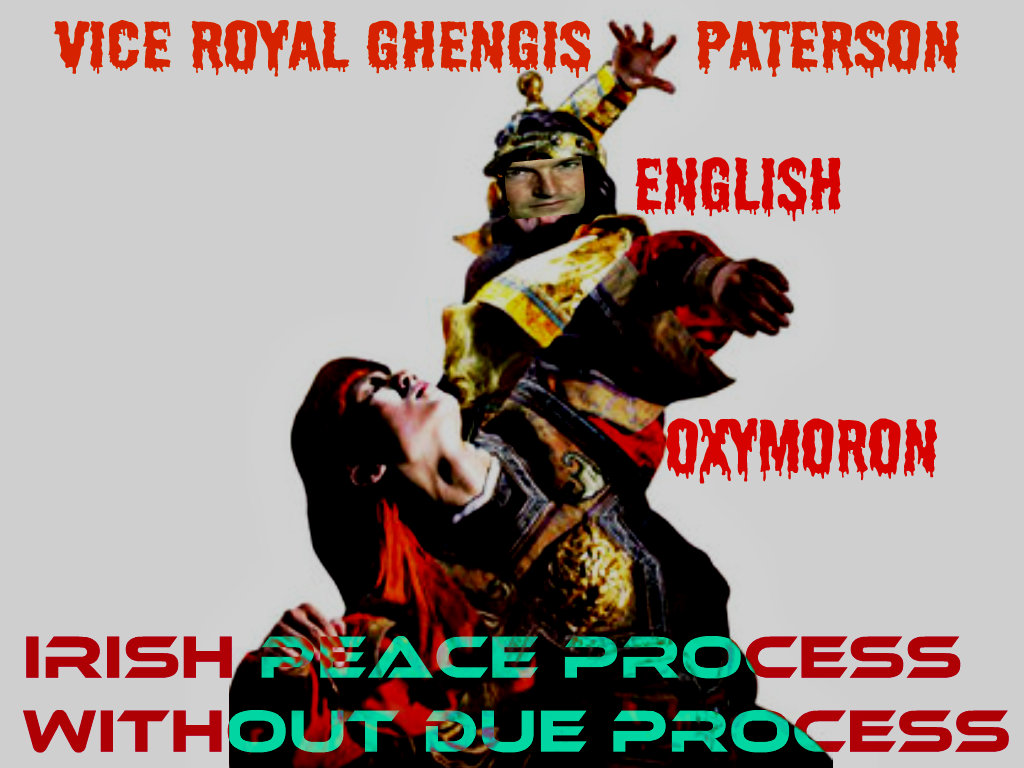
Irish Peace Process Without Due Process is an English Oxymoron


Irish Peace Process Without Due Process is an English Oxymoron

category international | rights and freedoms | opinion/analysis author Tuesday August 28, 2012 10:28author by BrianClarkeNUJ - AllVoices Report this post to the editors
Ghengis Paterson
It is becoming more transparent, with each passing day, that the British Tory Government is working relentlessly to dismantle the Irish peace process and escape responsibility for decades of war crimes in Ireland including murder, corruption and human rights violations.Reports submitted by the Committee on the Administration of Justice, Relatives for Justice, British-Irish Rights Watch recently submitted to Congressmen Chris Smith and Senator Ben Cardin, Co-Chairs of the Committee on Security and Cooperation in Europe read like a Nazi war crime file.
Irish Peace Process Vice Royal English Oxymoron
In their bullying arrogance and rank hypocrisy, the UK criticizes China for its persecution and record on human rights, while they threaten invasion of an Embassy and torture political prisoners interned without trial in Ireland such as Marian Price, while they have also admitted, colluding in the murder of Irish human rights attorney Patrick Finucane, because he knew too much about their dirty laundry in British Occupied Ireland. While this collusion came as a surprise to Congressman Speaker Boehner in the States and minority Leader Nancy Pelosi, it certainly came as no surprise to the long persecuted Irish.

Many believe their bullying arrogance displayed with their imperial dismissal of the Irish government's request for British Army documents, relating to the act of greatest slaughter of the current conflict, the no-warning car bombing of Dublin & Monaghan, is calculated to break the peace process in Ireland once and for all. Every dog on an Irish street knows, that the cars involved in delivering the bombs, were primed by British Army members and handlers. Their consistent meddling in the affairs of another country, something they always complain about with others, while the world objected to their brutal massacre of the civil rights movement in Derry, their corruption of their own supposed rule of law, their re-introduction of internment without trial, their continued use of torture, despite promises to the contrary after guilty verdicts at the Court of Human Rights in Europe, their rampant media censorship or all things genuinely Irish, their destruction of democracy with ongoing political assassinations.

The ongoing internment without trial of Marian Price exemplifies their efforts to provoke a violent reaction from the Irish and finally end the peace process, in an example of their determination to end the agreement. Marian a 58 year old political activist, should be released from internment without trial in British Occupied Ireland immediately, because rather than being 'on licence' she was given a full royal pardon or the Royal Prerogative of Mercy. Vice Royal Paterson's claims that this document, which would set Marian free, has been lost or shredded.

Patrick Ramsey, a Social Democratic Labour member of the elected British Assembly recently wrote to Paterson about this "lost" pardon and formally asked;

-- Where would Mrs. Price-McGlinchey's pardon have been held?
-- How many staff are currently seeking the document and in what departments?
-- Are those looking for it doing so on a full-time basis, if not, why not?
-- Has the Northern Ireland Office received comment from the judiciary on the apparent loss of the document?
-- How many Royal Prerogative's have been lost (or destroyed) that the government has record of?
-- Who is ultimately responsible for the care and maintenance of the building where these documents are kept?
-- What communication [has Paterson] personally had with this person/Department?
-- Can [Paterson] confirm the Department is still seeking the document and will do so until it is found?

The Unelected English Paterson in Ireland contemptuously dismissed the elected Irish Assembly members Ramsey's inquiry stating that "unfortunately the Royal Prerogative of Mercy was not recovered but has no bearing on current circumstances."

Vice royal Paterson has placed himself above the British Occupied Ireland Assembly, which was supposedly elected to govern British Occupied Ireland, just as he has previously overruled the judiciary. Two judges previously ruled that Marian Price should be released on bail and was no danger to society, both having seen precisely the same intelligence reports as Paterson. Each time Vice Royal Paterson negated the judge's decisions and ordered Marian Price interned without trial in solitary confinement sensory deprivation torture, for which Britain promised to cease, when previously found guilty of the same torture by the European Court of Human Rights in Strasbourg. The bigot Paterson, a sadistic blood sport enthusiast, is vindictively determined to keep Marian Price locked up, to keep his sectarian fox hunting loyalist friends happy and ensure the ongoing sadistic damage to her health, while the behavior of the sectarian prison regime is ongoing and deliberately torturing Marian daily.

There is big money involved and considerable political capital for the new Tory regime. British Occupied Ireland has for several decades now served as both a research laboratory and a conflict theatre, to showcase to prospective buyers and their Commonwealth neo-colonial Governments, the evolved crowd control equipment and Kitsonian tactics, developed over 40 years in their latest phase of British repression in Ireland.The peace process is also undermining the justification of hugely bloated taxpayer securocrat budgets of billions in their secret service gestapo establishment, aptly named Hollywood in British Occupied Ireland the centre that compiles secret service reports like movie scripts of pure fiction, that intern without trial for life, Irish prisoners of political conscience, like Marian price.

This Hollywood home of the faceless secret service gestapo, along with the Industrial war complex spending billions of taxpayers money, are about the only thriving British industry left, while they continue with a vested interest in compiling secret intelligence reports, that are never made public or can be refuted by the interned without trial. How can these scripts be regarded as impartial or part of any sort of impartial fair process?. There is big money in repression, internment without trial and torture for the Tories. There is much power too, in that their campaign coffers get bigger contributions from the arms industry, to promote wars abroad and continue to provoke the Irish to break the peace process nearer home.

Vice royal Paterson, the Shropshire leather businessman who married into royalty and the high society horsey set, knows this very well, from his lucrative career expereince in the Tory party.The gravy train pretence of democracy, has being expanded to include some recent Irish recruits to Stormont too, the boasted sectarian parliament for a sectarian people. In the instances of the British gravy that recruited Lord Muck of Londonderry to Stormont not being sufficient, a spot of blackmail on the enablers of child rape in both DUP and PSF circles doing the trick.

Meanwhile the long suffering impoverished working class nationalist people, the institutionalized, victims of British sponsored sectarianism from which Marian Price comes, still struggle for freedom. The slow moving gravy train has clearly not delivered the promised Bill of Rights or basics of justice, necessary for long term peace in this sectarian scum state, the product of age old imperial divide and conquer tactics, they still sponsor in British Occupied Ireland. The injustice of the internment of Marian Price is a good starting point for anyone remotely concerned with peace and justice in Ireland, both critically interdependent. A Peace Process without Due Process is clearly an english oxymoron.
Related Link: http://irishblog-brianclarkenuj.blogspot.com/

Sunday, August 26, 2012

VICE ROYAL PENIS PERVERT OF THE COURSE OF JUSTICE IN BRITISH ... on Twitpic

VICE ROYAL PENIS PERVERT OF THE COURSE OF JUSTICE IN BRITISH ... on Twitpic

VICE ROYAL PENIS PERVERTS THE COURSE OF JUSTICE IN BRITISH OCCUPIED IRELAND http://brev.is/Unh3

MARIAN PRICE should be released from internment without trial in British Occupied Ireland, because rather than being "on licence" she received a full royal pardon--the Royal Prerogative of Mercy. Vice Royal Paterson's claims that this document, which would set Marian free, has been lost or shredded.

Pat Ramsey, a Social Democratic and Labour member of the Northern Ireland Assembly recently wrote to Paterson about this "lost" pardon. He asked:

-- Where would Mrs. Price-McGlinchey's pardon have been held?
-- How many staff are currently seeking the document and in what departments?
-- Are those looking for it doing so on a full-time basis, if not, why not?
-- Has the Northern Ireland Office received comment from the judiciary on the apparent loss of the document?
-- How many Royal Prerogative's have been lost (or destroyed) that the government has record of?
-- Who is ultimately responsible for the care and maintenance of the building where these documents are kept?
-- What communication [has Paterson] personally had with this person/Department?
-- Can [Paterson] confirm the Department is still seeking the document and will do so until it is found?

Paterson contemptuously dismissed Ramsey's inquiry stating that "unfortunately the RPM (Royal Prerogative of Mercy) was not recovered but has no bearing on current circumstances."

Owen Paterson has placed himself above the British Occupied Ireland Assembly, which was supposedly elected to govern British Occupied Ireland, just as he has previously overruled the judiciary. Two judges have ruled that Marian Price should be released on bail. Each time Vice Royal Paterson negated the judge's decision and ordered Marian interned without trial in solitary confinement sensory deprivation torture, for which Britain promised to cease when previously found guilty of the same torture by the European Court of Human Rights in Strasbourg. Paterson is determined to keep Marian Price locked up to ensure the ongoing damage to her health and the behavior of the prison regime is ongoing and deliberate torture..

Saturday, August 25, 2012

PERFIDIOUS ALBION IN THE HIGHEST DEGREE ODIOUS BRITANNIA htt... on Twitpic

PERFIDIOUS ALBION IN THE HIGHEST DEGREE ODIOUS BRITANNIA htt... on Twitpic:


Any criminal justice system that adheres to international human rights, will only allow people to be punished, if they have been promptly charged with a recognizably criminal offence, tried and convicted in fair and transparent proceedings. Many of the measures introduced by the Tories in the UK , more particularly their unelected vice royal Paterson in British Occupied Ireland include torture and internment without trial. Deprivation of liberty of Irish people against whom there is no evidence to support a criminal charge, brings the law and the paramilitary PSNI British police charged with its enforcement, into disrepute. The British regime in Occupied Ireland is neither fair, just or lawful, resulting in the loss of public confidence and creating a brutal breeding ground for future violence.


The clearly bigoted UK Tories in conjunction with their sectarian loyalist friends, have mounted a sustained attack on human rights in Ireland, attacking the independence of the judiciary and any form of a rule of law. The UK has some of the most draconian laws in the world, supplemented by sweeping new provisions that contravene basic human rights law, which have given rise to serious human rights violations.Even Amnesty International flooded recently stuffed with British agents, considers British law inconsistent, with the UK’s obligations under domestic and international human rights riddled with serious human rights violations. Some people have been thrown into a Kafkaesque world interned for years, in horrific conditions on the basis of secret intelligence, the details of which are withheld from them and therefore they are unable to refute them.


Even the elite British Law Lords, ruled this internment unlawful but the government found new ways of interning them. None of these people of political conscience have been found guilty by any court of law in the UK. Indeed, the UK authorities have stated in court that in respect of those interned, there is insufficient evidence to support a criminal charge. Nevertheless the facelsss UK gestapo, maintain that these persons are a "threat to national security", resulting in many of them suffering serious mental and physical health. The cumulative effects of solitary confinement, interned torture by an unelected UK gestapo, amounts to political persecution. Many of the people currently interned without trial, have actually been acquitted in trials in the UK of the terrorism-related offences they are accused of and were originally ordered released by judges. In one particular case Marian Price who was ordered released by the queen but the British gestapo overruled her, either shredding or losing the queen's pardon without excuse  or investigation.

The British government’s dismissive attitude towards international standards of human rights are presently under attack by all respected international human rights bodies, with further attempts by the British to publicly flout the absolute ban on torture by circumventing it. British agents, particularly their secret Gestapo intelligence officials, have been implicated in outsourcing the interrogation and torture of suspects abroad, with the unlawful transfer or "rendition" of people to Bagram Airbase, Afghanistan, Libya, Guantánamo Bay, where torture is used routinely. The British government at the Court of Appeal in England, ruled that "evidence" extracted through torture was admissible in court proceedings, provided that UK agents were not involved in torture, giving outsourced torturers in British Occupied Ireland and abroad the green light to torture.

Formerly an independent Amnesty International monitored the UK's  measures and practices of stifling political dissent and opposition in places like Occupied Ireland finding them guilty of torture but since being infiltrated, now allow state agents to commit human rights abuses, such as unlawful killings, torture, arbitrary internment without and unfair trials with impunity. Those affected include ordinary members of the general population not involved in any illegal activity whatsoever, who have no legal redress or human rights against the brutality of the British intelligence gestapo. Peaceful protesters too are subjected to police action encouraging xenophobia, racism and faith-hate crimes in the ranks of the British police, particularly among sectarian elements of their paramilitary police in British Occupied Ireland.

Essentially the unaccountable secret-service gestapo of the British, have created a shadow criminal justice system, particularly in British Occupied Ireland, fronted by an un-elected English vice royal called Paterson. This blood sports enthusiast, re-introduced indefinite internment on the basis of secret gestapo intelligence, which regularly includes unreliable information, obtained through bribery, torture or blackmailed pedophiles.These practices often sectarian are discriminatory, draconian and unlawful, in a disturbing echo of earlier internment laws of the early 1970s, which proved totally counter-productive in the context of the war waged by the British Government on the ordinary people of Occupied Ireland.

The restrictions, of what has become in actuality the open air prison of the UK, violates a wide range of basic international human rights, including the right to freedom of thought, conscience, religion, freedom of expression, freedom of assembly, association, freedom of movement, the right to a fair trial and the right to basic liberties. The British have abused and created a detrimental effect on the human rights of ordinary working class families, of those subject to their secret orders. The illegal activity of the tyrannical English vice royal with autocratic unaccountable powers in Ireland, is tantamount to him "interning," "torturing," "charging," "trying," and "sentencing" a person without any regard to the guarantees of a fair trial that are standard in any civilized society. Marian Price in British Occupied Ireland has essentially been kidnapped and politically raped of all her human rights by this savage colonial autocrat.

The British criteria for these secret gestapo powers is broad, vague, subjective without any legal clarity and are being used arbitrarily to restrict human rights, including freedom of expression, to the point where any journalist or for example the author of this article, can be interned without trial, throwing away the key for life. Even conservative Law Lords have condemned this, with one Lord Steyn, calling it "exorbitant and unnecessary" calling them unlawful under the European Convention for the Protection of Human Rights and Fundamental Freedoms. Lord Lloyd describes them as "intolerable". The UK authorities with power to close down places of worship, is reminiscent of penal times in Ireland, where the British murdered every Catholic priest they could get their hands on. The British gestapo has attacked the independence of its judiciary. Their Government has threatened the courts who do not follow its express orders, with forcibly removing people from society, to be brought where they can be tortured and they it will amend the Human Rights Act  to make sure they get their way.


Meanwhile their corporate media is cultivating daily a creeping acceptance of torture and human rights abuse. The government's disregard for human rights has been reflected in various attempts to undermine a ban on torture and universally accepted prohibitions which guarantees international fundamental human rights elsewhere. Basic principles inherent in civilized societies on the absolute prohibition of torture or ill-treatment, is that one cannot ever be sent to a country to risk torture or ill-treatment, a principle known as non-refoulement. The British government has abandoned this principle and the UK is implicated and guilty of "rendition,"  the illegal secret transfer from one country to another, without due process, to places where torture is rife. Countries known to practice torture have been specifically selected by the British to interrogate, in an attempt to distance the UK from torture. This is the British outsourcing torture.

Torture is wrong and illegal wherever it happens with whoever does it. The British government exports innocent people to be tortured  and thus is responsible for that torture. The ban on sending anyone to a country to be tortured, is as absolute as the ban on torture itself. The UK gestapo's cultivated creeping acceptance of torture was even condemned by their own infiltrated Amnesty International, who condemned the British Court of Appeal as having shamefully abdicated its duty, to uphold human rights and the rule of law. The Council of Europe’s Commissioner for Human Rights stated, "To use evidence obtained under torture is to condone an entirely indefensible practice.".


Once any government begins to "sacrifice" human rights in the name of security, it is not long before individuals pay the price.
Amnesty International considered that the conditions of British internment amounted to cruel, inhuman and degrading treatment. This was also the conclusion of the UN Committee against Torture and the European Committee for the Prevention of Torture and Inhuman or Degrading Treatment or Punishment. It has also emerged that a "shoot to kill" policy has been authorized for police in the UK after it being common practice in British Occupied Ireland for many years.

Again international law has no provision for "shoot to kill" policies.Every effort must be made to apprehend rather than kill, with lethal force never being used, as an alternative to arrest. Amnesty International called for a prompt, thorough, independent, impartial and effective investigation into British shoot to kill and for any suspect of the unlawful, be brought to justice in fair proceedings. The UK government is also guilty of undermining human rights abroad and trying to circumvent international and domestic human rights law with unaccountable UK intelligence officers taking advantage of legal vacuums and coercive internment conditions at Guantánamo Bay and other locations, including Bagram Airbase to conduct interrogation. These interrogations happened without any normal safeguards or without a lawyer, circumventing domestic and international human rights law. UK gestapo officials have taken part in the interrogation under duress of UK detainees in other countries.


In response to substantiated allegations of the period of its Iraq occupation where the UK committed serious human rights abuses in Iraq involving murder and torture, the UK asserts that human rights law did not apply to its military in Iraq thus breaking promises they made, after being found guilty of torturing interned political prisoners in British Occupied Ireland. Even Amnesty International consider the UK bound by international obligations with regard to its military and gestapo agents. These obligations include the International Covenant on Civil and Political Rights and Convention against Torture. The UK is obliged to ensure prompt, competent, impartial, independent, thorough and effective investigations into all of their human rights abuses.

The UK has breached international and domestic human rights law in the internment without charge or trial not just in Britain but also in British Occupied Ireland and in the instance of at least 10,000 Iraqi people. The UK Government's policies and speeches persistently link foreigners with "the terrorism threat" with The Minister for Counter Terrorism warning Muslims that the police would target them in "stop and search" operations because of the threat of Islam. Such speeches and policies resulted in a 300% increase in stop and search by police with a particularly significant rise in the number of racist attacks on individuals, homes and places of worship. The Commissioner for Human Rights of Europe revealed growing concerns over British Islamaphobia. "Recent legislative changes relating to the prevention of terrorism had, they claimed, not only resulted in the discriminatory treatment of individual Muslims but also contributed to raising anti-Islamic sentiments."


The Commissioner of the Council of Europe stated that the UK had a tendency to "consider human rights as excessively restricting the effective administration of justice and the protection of the public interest." adding "it is perhaps worth emphasizing that human rights are not a pick and mix assortment of luxury entitlements" and "their violation affects not just the individual concerned, but society as a whole; we exclude one person from their enjoyment at the risk of excluding all of us." The Council of Europe agrees including its Secretary General and President of its Parliamentary Assembly. The global impact of the UK’s abuse of human rights is considerable with widespread evidence of gross human rights abuses, including allegations of war crimes by UK forces. A pattern is emerging where the UK announces tough counter-terrorism measures running contrary to international  human rights standards resulting in other brutal regimes then saying they need what the UK then in turn uses to support its initial proposals.


Respect for human rights is the way to security, not an obstacle. Respect for human rights and not violations are part of the solution, which the UN Secretary-General has stressed: "While we certainly need vigilance to prevent acts of terrorism... it will be self-defeating if we sacrifice, other key priorities, such as human rights in the process." Amnesty International’s message to the UK government is that it must respond to its attacks on human rights by defending, respecting and protecting human rights. Other courses of action are wrong, illegal and counter-productive. Amnesty International adds its voice to criticize British bad laws which makes everyone unsafe.
'via Blog this'

HUMAN RIGHTS SCUM STATE OF BRITISH TORTURE INTERNMENT


Any criminal justice system that adheres to international human rights, will only allow people to be punished, if they have been promptly charged with a recognizably criminal offence, tried and convicted in fair and transparent proceedings. Many of the measures introduced by the Tories in the UK , more particularly their unelected vice royal Paterson in British Occupied Ireland include torture and internment without trial. Deprivation of liberty of Irish people against whom there is no evidence to support a criminal charge, brings the law and the paramilitary PSNI British police charged with its enforcement, into disrepute. The British regime in Occupied Ireland is neither fair, just or lawful, resulting in the loss of public confidence and creating a brutal breeding ground for future violence.


The clearly bigoted UK Tories in conjunction with their sectarian loyalist friends, have mounted a sustained attack on human rights in Ireland, attacking the independence of the judiciary and any form of a rule of law. The UK has some of the most draconian laws in the world, supplemented by sweeping new provisions that contravene basic human rights law, which have given rise to serious human rights violations.Even Amnesty International flooded recently stuffed with British agents, considers British law inconsistent, with the UK’s obligations under domestic and international human rights riddled with serious human rights violations. Some people have been thrown into a Kafkaesque world interned for years, in horrific conditions on the basis of secret intelligence, the details of which are withheld from them and therefore they are unable to refute them.


Even the elite British Law Lords, ruled this internment unlawful but the government found new ways of interning them. None of these people of political conscience have been found guilty by any court of law in the UK. Indeed, the UK authorities have stated in court that in respect of those interned, there is insufficient evidence to support a criminal charge. Nevertheless the facelsss UK gestapo, maintain that these persons are a "threat to national security", resulting in many of them suffering serious mental and physical health. The cumulative effects of solitary confinement, interned torture by an unelected UK gestapo, amounts to political persecution. Many of the people currently interned without trial, have actually been acquitted in trials in the UK of the terrorism-related offences they are accused of and were originally ordered released by judges. In one particular case Marian Price who was ordered released by the queen but the British gestapo overruled her, either shredding or losing the queen's pardon without excuse  or investigation.

The British government’s dismissive attitude towards international standards of human rights are presently under attack by all respected international human rights bodies, with further attempts by the British to publicly flout the absolute ban on torture by circumventing it. British agents, particularly their secret Gestapo intelligence officials, have been implicated in outsourcing the interrogation and torture of suspects abroad, with the unlawful transfer or "rendition" of people to Bagram Airbase, Afghanistan, Libya, Guantánamo Bay, where torture is used routinely. The British government at the Court of Appeal in England, ruled that "evidence" extracted through torture was admissible in court proceedings, provided that UK agents were not involved in torture, giving outsourced torturers in British Occupied Ireland and abroad the green light to torture.

Formerly an independent Amnesty International monitored the UK's  measures and practices of stifling political dissent and opposition in places like Occupied Ireland finding them guilty of torture but since being infiltrated, now allow state agents to commit human rights abuses, such as unlawful killings, torture, arbitrary internment without and unfair trials with impunity. Those affected include ordinary members of the general population not involved in any illegal activity whatsoever, who have no legal redress or human rights against the brutality of the British intelligence gestapo. Peaceful protesters too are subjected to police action encouraging xenophobia, racism and faith-hate crimes in the ranks of the British police, particularly among sectarian elements of their paramilitary police in British Occupied Ireland.

Essentially the unaccountable secret-service gestapo of the British, have created a shadow criminal justice system, particularly in British Occupied Ireland, fronted by an un-elected English vice royal called Paterson. This blood sports enthusiast, re-introduced indefinite internment on the basis of secret gestapo intelligence, which regularly includes unreliable information, obtained through bribery, torture or blackmailed pedophiles.These practices often sectarian are discriminatory, draconian and unlawful, in a disturbing echo of earlier internment laws of the early 1970s, which proved totally counter-productive in the context of the war waged by the British Government on the ordinary people of Occupied Ireland.

The restrictions, of what has become in actuality the open air prison of the UK, violates a wide range of basic international human rights, including the right to freedom of thought, conscience, religion, freedom of expression, freedom of assembly, association, freedom of movement, the right to a fair trial and the right to basic liberties. The British have abused and created a detrimental effect on the human rights of ordinary working class families, of those subject to their secret orders. The illegal activity of the tyrannical English vice royal with autocratic unaccountable powers in Ireland, is tantamount to him "interning," "torturing," "charging," "trying," and "sentencing" a person without any regard to the guarantees of a fair trial that are standard in any civilized society. Marian Price in British Occupied Ireland has essentially been kidnapped and politically raped of all her human rights by this savage colonial autocrat.

The British criteria for these secret gestapo powers is broad, vague, subjective without any legal clarity and are being used arbitrarily to restrict human rights, including freedom of expression, to the point where any journalist or for example the author of this article, can be interned without trial, throwing away the key for life. Even conservative Law Lords have condemned this, with one Lord Steyn, calling it "exorbitant and unnecessary" calling them unlawful under the European Convention for the Protection of Human Rights and Fundamental Freedoms. Lord Lloyd describes them as "intolerable". The UK authorities with power to close down places of worship, is reminiscent of penal times in Ireland, where the British murdered every Catholic priest they could get their hands on. The British gestapo has attacked the independence of its judiciary. Their Government has threatened the courts who do not follow its express orders, with forcibly removing people from society, to be brought where they can be tortured and they it will amend the Human Rights Act  to make sure they get their way.


Meanwhile their corporate media is cultivating daily a creeping acceptance of torture and human rights abuse. The government's disregard for human rights has been reflected in various attempts to undermine a ban on torture and universally accepted prohibitions which guarantees international fundamental human rights elsewhere. Basic principles inherent in civilized societies on the absolute prohibition of torture or ill-treatment, is that one cannot ever be sent to a country to risk torture or ill-treatment, a principle known as non-refoulement. The British government has abandoned this principle and the UK is implicated and guilty of "rendition,"  the illegal secret transfer from one country to another, without due process, to places where torture is rife. Countries known to practice torture have been specifically selected by the British to interrogate, in an attempt to distance the UK from torture. This is the British outsourcing torture.

Torture is wrong and illegal wherever it happens with whoever does it. The British government exports innocent people to be tortured  and thus is responsible for that torture. The ban on sending anyone to a country to be tortured, is as absolute as the ban on torture itself. The UK gestapo's cultivated creeping acceptance of torture was even condemned by their own infiltrated Amnesty International, who condemned the British Court of Appeal as having shamefully abdicated its duty, to uphold human rights and the rule of law. The Council of Europe’s Commissioner for Human Rights stated, "To use evidence obtained under torture is to condone an entirely indefensible practice.".


Once any government begins to "sacrifice" human rights in the name of security, it is not long before individuals pay the price.
Amnesty International considered that the conditions of British internment amounted to cruel, inhuman and degrading treatment. This was also the conclusion of the UN Committee against Torture and the European Committee for the Prevention of Torture and Inhuman or Degrading Treatment or Punishment. It has also emerged that a "shoot to kill" policy has been authorized for police in the UK after it being common practice in British Occupied Ireland for many years.

Again international law has no provision for "shoot to kill" policies.Every effort must be made to apprehend rather than kill, with lethal force never being used, as an alternative to arrest. Amnesty International called for a prompt, thorough, independent, impartial and effective investigation into British shoot to kill and for any suspect of the unlawful, be brought to justice in fair proceedings. The UK government is also guilty of undermining human rights abroad and trying to circumvent international and domestic human rights law with unaccountable UK intelligence officers taking advantage of legal vacuums and coercive internment conditions at Guantánamo Bay and other locations, including Bagram Airbase to conduct interrogation. These interrogations happened without any normal safeguards or without a lawyer, circumventing domestic and international human rights law. UK gestapo officials have taken part in the interrogation under duress of UK detainees in other countries.


In response to substantiated allegations of the period of its Iraq occupation where the UK committed serious human rights abuses in Iraq involving murder and torture, the UK asserts that human rights law did not apply to its military in Iraq thus breaking promises they made, after being found guilty of torturing interned political prisoners in British Occupied Ireland. Even Amnesty International consider the UK bound by international obligations with regard to its military and gestapo agents. These obligations include the International Covenant on Civil and Political Rights and Convention against Torture. The UK is obliged to ensure prompt, competent, impartial, independent, thorough and effective investigations into all of their human rights abuses.

The UK has breached international and domestic human rights law in the internment without charge or trial not just in Britain but also in British Occupied Ireland and in the instance of at least 10,000 Iraqi people. The UK Government's policies and speeches persistently link foreigners with "the terrorism threat" with The Minister for Counter Terrorism warning Muslims that the police would target them in "stop and search" operations because of the threat of Islam. Such speeches and policies resulted in a 300% increase in stop and search by police with a particularly significant rise in the number of racist attacks on individuals, homes and places of worship. The Commissioner for Human Rights of Europe revealed growing concerns over British Islamaphobia. "Recent legislative changes relating to the prevention of terrorism had, they claimed, not only resulted in the discriminatory treatment of individual Muslims but also contributed to raising anti-Islamic sentiments."


The Commissioner of the Council of Europe stated that the UK had a tendency to "consider human rights as excessively restricting the effective administration of justice and the protection of the public interest." adding "it is perhaps worth emphasizing that human rights are not a pick and mix assortment of luxury entitlements" and "their violation affects not just the individual concerned, but society as a whole; we exclude one person from their enjoyment at the risk of excluding all of us." The Council of Europe agrees including its Secretary General and President of its Parliamentary Assembly. The global impact of the UK’s abuse of human rights is considerable with widespread evidence of gross human rights abuses, including allegations of war crimes by UK forces. A pattern is emerging where the UK announces tough counter-terrorism measures running contrary to international  human rights standards resulting in other brutal regimes then saying they need what the UK then in turn uses to support its initial proposals.


Respect for human rights is the way to security, not an obstacle. Respect for human rights and not violations are part of the solution, which the UN Secretary-General has stressed: "While we certainly need vigilance to prevent acts of terrorism... it will be self-defeating if we sacrifice, other key priorities, such as human rights in the process." Amnesty International’s message to the UK government is that it must respond to its attacks on human rights by defending, respecting and protecting human rights. Other courses of action are wrong, illegal and counter-productive. Amnesty International adds its voice to criticize British bad laws which makes everyone unsafe.