Monday, September 10, 2012

THE IRA BEFORE DRUGS


I HAVE met them at close of day
Coming with vivid faces
From counter or desk among grey
Eighteenth-century houses.
I have passed with a nod of the head
Or polite meaningless words,
Or have lingered awhile and said
Polite meaningless words,
And thought before I had done
Of a mocking tale or a gibe
To please a companion
Around the fire at the club,
Being certain that they and I
But lived where motley is worn:
All changed, changed utterly:
A terrible beauty is born.

That woman's days were spent
In ignorant good-will,
Her nights in argument
Until her voice grew shrill.
What voice more sweet than hers
When, young and beautiful,
She rode to harriers?
This man had kept a school
And rode our winged horse;
This other his helper and friend
Was coming into his force;
He might have won fame in the end,
So sensitive his nature seemed,
So daring and sweet his thought.
This other man I had dreamed
A drunken, vainglorious lout.
He had done most bitter wrong
To some who are near my heart,
Yet I number him in the song;
He, too, has resigned his part
In the casual comedy;
He, too, has been changed in his turn,
Transformed utterly:
A terrible beauty is born.

Hearts with one purpose alone
Through summer and winter seem
Enchanted to a stone
To trouble the living stream.
The horse that comes from the road.
The rider, the birds that range
From cloud to tumbling cloud,
Minute by minute they change;
A shadow of cloud on the stream
Changes minute by minute;
A horse-hoof slides on the brim,
And a horse plashes within it;
The long-legged moor-hens dive,
And hens to moor-cocks call;
Minute by minute they live:
The stone's in the midst of all.

Too long a sacrifice
Can make a stone of the heart.
O when may it suffice?
That is Heaven's part, our part
To murmur name upon name,
As a mother names her child
When sleep at last has come
On limbs that had run wild.
What is it but nightfall?
No, no, not night but death;
Was it needless death after all?
For England may keep faith
For all that is done and said.
We know their dream; enough
To know they dreamed and are dead;
And what if excess of love
Bewildered them till they died?
I write it out in a verse -
MacDonagh and MacBride
And Connolly and Pearse
Now and in time to be,
Wherever green is worn,
Are changed, changed utterly:
A terrible beauty is born. 

Volunteer Martin Savage IrishMáirtín Sabhaois (1898 – 19 December 1919) was an Officer in the Dublin Brigade of the Irish Republican Army, fromBallisodareCounty Sligo.[1] On 19 December 1919 he was killed during a gun battle after an ambush at Ashtown, near the border of County Meath andCounty Dublin, during the early stages of the Irish War of Independence.

Contents

  [hide

[edit]Early life

Savage was born in Streamstown, BallisodareCounty Sligo in 1898. He was the youngest son of Michael Savage, who was known locally as a Fenianactivist.[2] After leaving school he worked as an apprentice grocer in Sligo Town before committing himself to the fight for Irish Independence.[3][4][5][6][7][8]

[edit]Military action

Savage moved to Dublin in 1915 and joined the Irish Volunteers. As a 17 year old he took part in the 1916 Easter Rising in Dublin and fought with Padraig Pearse and James Connolly in the GPO.[9] He was captured by the British Army and imprisoned in Richmond Barracks. On 30 April 1916 he was deported to Knutsford Detention Barracks in CheshireEngland along with 200 other captured prisoners. Upon his release Savage returned to Dublin and resumed his fight for Irish freedom and became a Lieutenant in the 2nd Battalion of the Dublin Brigade. Within republican circles he was known as a shy, slim built, handsome Sligonian who was a popular and trusted comrade especially amongst the likes of Dan BreenSeán Treacy and Seán Hogan.[2] [10]

[edit]The Ashtown ambush

[edit]Planning by Breen

On 19 December 1919, Savage and his unit which consisted of 10 fellow Volunteers, including Mick McDonnellTom KehoeSeán TreacySeamus RobinsonSeán HoganPaddy Daly (Leader), Vincent ByrneTom KilcoyneJoe Leonard and Dan Breen, met after planning to assassinate the then British ViceroyLord Lieutenant of Ireland and Supreme Commander of the British Army in Ireland,Lord John French, as he returned from a private party which he had hosted the previous evening at his country residence in Frenchpark,County Roscommon.[11]
It was not originally planned that Savage was to take an active part in the ambush, however, after a chance meeting with Breen and Hogan, Savage insisted that he join the party. Sean Hogan initially attempted to dissuade the eager young volunteer, but eventually he relented and gave Savage an automatic pistol. The Volunteers' intelligence operative had informed the unit that Lord French would be travelling in the second car of the armed convoy that comprised an outrider and three following cars which would bring Lord French from Ashtown railway station to the Vice-Regal Lodge in Phoenix Park, Dublin.[12]

[edit]Events of the day

On the day of the ambush, Savage attended work as usual and slipped away early in the morning to meet with the Volunteers who were gathered at Fleming's Pub in Drumcondra. They departed Drumcondra in small groups to avoid raising suspicion as they cycled through Phibsboro and up the Cabra Road, and then regrouped at Kelly's Public House (now called the Halfway House) in Ashtown. At approximately 11:40 a.m., as the train carrying Lord French pulled into the station, the unit left the pub and took up positions along the crossroads at Ashtown.
The plan was for Martin Savage, Tom Kehoe and Dan Breen to push a hay-cart halfway across the road and then, after the out-rider and the first car had passed, they would push it the rest of the way across the road, thereby completely blocking the path of the remaining vehicles. They had been informed that Lord French was to be in the second car and this car would be attacked with grenades, Mills Bombs and concentrated rifle fire.
As they pushed the hay-cart across the road their plan was almost foiled as a member of the Royal Irish Constabulary (RIC) disturbed them, telling them to move on. One of Volunteers lobbed a grenade at him, although it didn't explode it struck the police officer on the head, knocking him unconscious. The police officer was then dragged from the road and the attack went ahead as planned.[13]

[edit]Lord French's car and the gun battle

When the convoy appeared minutes later, each Volunteer fulfilled their role in the operation and attacked the second car forcing it to swerve off the road. However, unknown to the unit, Lord French was travelling in the first car and managed to drive through the blockade. The occupants of the second car, part of Lord French's guard, returned fire. As the fierce gun battle developed the third car arrived on the other side of the cart and began firing with rifles and machine-guns on the now exposed Volunteers.
In the crossfire Dan Breen was shot in the leg and seconds later Savage fell mortally wounded after being hit by a bullet in the neck. He died in the arms of Dan Breen and his last words to Breen were "I'm done, but carry on....". Tom Kehoe and the wounded Dan Breen succeeded in carrying Martin Savage's body from the road and back to Kelly’s Pub while the gunfight continued.[14]
Two RIC men and a driver were also wounded in the gun battle. At this point the British military, including some wounded, began to withdraw from the scene and continued on towards the Phoenix Park. Knowing British reinforcements would be on their way, the IRA unit then dispersed to safe houses in the Dublin area. Dan Breen was helped onto his bike by Paddy Daly who helped him to a safehouse in the Phibsboro' area, where he was attended to by the captain of the Dublin hurling team, Dr J.M. Ryan.
The next morning, the Irish Independent published an article which described the attackers as "assassins" and included other such terms as "criminal folly", "outrage" and "murder." Taking these terms as an insult to their dead comrade, it was decided to attack the paper. On Sunday, at 9pm, between twenty and thirty Volunteers under Peadar Clancy entered the offices of the Independent. They informed the editor of their intentions and began to dismantle and smash the machinery. Despite this action, with the assistance of the other Dublin papers, the Independent was able to appear the next day, and the owners were awarded £16,000 pounds in compensation. According to Breen, neither the Independent, nor any other Dublin paper, referred to the IRA as murderers or assassins again.[15]

[edit]Funeral

Savage's body was taken by British military and an inquest was held into his death. The inquest was attended by his brother and his employer William Kirk, who described the dead soldier as "a steady, sober and industrious young man, gentlemanly in manner and extremely courteous."[16]
After the inquest, Savage's body was handed over to his relatives. His remains lay overnight at Broadstone Station before departing for Sligo where it was met at Collooney railway station by a large crowd.[17] His coffin, draped in an Irish Tricolour, was carried over two miles at shoulder height to his family's burial ground. Savage was buried with full military honours in his native Ballisodare, County Sligo.[18]

Street plaque at Martin Savage Terrace, Sligo.
Dan Breen noted that "the cortege was several miles long, the Parish Priest attended and recited the last prayer, while the RIC, with a chivalry characteristic of them, surrounded the graveyard with guns and bayonets. However, I suppose, this was the best tribute they could have paid to a gallant soldier, even though they did not mean it that way".[18][19]

Martin Savage

From Wikipedia, the free encyclopedia
THIS AUTHOR DOES NOT SUPPORT THE PARAMILITARY GROUP CALLED THE REAL IRA BUT CALLS ON EVERYONE TO SUPPORT THE MARCH BELOW
Dublin March to Free Marian Price
dublin / rights and freedoms / event notice Monday August 20, 2012 17:56 by Fearfeasa 2 comments (last - thursday august 23, 2012 23:02)
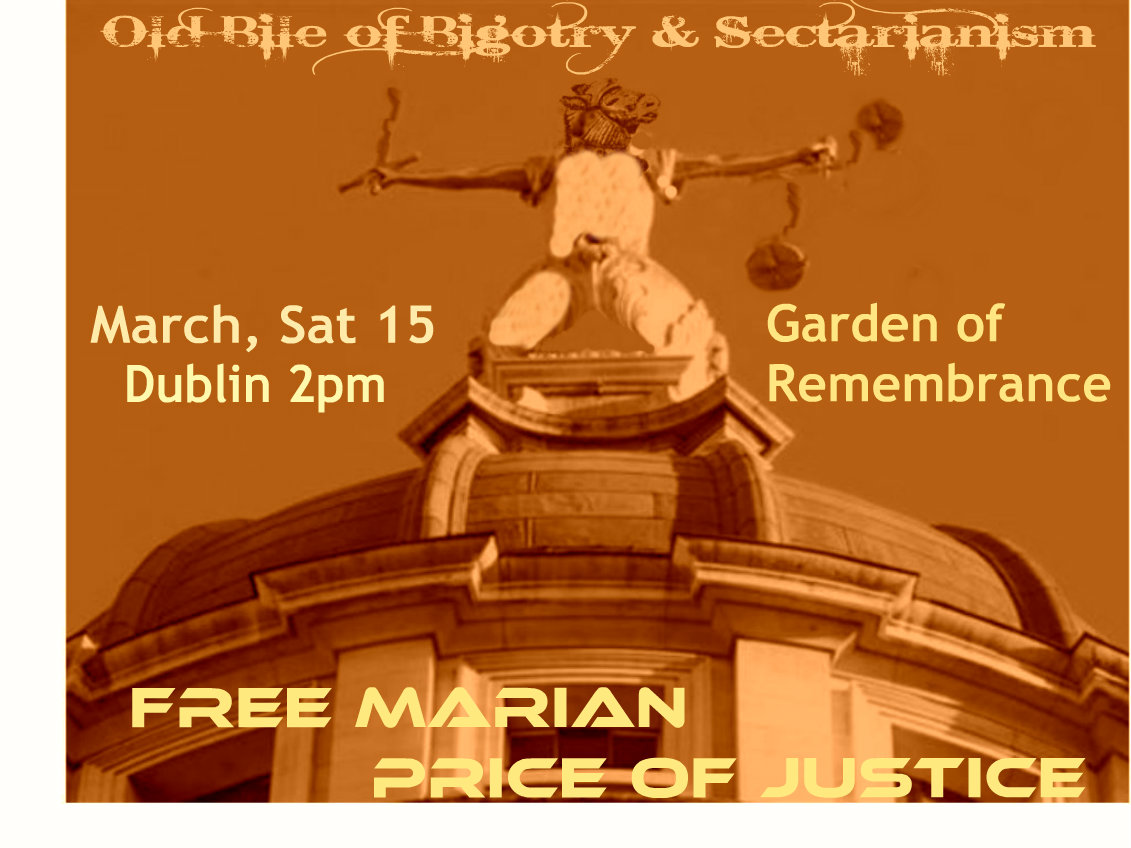
A March is being organized in Dublin on Sat. 15th September at 2 p.m. Starting at the Garden of Remembrance, to O'Connell Bridge and back to the GPO, where we will have prominent speakers and some music.
Join with us and call for Freedom for Marian Price agus support human rights for all political prisoners.

Mórshiúl i mBaile Átha Cliath chun Marian Price a shaoradh
dublin / rights and freedoms / event notice Monday August 20, 2012 17:39 by Fearfeasa
Tá mórshiúl á eagrú, oscailte don phobal, i mBaile Átha Cliath ar an Satharn, 15 Meán Fómhair ar 2 p.m. ag an nGáirdin Cuimhneacháin, síos go Droichead Uí Chonaill, agus ag leanúint go Ardoifig an Phoist, áit a mbeidh cainteoirí aitheanta agus ceol.
Bí ann agus tacaigh le saoirse do Mharian Price agus do Chearta Daonna gach príosúnach polaitiúil.

Sunday, September 9, 2012

The Wests Awake


All-Ireland hurling final Galway and Kilkenny Draw

Galway's Joe Canning equalized with free instoppage-time to make an All-Ireland hurling final replay with Kilkenny.
Kilkenny came from behind and were leadin 0-19 to 2-12 up with seconds left but Canning, who also scored a 10th-minute goal equalized for Galway 2-13, Kilkenny 0-19. The first All-Ireland hurling replay since 1959 will on the 30 September at Dublin's Croke Park. Canning had a total of 1-09 while Kilkenny's Henry Shefflin matched the total with 12 points.
Galway started well when Canning angled a shot past Kilkenny keeper David Herity and they had a healthy lead of 1-09 to 0-07 advantage at half-time.However their lead melted away and Shefflin brought Kilkenny level before putting them in front with a brilliant free.Niall Burke's goal moments later saw Galway regain the lead. In a truly exciting finish, with the sides level, Kilkenny got a penalty with Shefflin choosing to take a point. It looked like  enough until Portumna's Canning sent his last gasp free over the bar..


Link


All-Ireland hurling fans 2012


Saturday, September 8, 2012

EATING BABIES THE VILLIERS OCCUPIED IRELAND LEGACY


What about the Villiers Family ?


"I have been assured .. in London; that a young healthy Child, well nursed, is, at a Year old, a most delicious, nourishing, and wholesome Food; whether Stewed, Roasted, Baked, or Boiled; and, I make no doubt, that it will equally serve in a Fricasie, or Ragoust."
—Jonathan Swift, A Modest Proposal


George Villiers, 1st Duke of Buckingham  28 August 1592 – 23 August 1628) was the favourite, claimed to be the lover, of King James I of England and despite a very poor political and military record remained at the height of royal favour for the reign of Charles I, until he was assassinated. He was one of the most rewarded royal courtiers in all history.


Born in Brooksby, Leicestershire, the son of the minor gentleman Sir George Villiers 1550–1604, he could dance well, fence well, and speak a little French. In August 1614, Villiers, reputedly "the handsomest-bodied man in all of England",was brought before the king, in the hope that the king would take a fancy to him, diminishing the power at court of then favourite Robert Carr, 1st Earl of Somerset.

Following Villiers' introduction the king developed a strong affection for Villiers, calling him his "sweet child and wife"; the personal relationships of James are a much debated topic, with Villiers making the last of a succession of favourites on whom James lavished affection and rewards. The extent to which there was a sexual element, or a physical sexual relationship, involved in these cases remains controversial. Villiers reciprocated the King's love and wrote to James: "I naturally so love your person, and adore all your other parts, which are more than ever one man had" and "I desire only to live in the world for your sake". Restoration of Apethorpe Hall in 2004–2008 revealed a previously unknown passage linking his bedchamber with that of James.

Villiers gained support from those opposed to the current favourite, Robert Carr, 1st Earl of Somerset, and under the King's patronage he prospered greatly. Villiers was knighted in 1615 as a Gentleman of the Bedchamber, and was rapidly advanced through the peerage: he was created Baron Whaddon and Viscount Villiers in 1616, Earl of Buckingham in 1617, Marquess of Buckingham in 1618 and finally Earl of Coventry and Duke of Buckingham in 1623. After the reductions in the peerage that had taken place during the Tudor period, Buckingham was left as the highest-ranking subject outside the royal family.

In the 1620s, Villiers acquired York House on the Strand, the street linking the City of London to that of Westminster. Apart from an interlude during the English Civil War, the property remained in the family until his son sold it to developers for £30,000 in 1672. He made it a condition of the sale that his name and title be commemorated by George Street, Villiers Street, Duke Street, Of Alley, and Buckingham Street, some of which have survived into the 21st century.

Ireland

From 1616, Buckingham established a dominant influence in Irish affairs, beginning with the appointment of his client, Sir Oliver St John, as Lord Deputy, 1616–1622. Thence, he acquired control of the Irish customs farm, dominated Irish patronage at court, particularly with the sale of Irish titles and honours, and (from 1618) began to build substantial Irish estates for himself, his family and clients—with the aid of a plantation lobby, composed of official clients in Dublin. To the same end, he secured the creation of an Irish Court of Wards in 1622. Buckingham's influence thus crucially sustained a forward Irish plantation policy into the 1620s.
Relations with Parliament, 1621–1624

The 1621 Parliament began an investigation into monopolies and other abuses in England and extended it later to Ireland; in this first session, Buckingham was quick to side with the Parliament to avoid action being taken against him. However, the king's decision in the summer of 1621 to send a commission of enquiry, including parliamentary firebrands, to Ireland threatened to expose Buckingham's growing, often clandestine interests there. Knowing that, in the summer, the king had assured the Spanish ambassador that the Parliament would not be allowed to imperil a Spanish matrimonial alliance, he therefore surreptitiously instigated a conflict between the Parliament and the king over the Spanish Match, which resulted in a premature dissolution of the Parliament in December 1621 and a hobbling of the Irish commission in 1622. Irish reforms nevertheless introduced by Lionel Cranfield, Earl of Middlesex, in 1623–1624 were largely nullified by the impeachment and disgrace of the pacific Lord Treasurer in the violently anti-Spanish 1624 parliament spurred on by Buckingham and Prince Charles.


George William Frederick Villiers , fourth Earl of Clarendon and fourth Baron Hyde (1800-1870)

In 1823 Villiers was appointed a commissioner of customs, and from 1827 to 1829 was in Ireland arranging the details of the union of the English and the Irish excise boards. He became at this time intimate with Irish affairs, and was one of those frequently consulted in private by the lord lieutenant, the Marquis of AngleseyIn 1847 he was nominated lord lieutenant of Ireland where Clarendon almost at once pressed the cabinet for further coercive powers, not all of which were conceded. During his term of office he was involved with the holocaust that cost 6 million Irish lives, the Young Ireland agitation, the Smith O'Brien rising, the Orange disturbances. He came into conflict with all parties in turn, and was detested impartially by all. With the extreme protestant party he had great difficulty. His life was constantly threatened, and for a time he was almost a prisoner in Dublin Castle. 

His letters to Henry Reeve, with whom he constantly corresponded from 1846, show that he considered the position in Ireland so critical that a slight mistake on the part of government might involve grave disaster. Although his industry and philanthropy were conspicuous, his services to Ireland great, and his failures chiefly due to the circumstances of his time, he earned for himself more censure than thanks. Lord Derby attacked him in the House of Lords on 18 February 1850 for striking Lord Roden's name out of the commission of the peace in the previous October in consequence of the riot at Dolly's Brae on 12 July 1849, and Clarendon, who had come over from Ireland on purpose, replied with effect in a survey of his policy, which was afterwards published.

 The merits and achievements of his lord-lieutenancy are well tabulated and explained in the Edinburgh Review; the Orange side of the question is stated with vigour and even violence in the Quarterly Review and the Dublin University Magazine. The measure which he was most instrumental in passing through parliament, and most relied upon, was the Encumbered Estates Act, and this certainly proved no settlement of the agricultural question. 

Villier's administration was involved in war crimes and crimes against humanity in Ireland. In the engineered holocaust called the famine he resisted pressure, that urged a general government importation of food and a general prohibition of the export of prime livestock and food exported under military escort out of Ireland while 6 million Irish starved. He repressed Ireland with military force, in a period of conspiracy and revolution amid the starving 6 million Irish.He didn't simply grab Ireland's surplus food to save England from Europe's potato blight but took it for profit and yo exterminate the people of Ireland, While his economist Nassau expressed doubts, that the Irish holocaust "will not kill more than one million Irish in 1848 and that will scarcely be enough to do much good, " his colleague screamed Trevelyan replied "We must not complain of what we really want to obtain." 

There was a "disappearance" of 6,257,456. This population-loss figure of 6,257,456 is scarcely susceptible to significant challenge, being derived directly from the British government's own censuses for Ireland.  We invite bona fide documentation of the foregoing; whether in confirmation or rebuttal. Economists and historians are disqualified if their published work on the events of 1845-1850 covers up the British army's central role therein. Such individuals lack the standing to participate in this truth-quest. 

Villier's refused entry of American food relief ships such as the Sociere and prevented aid from the middle-east while Thomas Carlyle wrote,  "Ireland is like a half-starved rat that crosses the path of an elephant. What must the elephant do? Squelch it - by heavens - squelch it." "Total Annihilation;" screamed the Times leader of September 2, 1846 and its editor boasted in 1848  "A Celt will soon be as rare on the banks of the Shannon as the red man on the banks of Manhattan." On 23 March 1849 Villiers was awarded the order of the Garter by the queen of England for ethnically cleansing Ireland so effectively, departing from the usual practice, desired him not to surrender the insignia of the Bath, as he had so fully merited both distinctions.


Theresa Villiers  descendant of British War Criminals crowned Vice-royal of British Occupied Ireland on 4th September 2012

Villiers born in London in 1968, the daughter of George Edward Villiers and Anne Virginia (née Threlfall). On her father's side she is a descendant of Edward Ernest Villiers (1806–1843), brother of George Villiers, 4th Earl of Clarendon.

John Mitchell from Newry was sent into exile for being a truth teller about Villiers and his colleagues. Ireland's truth-tellersdont receive Nobels. The Big Lie prevails prevails the Irish Holocaust deniers started when Villier's government genocidally stripped Ireland of its abundant foodstuffs while internationally it was begging help for the "starving Irish." John Mitchel remonstrated; "Many will, perhaps, be surprised to learn neither Ireland, nor anybody in Ireland ever asked alms or favors of any kind, either from England or from any other nation or people. On the contrary, it was England herself that begged for us, asking a penny, for the love of God, to relieve the poor Irish. And further, constituting herself the almoner and agent of all that charity, she, England, took all the profit of it." Mitchel again; 'Thus any man who had a house, no matter how wretched, was to pay the new tax; and every man was bound to have a house; for if found out of doors after sunset; and convicted of that offence, he was to be transported for fifteen years, or imprisoned for three - the court to have the discretion of adding hard labor or solitary confinement. This law would drive the survivors of ejected people (those who did not die of hunger) into the poorhouses or to America; because, being bound to be at home after sunset, and having neither house nor home, they would be all in the absolute power of the police, and in continual peril of transportation to the colonies (Australian slave labor camps). By another act of parliament the police force was increased, and taken more immediately into the service of the Crown; the Irish counties were in part relieved from their pay; and they became, in all senses, a portion of the regular army. They amounted to twelve thousand chosen men, well armed and drilled. The police were always at the command of sheriffs for executing ejectments; and if they were not in sufficient force, troops of the line could be had from the nearest garrison. No wonder that the London Times, within less than three years after, was enabled to say; 'Law has ridden roughshod through Ireland, it has been taught with bayonet, and interpreted with ruin. Townships levelled with the ground, straggling columns of exiles, workhouses multiplied, and still crowded, express the determination of the legislature to remove Ireland from its slovenly old barbarism, and to plant the institutions of this more civilized land' (meaning England!)" Mitchel also wrote; "Steadily, but surely, the 'Government' was working out its calculation; and the produce anticipated by 'political circles' was likely to come out about September (of 1847), in round numbers - two millions of Irish corpses." 

Ireland unlike Israel has never had a formal apology for the holocaust committed by the British in Ireland nor has it like the Jews received the hundreds of billions of pounds due in war reparations to confirm a genuine apology. It has instead spent millions on revisionist historians including west Brits airbrushing the truth from history books and being paid holocaust deniers.


Dublin March to Free Marian Price
dublin / rights and freedoms / event notice Monday August 20, 2012 17:56 by Fearfeasa 2 comments (last - thursday august 23, 2012 23:02)
A March is being organized in Dublin on Sat. 15th September at 2 p.m. Starting at the Garden of Remembrance, to O'Connell Bridge and back to the GPO, where we will have prominent speakers and some music.
Join with us and call for Freedom for Marian Price agus support human rights for all political prisoners.

Mórshiúl i mBaile Átha Cliath chun Marian Price a shaoradh
dublin / rights and freedoms / event notice Monday August 20, 2012 17:39 by Fearfeasa
Tá mórshiúl á eagrú, oscailte don phobal, i mBaile Átha Cliath ar an Satharn, 15 Meán Fómhair ar 2 p.m. ag an nGáirdin Cuimhneacháin, síos go Droichead Uí Chonaill, agus ag leanúint go Ardoifig an Phoist, áit a mbeidh cainteoirí aitheanta agus ceol.
Bí ann agus tacaigh le saoirse do Mharian Price agus do Chearta Daonna gach príosúnach polaitiúil.

Irish Times & Stew


FreeMarianPrice

@FreeMarianPrice

CAUSE calls on ALL people and parties including PSF to UNITE and support the immediate end to political internment without trial in British Occupied Ireland
    
IRISH STEW OR INTERNMENT  http://irishblog-irelandblog.blogspot.com/
Views 278

about 5 hours ago
IRISH STEW OR INTERNMENT http://irishblog-irelandblog.blogspot.com/ — with (Add/edit faces)

FreeMarianPrice


111

1 Comment

Realtime comments enabled

FreeMarianPrice about 5 hours ago  delete

Dublin March to Free Marian Price
March in Dublin on Sat. 15th September at 2 p.m. Starting Garden of Remembrance, to O'Connell Bridge and back to the GPO, prominent speakers and some music.
Join and call for Freedom for Marian Price 

An Irish Times article;

Drink! Fecklessness! Partitionism! Shame! The Irish ideologies


07 September 2012|By Fergal Keane, Lonely Planet Traveller

Friday, September 7, 2012

A Modest Proposal to the Great, Great, Great, Grand Irish Vice-royal Villiers


A Modest Proposal to the newly crowned vice royal, Theresa Villiers, direct descendant of George William Frederick Villiers (1800-1870), Fourth Earl of Clarendon, who served as Vice Royal of Ireland, 1847–52, during the Irish holocaust that exterminated 6 million native Irish


Being that the Union of Britain and Occupied Ireland, is founded on the values of respect for the Monarchy, freedom, democracy, the rule of law and respect for human rights, including rights of persons belonging to Irish minorities, I would like to make a modest proposal, in relation to the fair and reasonable distribution of food supplies, to lesser well off Irish natives, not unlike the victims of that Holocaust, which your great great great grandfather, presided over in Ireland.

This proposal has come to my mind, since I became aware that you're royal self, graduated and worked as a barrister and as a lecturer at King's College London. Driven by the sad object of your Irish sister being interned without trial, in solitary confinement for her political conscience and observing that you're bosses in the secret services, are hell bent in keeping her there, I concluded  while travelling through your god fearing colony to which you have just come, in places such as Banbridge, Ballymena, Lisburn, Shankill Road, etc, the great prosperous parts of the colony, the growth of flesh upon the loyal inhabitants there. Sad to say however, loyalists in Ireland these days, are more likely to wobble and ripple as they progress about their British marching business, rather than move in any brisk military way, in the hats their father wore. This growth in weight and stature, since your great, great, great grandfather's time of holocaust famine, treatedin a notoriously flippant fashion by the BBC and the great and good British media, as being the result of "Modern Life" rather than a stark mentored, priviliged, contrast, to places like Newry, Derry, Craigavon, etc.


Alas, the ghost of your great, great, great, grandfather's holocaust famine years of skeletal, spectres of the starving 1840's and the calculated Victorian, eugenics of ridding Ireland of 6 million of those native, Irish savages. Not to worry your royal Villiers, all traces of war crimes and systematic ethnic claasnisng, have been well and truly exorcised, by well paid revisionist historians, expensive quills, still updating and diligently revising, more recent events, as the shape and girth of their bodies blend, harmoniously in the loyal towns of your colony in Ireland, that I have just mentioned. Unfortunately in the present economic circumstance, our already hard pressed health system, is squeezed by the presence of this epidemic of loyal obesity. Fifty percent of adults in your loyal towns, now suffer this illness and its very existence, strikes at the core of any god fearing loyal subject. While in far-flung communities, like Newry, Derry, Lurgan, etc. people stretch out their hands, for food supplies and thousands of children suffer from malnutrition, while their so-called brethern of your great colony wear with pride, their well rounded abdomens and double layered spare tyres.


The solution, like the good solution of our dear Dean Swift, is breathtakingly simple. Special surgery for the removal of loyal body parts, would be a key role in the implementation of my proposal. To set up clinics testing individuals by measurement of body mass, followed by recommendation from medical experts, on whether a spot of internment or surgery would be appropriate. Naturally there would be much gratitude displayed by your loyal subjects, to be interned like Marian Price, rather than carved, as is the case presently, in the instance of Ms Price, who has the audacity, to question British royalty in Ireland The discarded loyal flesh would be cured and processed, using the expertise of the finest chefs, transformed into meat products, which could be distributed amongst the poor starving Irish dissident minorities.The fat matriarchs of Banbridge and Ballymena, could then keep Ms. Price company in solitary confinement, while they are force starved and she is force fed.

A particularly large Ballymena abdomen for example, carrying five stone of extra flesh, would after the necessary refinement, produce three hundred large sausages, five hundred best back rashers and lashings of well-seasoned, savoury meat-balls. No loyalist will be exempt from flesh testing. In a demonstration of leadership by example, I suggest that Ian Paisley be the first to step up to the podium, followed by Lord of Muck of Londonderry, to ensure there is no perception of discrimination. I believe Mr Paisley would effortlessly produce a great supply of best sausages, substantial rashers and greasy finger licking, meat balls. Mr Paisley would be showing great leadership, as in the the Lord Muck royal handshake, by pioneering a method of food provision, to starving, dissident, barstewards in North Belfast.Your vice royal, Ms Villiers, I make my modest proposal, that the over-indulgent part of you Irish colony, be absolved to sustain the other, in perfect British royal symmetry, with a dash of progressive internment without trial which a graduated and hardworking barrister and lecturer at King's College will hopefully appreciate.


Thursday, September 6, 2012

Farcical Charges Against Marian Price Again !


Farcical Charges Against Marian Price Again !

category international | rights and freedoms | news report author Thursday September 06, 2012 07:44author by BrianClarkeNUJ - AllVoices Report this post to the editors
Ant-Internment March, Sat 15 at 2 pm, Garden of Remembrance, Dublin
Farcical charges ahead of an anti-internment March in Dublin, have been re-instated by the British against Marian Price again, creating further internment again by remand. Charges previously thrown out of court by a judge and dismissed against four people, including former hunger striker Marian Price have been re-instated by the Public Prosecution Service of British Occupied Ireland. Marian Price's lawyer said she was seriously ill and may not be fit to appear in court.The charges relate to a traditional Easter republican ceremony in Derry in April 2011.
British Law in Ireland is a Farse
In May, a judge dismissed the charges and said he would not return the four for trial as there were "no papers in front of him" and the charges were not proceeded with. However farcically the decision by the PPS means that the four will now face the original charges again and be on remand for yet many more years as a result. Three Derry men were freed but Ms Price continued to be held interned without trial.

Ms Price, under her married name of Marian McGlinchey was charged after holding up a piece of paper on a windy day at the ceremony, along with Paddy McDaid, 42, of Sackville Court, Frank Quigley, 29, of Elmwood Road and Marvin Canning, 50, of Glendara, all of Derry with taking part in a meeting in support of a proscribed organisation.They are due to appear in a preliminary enquiry at the city's Magistrate's Court on 27 September.

At the time of her first appearance on this charge in May 2011, it was announced that the secretary of state had revoked Ms Price's licence and she has remained interned ever since. Her licence was revoked by the British Vice royal Owen Paterson who was ordered back to England on Tuesday and is to be replaced Theresa Villiers MP who is direct descendant of George William Frederick Villiers (1800-1870), Fourth Earl of Clarendon, c. 1864 who served as Lord Lieutenant of Ireland 1847–52 during the Irish holocaust

The 44-year-old divorcee from Barnet in London takes over as British Direct Ruler following several nights of parades-related
sectarian loyalist rioting in north Belfast.Ms Villiers is a brother of the 4th 'Earl of Clarendon' George Villiers and has represented the constituency of Chipping Barnet, situated between Hertfordshire and Finchley in north London, since 2005.

She is a former barrister with an interest in aviation, and served in Tory leader David Cameron's shadow cabinet before being named Minister of State for Transport in 2010. While Villiers is a relative unknown in Ireland, the departure of Paterson, who becomes Cameron's Minister for the Environment, Food and Rural Affairs, will be welcomed. Detested among all people of justice and Irish republicans, Paterson will always be identified with the re-introduction of selective internment without trial, as well as
the criminalisation of Irish political prisoners.His high-handed British rule coupled with internment made him a highly unpopular figure across the political divide in Ireland.

The appointment of Villiers, the first woman in the post since the relatively more reasonable Mo Mowlam, may bring a more human outlook to British rule in Occupied Ireland and boost hopes for peace however with recent events, it is becoming clearer that justice is not possible in the sectarian statelet for ordinary Irish working people or people of no property. Villiers has a royal 'true blue' Tory background and is unlikely to help resolve sectarian problems created by her predecessors, resulting in riots and intimidation.

The Loyalist UVF and UDA orchestrated clashes with the detested PSNI in the Carlisle Circus/Denmark Street area of Belfast. The PSNI used water cannon and fired plastic bullets on the Loyalist rioters placing more pressure on the Parades Commission
ahead of a giant sectarian parade planned later this month. The article below explains the saga of the long running debacle of the internment without trial of Marian Price and the type of British injustice feeding the violence, that poisons young Irish minds and hearts with injustice.

What Civil Rights ?
"The accumulation of all powers, legislative, executive, and judiciary, in the same hands ... is the definition of tyranny."

- James Madison

The power of the Executive to cast a man into prison without formulating any charge known to the law, and particularly to deny him the judgment of his peers, is in the highest degree odious and is the foundation of all totalitarian government whether Nazi or Communist.

Winston Churchill as, In The Highest Degree Odious : Detention Without Trial in Wartime Britain by A. W. B. Simpson

Dublin Sept 15th at 2pm, Garden of Remembrance Free Marian Price

Forty years ago Marian Price marched for civil rights, with her friend Moira Drumm in British Occupied Ireland after being inspired by the Black Civil Rights movement lead by Martin Luther King in the US. Over 40 year later on a windy day, she reached up and held a script, to prevent it being blown away, while a masked man read the traditional IRA’s “Easter Message.” She was arrested on May 13th 2011 and charged with encouraging support of an illegal organisation. Marian appeared three days later in court in Derry, where she was granted bail but as she left the courthouse, she was re-arrested, as per order of a document, signed by the Vice royal Owen Paterson and taken to high-security, solitary confinement in the all male Maghaberry jail. The court case was meaningless, because Paterson’s contempt for justice and due process was trumped by his order to override the bail decision of the Judiciary.

Now, as a result of sensory deprivation torture, she is seriously ill and has been transferred to a Belfast hospital, like her former friend Moira Drumm whom the British shot dead in a Belfast hospital many years ago. Marian is under armed guard with locked bolted doors, barred windows and under 24 hour surveillance. She is gravely ill with pneumonia, while probably being held until she dies in one way or another. Paterson’s order for Marian to effectively die in a British prison, was based on “intelligence” information from his secret services, who have a vested interest in the internment of traditional Irish republicans and political dissidents.

In July, Marian was then charged with “providing property for the purposes of terrorism” allegedly having bought a mobile phone which the British maintained was subsequently used in the killing of two British soldiers at Massereene barracks, back in early 2009. Marian was held then, for two days, questioned about this specific allegation, before being released without charge. No evidence was found in the interim or proffered to the court on this matter. The Judge looking at precisely the same lack of evidence, again granted Marian bail. But yet again as she left the court, another unelected vice royal Paterson order, took precedence over the judge and the court.The Massereene charge was meant to discredit her and associate her with the shootings to undermine a public campaign for her release which attracted considerable support, from people not politically aligned, who could not fathom what crime she had actually been committed, at the traditional Easter Commemoration. Since then the British have orchestrated several personal whispering campaigns, against Marian and her supporters.

A year after her original arrest, the charges relating to the commemoration were thrown out of a Derry court by the judge, who was told, preliminary papers were still not ready. Judge McElholm declared every citizen was entitled to a fair trial, in a reasonable period and that the British had clearly not met this criteria. But again Marian was imprisoned by an order from Paterson. This was the third time a court ordered her released and the third time the unelected English Vice royal in British Occupied Ireland, overruled the court and said no. Further to overruling the judiciary, he also overruled his own Queen. Marian Price was previously given a full royal pardon by the Queen of England or the royal Prerogative of Mercy.Cardinal O'Fiach the head of the Catholic Church bore witness to the fact. Vice royal Paterson again claimed that this document, which would set Marian free, had been lost or shredded by his colleagues. This is a rather serious matter, because perverting the course of justice, is a very serious matter carrying a life in prison for ordinary mortals.

Patrick Ramsey, a Social Democratic Labour member of the elected British Assembly recently wrote to Paterson about this "lost" pardon and formally asked;

-- Where would Mrs. Price-McGlinchey's pardon have been held?

-- How many staff are currently seeking the document and in what departments?

-- Are those looking for it doing so on a full-time basis, if not, why not?

-- Has the Northern Ireland Office received comment from the judiciary on the apparent loss of the document?

-- How many Royal Prerogative's have been lost (or destroyed) that the government has record of?

-- Who is ultimately responsible for the care and maintenance of the building where these documents are kept?

-- What communication [has Paterson] personally had with this person/Department?

-- Can [Paterson] confirm the Department is still seeking the document and will do so until it is found?

Again the unelected English Vice royal Paterson in Ireland contemptuously dismissed the elected Irish Assembly member Ramsey's inquiry, stating that "unfortunately the Royal Prerogative of Mercy was not recovered but had no bearing on current circumstances. Patterson has now even gone further and is now demanding, the local elected Assembly be downsized and it's 'peace process' structures be dismantled.

The UN Special Rapporteur on Torture, Juan Mendez and two leading criminologists, Dr. Phil Scraton of Queen’s University and Dr. Linda Moore of the University of Ulster, have visited Marian with all three calling for her release both on the grounds of her civil rights, basic due process and for humanitarian health reasons before she dies. Both academics and authors of several official reports on prisons in Occupied Ireland, stated: “Given the concerns expressed locally and internationally regarding her continued detention and declining health, we urge you to release her on humanitarian grounds. Marian Price has been imprisoned…without trial in circumstances which may amount to administrative internment and which we believe to be in breach of the European Convention on Human Rights.”

Vice royal Paterson the horsey blood sport enthusiast, married into British royalty, sniffed his stiff Tory upper lip and overruled their recommendation once again. Internment without trail, like all things experimented with in British Occupied Ireland, in the last 40 years of British war on the Irish people, is now being introduced in England itself. While Patterson was overruling his British judiciary and Queen, his Tory party colleagues are introducing a Bill to give it's Ministers power, to use secret service gestapo evidence in secrecy, under “Closed Material Procedures.” Such evidence would not be produced in court, for “national security” reasons, preventing even the accused, the right of defence or the right to know what charge exactly is being made against them..

When Marian was 19, she was one of nine members of the Provisional IRA, who planted four bombs in London, which included the Old Bailey almost 40 years ago in March 1973. Despite a two hour warning, a man died from a heart attack. The IRA team, included Gerry Kelly now a Minister at the Stormont parliament and she was also under orders of several current leading Irish politicians, involved in the peace process, a peace process undermining justification for huge secret service, British taxpayers budgets in Ireland. Marian Price was freed more than 30 years ago in 1980, suffering from tuberculosis, anorexia and weighing just five stone. She and her sister Dolours spent 200 days on hunger strike, demanding political status. They were force-fed three times a day for 167 of the 200 days, with a tube forced down their the throats into their stomach, which almost murdered Marian several times. The resulting trauma and psychological damage of ongoing torture then and now, led to a 1980 royal pardon because of imminent death.

Marian has insisted from the moment arrested in May last year, that she was released in 1980 on a Royal Prerogative of Mercy, which Paterson does not have the authority to override. Paterson claims its terms, which he has not seen, authorizes him to override his queen. Marian's lawyers have repeatedly asked that the pardon be produced, so the terms can be checked by a judge. One does not have to be particularly bright, cynical or subjective, listening to the contradictions in Patterson's waffle subsequently, to conclude who precisely should be spending the rest of their life in prison for perverting the course of justice in British Occupied Ireland. The cause of peace in Ireland is not served by the denial of justice. The only cause served by keeping Marian Price and other political prisoners of conscience interned without a proper trial Maghaberry, is the cause and coffers of the bloated secret service British taxpayers budgets. There is a call for those who genuinely want peace in Ireland, to work for justice and protest in Dublin on Sept 15th at 2pm, from the Garden of Remembrance.

Related Link: http://irishblog-irelandblog.blogspot.com/
Related Link: http://irishblog-brianclarkenuj.blogspot.com/
47 PSNI Officers Injured In Loyalist North Belfast Riots (2/9/12)