Tuesday, May 7, 2013

GREEN IRELAND LEFT


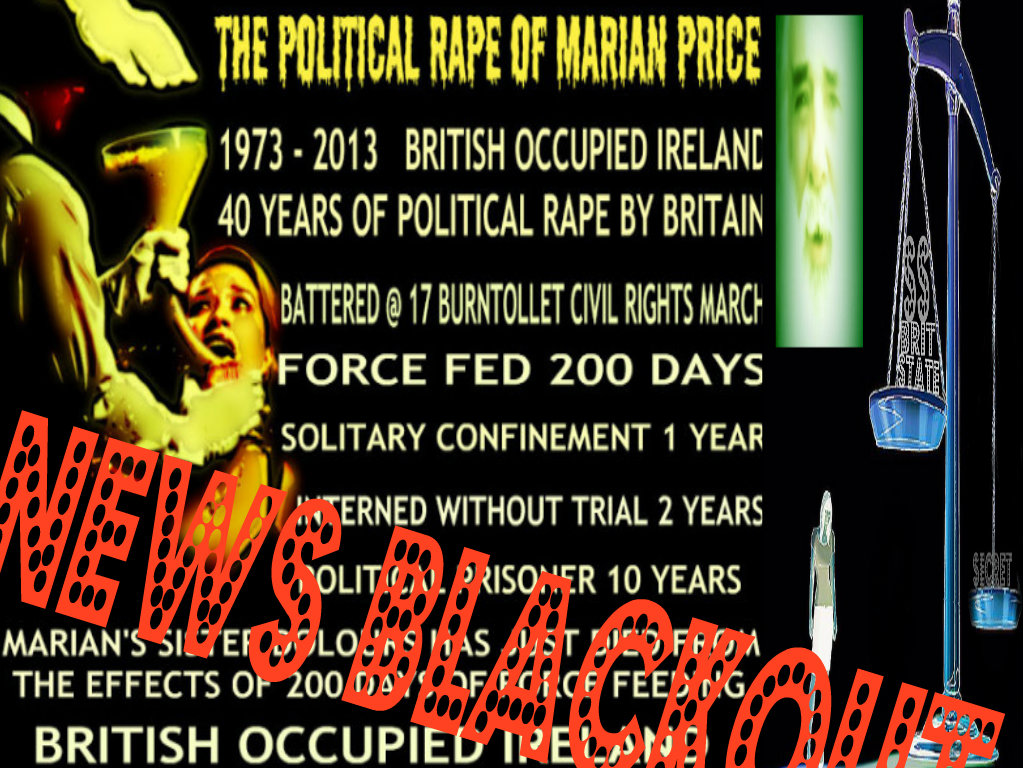
Ireland: Political prisoner Marian Price victim of British injustice

Tuesday, May 7, 2013
Bernadette Devlin McAliskey, veteran Irish civil rights leader, said in response to the case of Irish republican Marian Price, who was returned to jail in 2011: “It is a clear signal to everyone who is not 'on board' and who is not of the same mind as the government that no dissent will be tolerated.
“No dissent will be tolerated and you challenge the status quo at your peril.”.
Marian Price, 59, is a long-time Irish republican activist and ex-Irish Republican Army volunteer. She was given two life sentences over bomb blasts in London in March 1973 that targeted a British army recruitment centre and Old Bailey courts. Price was one of nine republicans sentenced, including her sister Dolours and Gerry Kelly, who is now Sinn Fein MLA for North Belfast.
Price was given a “royal pardon” in 1980 and left prison suffering from poor health and weighing only five stone. The Price sisters had spent 200 days on hunger strike demanding to be transferred to a jail in Ireland's north, where republican prisoners had political status.
They were both forcibly restrained and force-fed three times a day over the last 167 days of the hunger strike.
Despite her health issues and prolonged jailing, Price remained politically active after her release. Her outspoken criticism of British rule caused problems for the British administration, who had probably hoped she would quietly fade from the political scene.
Price’s continued activism and vocal support for republicanism kept her under scrutiny and made her a target for British security services.
Jailed on orders of government official
Price was returned to prison in 2011, not on the basis of fresh evidence or any new offence. Rather, then-British Secretary of State for Northern Ireland Owen Paterson ordered her detention and charged her with encouraging support for an illegal organisation.
The basis of this charge is that Price attended a 1916 Easter Rising Commemoration held in Derry; one of many held by Irish republicans each year. At the event, Price held up a piece of paper for a masked man from the 32-County Sovereignty Movement as he read out a message.
Three days later, Price was arrested. She was then granted bail, but arrested again after she left the court on Paterson's orders.
This time, the reason was based on secret information from the British intelligence services, which claims the evidence cannot be revealed due to national security concerns.
Later, Price was also charged with “providing property for the purposes of terrorism”; this allegedly related to her purchase of a phone, which authorities “think” was later used by attackers who killed two soldiers in 2009.
Price's supporters believe this is merely an attempt by the British authorities to link her with a crime. No evidence or connection to the incident was produced and she was again granted bail by the court.
Yet Price remains in prison due to Paterson's order.
Price's real transgression seems to be her critical remarks about conditions in the six Irish counties still claimed by Britain, and of the Good Friday Agreement that lead to the power-sharing arrangement between Sinn Fein and parties that support British rule in the north.
Solitary confinement
After her arrest, Price was held in solitary confinement in the all-male Maghaberry high security prison for more than nine months, despite not being convicted of any crime.
Then in February last year, Price was taken to Hydebank Women’s Prison where she served another nine months in solitary confinement.
In May last year, the so-called charges involving the Easter Commemoration incident were thrown out of court by a judge. Still Price remained in prison as her mental and physical health rapidly deteriorated.
Then in June, by now seriously ill, she was transferred to a secure ward at Belfast hospital.
The European Court and former Commission on Human Rights, as well as the European Committee for the Prevention of Torture (CPT), have said the use of solitary confinement can be classified as torture, depending on the circumstances.
The CPT has also said that solitary confinement “can amount to inhuman and degrading treatment” and has on several occasions criticised such practices. It has recommended reforms such as abandoning specific regimes, limiting the use of solitary confinement to exceptional circumstances, and/or securing inmates a higher level of social contact.
Furthermore, the revised European Prison Rules of 2006 have clearly stated that solitary confinement should be an exceptional measure and, when used, should be for as short a time as possible.
The Inter-American Court of Human Rights has also stated that prolonged solitary confinement constitutes a form of cruel, inhuman or degrading treatment prohibited under Article 5 of the American Convention on Human Rights.
The UN’s lead investigator on torture, Juan Mendez, has called for governments to end the use of long spells of solitary confinement in prison. Mendez said such isolation could cause serious mental and physical damage and amounted to torture.
He further said that short term isolation was permissible only for prisoner protection, but all solitary confinement longer than 15 days should be banned.
Support for Price
In a joint statement in November last year appealing to US officials visiting Ireland to support calls for the release of Price, Sinn Fein President Gerry Adams and Sinn Fein deputy first minister of the Northern Ireland Executive Martin McGuinness said: “[Price's treatment is a] serious case of injustice and denial of human rights and judicial rights in the north of Ireland.
“We believe that her detention is unjust and runs contrary to the principles of natural justice. We believe very strongly that Marian Price McGlinchey should be released.
“ Her human rights have been breached. She has been denied justice and due process. She is seriously ill. Her detention undermines the justice system and the political process.
“She clearly presents no threat to anyone.”
The campaign to release Price has encompassed a diverse range of people and political, social and community organisations across Ireland and elsewhere. Calls for her freedom have been backed by the two parliamentary nationalist parties in the north, Sinn Fein and the Social Democratic Labour Party (SDLP).
Adams called for Marian’s release in November, January and again in March. McGuinness has also appealed several times for her release, most recently at Sinn Fein's Ard Fheis (congress). He also attended and gave evidence at the Parole Commissioners hearing a short time ago.
SDLP leader Alistair McDonnell called for her release on March 30. SDLP MLA Pat Ramsey has been a vocal supporter of the release of Price, as has Lisburn independent councillor Angela Nelson.
The campaign is also supported by a wide range of republican and national groups, including the 32 County Sovereignty Movement (of which Price is a member), Irish Republican Socialist Party, Republican Network for Unity, Eirigi, Republican Sinn Fein, Irish Freedom Committee, Friends of Irish Freedom, the Celtic League, the United Celtic Brotherhood and the 1916 Societies.
Calls for Price's freedom have also come from Dublin City Council, Fermanagh Council, Dungannon Council, Galway Council, Derry Council, Sligo Council and Omagh Council.
Among other groups calling for Price’s release are the Scottish Republican Socialist Party and Human Rights Watch UK.
Justice
Devlin McAliskey said: “I think what is very important for people to recognise that what is happening to Marian is not an isolated case. While it's happening here in Northern Ireland and we have had to call upon the UN Rapporteur for Health to exercise his authority to examine it ... [it relfects] the arrogance [of] many of the Western powers ...
“I think Marian's case is symptomatic of those things we see every day ... That people can still be imprisoned without due process and that many countries, particularly in the very powerful Western alliances, feel that UN resolutions and UN protections are for protecting them from their enemies, but not people from powerful states.
“Marian's case is not just something peculiar to the Northern Ireland situation. The increasing confidence with which fundamental human rights and due process and protections are being ignored ― I think is frightening.”
The treatment of Price amounts to a return to the bad days of interment without trial, enforced by the British on the nationalist community in Ireland's north in the early 1970s.
Price is being held purely because of her views and criticisms. She is being selectively targeted because she refuses to remain silent in the face of British coercion and repression.
The British justice system’s mistreatment of Price has again exposed it as the disgraceful, hypocritical and discriminatory structure that it is, a fact that Irish people have experienced throughout the colonial occupation of Ireland.
Price’s case reveals the contempt the British judicial system has for genuine fairness and due process.
Twice she was granted bail by judges, only to be rearrested due to orders signed by the Northern Ireland secretary of state. Price has been illegally imprisoned. The lack of a genuine case against Price and her jailing without due process is a travesty that must be remedied by her unconditional freedom.
Price’s human rights are being grossly violated by her long-term incarceration. She is effectively detained without trial, sentence or release date. This means she could be held for an indefinite time, an illegitimate procedure that allows the British administration to hold her for the rest of her life if it so desires.
On the basis of compassion, legal, civil and political rights, and those of common sense, Price should be released immediately.

Monday, May 6, 2013

THE FALSE NARRATIVE OF PENSIVE QUILL


Monday 9th March 1981
I have left this rather late tonight and it is cold. The priest Fr Murphy was in. I had a discussion with him on the situation. He said he enjoyed our talk and was somewhat enlightened, when he was leaving.
On the subject of priests, I received a small note from a Fr S. C. from Tralee, Kerry, and some holy pictures of Our Lady. The thought touched me. If it is the same man, I recall him giving a lecture to us in Cage 11 some years ago on the right to lift arms in defence of the freedom of one’s occupied and oppressed nation. Preaching to the converted he was, but it all helps.
It is my birthday and the boys are having a sing-song for me, bless their hearts. I braved it to the door, at their request, to make a bit of a speech, for what it was worth. I wrote to several friends today including Bernie and my mother. I feel all right and my weight is 60 kgs.
I always keep thinking of James Connolly, and the great calm and dignity that he showed right to his very end, his courage and resolve. Perhaps I am biased, because there have been thousands like him but Connolly has always been the man that I looked up to.
I always have tremendous feeling for Liam Mellowes as well; and for the present leadership of the Republican Movement, and a confidence in them that they will always remain undaunted and unchanged. And again, dare I forget the Irish people of today, and the risen people of the past, they too hold a special place in my heart.
Well, I have gotten by twenty-seven years, so that is something. I may die, but the Republic of 1916 will never die. Onward to the Republic and liberation of our people.      
Bobby Sands


THE GREEN BOOK
The recruit is also made aware of the importance of another tenet forced on the I.R.A. by harsh experience: motivation. Mindful of the splits and informers which grew out of both internment and more particularly the I.R.A.'s own blanket style of recruiting, he is warned.
The Army as an organisation claims and expects your total allegiance without reservation. It enters into every aspect of your life. It invades the privacy of your home life, it fragments your family and friends, in other words claims your total allegiance.All potential volunteers must realise that the threat of capture and of long jail sentences are a very real danger and a shadow which hangs over every volunteer. Many in the past joined the Army out of romantic notions, or sheer adventure, but when captured and jailed they had after-thoughts about their allegiance to the Army. They realised at too late a stage that they had no real interest in being volunteers. This causes splits and dissension inside prisons and divided families and neighbours outside. Another important aspect all potential volunteers should think about is their ability to obey orders from a superior officer. All volunteers must obey orders issued to them by a superior officer regardless of whether they like the particular officer or not.
This motivation is not merely expected to carry the volunteer through vicissitudes such as capture, interrogation and prison; it is expected to sustain him to the Movement's ultimate political goal - a socialist Republic. It is dinned into him that military action is an extension of political action, therefore the military campaign of the I.R.A. is in effect a political campaign. The recruit is told bluntly: 'people with no political concepts have no place in the Army.' Furthermore, those concepts must be of a particular type: 'All potential volunteers must be socialist in outlook.' The recruit is given a very clear eyed vision of the facts.
Before any potential volunteer decides to join the Irish Republican Army he should understand fully and clearly the issues involved. He should not join the Army because of emotionalism, sensationalism, or adventurism. He should examine fully his own motives, knowing the dangers involved and knowing that he will find no romance within the Movement. Again he should examine his political motives bearing in mind that the Army are intent on creating a Socialist Republic.

Life in an underground army is extremely harsh and hard, cruel and disillusioning at times. So before any person decides to join the Army he should think seriously about the whole thing."  
_

Green Book


THE FALSE NARRATIVE OF THE PENSIVE QUILL


... only to end up ourselves beneath the blade of a Committee of Public Safety or some Dictator of the Proletariat … Nicos Poulantzas


When Bobby Sands died on hunger strike 32 years ago today, for a short time he pushed republicanism into a moral stratosphere from where it could gaze down on its critics, detractors and opponents. It was a commanding height, attained courtesy of interminable suffering, that was never going to be held for long despite the enormous selflessness of the Sands action.  The exigencies of armed conflict, the persistently ebbing support for armed struggle, the relentless attrition and unremitting war fatigue all combined to paint armed republicanism into a corner where strategic versatility was heavily circumscribed. Yet for all of that Bobby Sands and the nine comrades who followed in his wake left a footprint which has never been erased from public consciousness.

Before Richard O’Rawe came along and began his lonely endeavour of chipping away at the block lie, a narrative was set in stone that helped keep the public misinformed. In addition to mediator Brendan Duddy two groups of people knew how fallacious the narrative was and for different reasons these two bodies had little incentive to be forthcoming about the events of 1981. The Committee for Prisoner Safety that ran the hunger strike, to the exclusion of the prisoners on strike, banked all the capital that accrued from ten men dead, using it to promote the political career of its leader to whose wagon it was firmly hitched.  It wasn’t going to rain on its own parade. Until lately the British maintained radio silence although it is inconceivable that they did not put their wealth of  knowledge to major strategic use even though the public might have to wait a while yet to discover the finer details of whatever nefarious transaction occurred there.

The false narrative depicted the British Prime Minister of the day as the Iron Lady who would neither yield nor turn, her intransigence tactile rather than tactical:  despite their best efforts the hunger strikers had failed to break the woman and in the end her malevolence won the physical battle while their victory was a moral one

Since the 2005 publication of Blanketmen, clarity has displaced the manufactured clouds that shielded the false narrative. The Committee has fulminated and fumed against O’Rawe but was possessed of neither the punching power to take him out nor the ring craft to evade his hand speed. Now the ring is his to discourse freely from without any fear of serious challenge. As the late Springhill republican Harriet Kelly was fond of saying, there is a hundred ways to lie but only one way to tell the truth. It has been the one way with O’Rawe since his counter narrative emerged. Assailed by a barrage of lies from the managers of mendacity it has withstood everything hurled at it.

Margaret Thatcher outlived Bobby Sands by almost 32 years. Yet there is a certain irony in that she of all people, the bane of the hunger strikers, has posthumously acknowledged their victory though the release of her archive. She has restored to them the victory the Committee robbed them of. The lady who was not for turning was forced to turn by the moral force of the hunger strikers combined to British state strategic acuity which was even at that juncture moulding a leadership that in the language of diplomacy it could do business with or, in the language of counter insurgency, bring to heel and co-opt.

What is galling about documentation that has been making its way into the public domain is that the British interlocutors dealing with the Committee were ‘appalled’ that the Committee men would continue to refuse an offer that would have ended the hunger strike and saved six lives. The prisoners had already accepted the offer and transmitted this to the Committee which overruled them and sabotaged the transmission of their acceptance to the British, thus ensuring only one outcome: coffins on the streets. The Committee had objectives other than saving prisoners’ lives on its agenda.

Richard O’Rawe, comrade of the hunger strikers, foil of the Committee of slayers, no longer requires vindication. His case is proven beyond all doubt. The Committee cannot even take shelter behind the Scottish legal verdict of 'not proven'. Exposed in its disgusting betrayal of great men its own sorry lot could never hope to match, it can claim its rightful spot in the Hall of Shame.

It is a place where Bobby Sands will never be afforded space. 

Sunday, May 5, 2013

INVADE ENGLAND NOW


The REAL danger to the USA lies to the East in Jolly Old England. Their old oppressors and so-called allies pull the strings.That’s right–England (if that’s what it really is).  Is it England?  Or Britain?  Or GREAT Britain?  What the hell is the United Kingdom?  The Commonwealth of Nations?  They have a staggering number of names for such a small  place.  What’s in the United Kingdom?   England and British occupied Ireland, I guess.  What about Scotland?  I think so, although I’ve seen Braveheart a bunch of times, and I’d cut those violent, skirt-wearing, bagpipe-playing loonies a wide path.  Wales?  I guess so.  My ancestors came from Wales, and I’ve never heard anything about it being a country.  Then again, I don’t pay much attention to current events.  Maybe it is a country. How the hell should I know?  I know British Occupied Ireland is part of it because they blow up a lot of stuff.  What about Canada?  I have no idea, but it seems like they are part of the same Axis of Evil.  I’m pretty sure Australia isn’t part it, because that’s where England dumped all their convicts, at least the ones that didn’t end up in America.
Their government is sketchy, to say the least.  Have you ever watch Parliament on CSPAN?  It consists of people standing up and flipping through notebooks while exchanging insults.  I’m torn between thinking it is the ultimate democracy or a Monty Python skit. So, I suppose England is part of the UK which is a collection of countries.  Sounds like Communism to me.  That alone should make them our enemy.  But there are other equally compelling reasons to take Draconian measures against this “nation.”
What do the American Revolutionary War, The War of 1812, World War I and World War II have in common?  The British forced us into all of them.  Okay, I’m not sure about the War of 1812, but I think that’s right.  On the other three, I’m dead certain.
In both World Wars, we were forced to save their asses from the Germans.  If it weren’t for us, they’d be goose-stepping in front of Buckingham Palace right now.  Arguably, the Japanese forced us into WWII, but why do you think we were in Europe?  To save France?  Don’t make me laugh.  England.  Plain and simple.
Now, check out this little bit of history:
  1. Germany tries to take over the world.
  2. England starts getting its ass kicked.
  3. USA jumps into WWI.
  4. German ass is kicked.
  5. Germany is torn apart
  6. Germany becomes a democracy.
  7. Germany becomes a bunch of Nazis.
  8. Germany tries to take over the world.
  9. England starts getting its ass kicked
  10. USA jumps into WWII
  11. Germany gets its ass kicked.
  12. Germany gets torn apart again.
  13. Germany becomes a democracy again.
  14. ??????? 
Do you see a pattern here? Hopefully, they’ll skip the Nazi thing this time, but it’s clear that the Germans will try to take over the world again.  Then, we’re right back in another war.  How is this England’s fault, you ask? It is obvious that they are particularly offensive to Germans and an inviting target as well.  But, imagine if they were part of the old US of A?  We are the most powerful warriors the planet has ever seen!  The Germans will stay right where they are, except maybe for overrunning France.  Again, who cares?

England has to have nuclear weapons, doesn’t it?  Indian and Pakistan do, so England has to.  I’ll just assume that’s correct.  Imagine if those weapons fell into the hands of the Scots with their fiery temperaments and willingness do battle.  How about British occupied Ireland?  Violent drunks–good lord.  Is there any other country full of such unstable sorts that we would allow to have WMD (other than us, of course)?  We take over and seize all the weapons.  The world will be safer for it.  I expect at least one Nobel Peace Prize for this idea alone.

The pure silliness of the Brits is enough to justify military action.  Their penchant for monocles, top hats and tailcoats.  Their odd money–pounds, pence, quids and guineas.  But, it’s their language which reduces them to little more than a sideshow.  Consider that they say–and understand–the following:
  • I attend University.
  • I am going on holiday.
  • I am queued up.
  • I say, old man, where is the wash closet?
  • I’ve stored that in my boot.
  • My lorry needs petrol.
  • I’m cheesed off at your cockup!
  • He’s a beastly bugger–a bit of an arse.
  • I enjoy a fag with my tea.
  • She’s such a jammy bird, why is she with that josser?
  • Don’t give me any of your cheek, you git!

                    INVADE  ENGLAND


uklarge
You may think conquering England, Britain, Great Britain, The United Kingdom and The Commonwealth of Nations is a daunting task.  I think not.  I’m sure our military leaders have already planned out a takeover “just in case.”  If not, I have devised a simple strategy to crush them.  Here is my plan:
  1. We establish a beach head in Southern Ireland with the cooperation of our Irish friends whom we will ply with strong drink.
  2. We will proceed on land across Ireland.  Those who are not dead drunk after that march will stage an attack on Northern Ireland.
  3. We will roll through British Occupied Ireland chanting anti-British slogans lulling them into inaction. British Occupied Ireland will then serve as our base of operations.
  4. Simultaneously, we will invade Wales.  I can’t imagine they have a military.
  5. Once the Scots get wind of our invasion, they will rise up again, paint their faces blue and attack England from the north.  Just to be safe, once the war is over, we’ll build a huge peat wall to keep them at bay.
  6. Once hemmed in, the Brits will surrender realizing that no Americans are available to save them.
  7. Scotland and England will be combined into one land–Fabulous America.
  8. British Occupied Ireland will become a penal colony for political dissidents.
  9. As my ancestral homeland, I will grant Wales its independence but only as a puppet state.  One condition–Tom Jones has to be named President.
  10. Crest White Strips will be distributed throughout the country by air drop, thus winning the hearts of the people.


Bye, bye “Great” Britain.  Hello, Fabulous America!  With their overlords crushed, those hockey-playing Canadian goons will be vanquished to the scrap heap of history.  What then? I suppose every group of savages has its redeeming qualities.  The same is true of the British.  Their humor is excellent.  Monty Python, Marty Feldman, Harry Enfield and Benny Hill are just a few of their entertaining sorts.  Certainly, their music has been fine with The Beatles, The Rolling Stones, Bon Scott and Led Zeppelin.  We’ll preserve some of that.

Beyond those few attributes, the rest of their culture will be wiped out.  No more bangers and mash.  Beer will be served cold–not luke warm.  French fries are French fries–not chips.  They’ll eat cookies, not biscuits.  Iced tea will be iced.  Football is football, not soccer.  Quit boiling all your food.  Drive on the correct side of the road.  Our cops aren’t called bobbies, and they carry guns.  Everyone else does, too, so get armed, and Bob’s your uncle!
In this new world, the USA is supreme, if it isn’t already.  France will reflexively surrender (old habits die hard, you know).  Canada will fall without even a whimper.  And that, old chap, will be jolly good. Now, bugger off.

BOBBY SANDS OF TIME AND EXPERIENCE


"This above all, to my own self be true; and it must follow, as night follows day, that I then cannot be false to any man or woman."


What does this mean?

Why was it written??

Was it good advice???


The basic idea underlying this, is of being true to my own will or who I believe, I really am. Hamlet here is steering Laertes away from the existential doubt, plaguing him at this moment in his life. Hamlet then shares about 'the slings and arrows of outrageous fortune' that oppress him. So what are these 'slings and arrows'?

These 'slings and arrows' are falsehoods, deceptions, cheats, lies etc. Hamlet as happens often in life, has been betrayed by those closest to him and is not secure in himself or his relationships with others at this particular time.


He advises Laertes about how to be an honest man, to be true to himself, not coerced or manipulated by others into acting against his own real self. Hamlet's argument is that he/she who is true to herself/himself cannot be false.

Is it good advice?, that is really up to me and you and the choices we make. If we read the whole extract from where this extract comes, we might say Hamlet is advising Laertes to be average or mediocre. Advising him to stay on the middle ground of life.

However there is much passion of the heart in this also, which recommends, the virtue of 'self', as opposed to appearances, shallow people pleasing, while always following the old hierarchy or status quo, with this being essentially a rant against superficiality.

Other's have said, that the most valuable thing in life is experience. I believe its good advice but sometimes it is tempered or balanced by the realities of life, with regard to the quality and quantity of life I choose. It is also pitted against the many contradictions of life, best said by another Irishman, Oscar Wilde with, "the truth is rarely pure and never simple."


To first know myself, who I am, why I behave, act, speak and react in the way I do. To know my subconscious, sometimes driving me to self-destruct. To know my real self, not just the fake one, to be true to myself without egoism. Much, much, easier said than done.
I believe it is good advice, in the sense of when I leave this world, I leave knowing that I have been true to myself and in so doing, have lived the wonderful gift of life to the full. 


Unlike Bobby Sands, I personally have not always been able to live up to this ideal and have pursued my dark side consistently. Bobby lived just 27 years but in that short time, like candlelight, he held it aloft in that place and time he came from in Ireland, to a world of darkness around him, while at the same time being true to himself and an inspiration for others.


I used to give myself a hard time, about not being able to live up to the ideals of Bobby Sands but then I remember another of his sayings; "Everyone, Republican or otherwise has their own particular part to play. No part is too great or too small, no one is too old or too young to do something."


Somebody asked me yesterday, how do we follow Bobby in a country, where it is illegal to go out and protest march on the street. I replied from my own experience, that really it has always been so for Irish republicans and socialists and that it never has stopped us. I suggested starting off, by picketing a place that needs to be picketed, using it to educate, agitate and organize and that essentially it is simple process.

This takes me back to what I call my own, "Bobby Sands Experience". I was in London,when the first hunger-strike of that time started, which was an extension of several years of the blanket and dirt strike, by Irish political prisoners. I had attended previously the huge funeral of the dead hunger striker Michael Gaughan from Cricklewood to Kilburn. It was an overwhelming, thought provoking, emotional and spiritual experience.

At this time I joined a weekly picket in London, with placards about prison conditions in Long Kesh which were dire. We also had a "loud hailer" and handed out leaflets to passers by, explaining as best we could the details of our protest and the prison conditions. We were generally treated well by the public, which was largely immigrant but also the ordinary English working class.

The protesters included, Provisional Sinn Fein, the Irish Republican Socialist Party and a significant number of English  activists, from the United Troops Out Movement, which included Ken Livingstone and his comrades from that genuine part of Labour which is rare. These people were an inspiration to work alongside with their persistent commitment and hard work for the Cause of Ireland. " The Cause of Ireland is the Cause of Labour and Cause of Labour is the Cause of Ireland." James Connolly.

I was regularly taken in for interrogation by the police but generally treated OK. I was totally unprepared for all of this and had as much fear, as the average person but my commitment and belief in the Cause of what I was doing saw me through. I would suggest though for anyone or party who follows, that there is some sort of tutoring or training needed, to prepare comrades for the experience. This is a major weakness in most parties of the left in my not so humble opinion.

The harassment of my wife and new born child started at home returning from work one day, to find my wife unconscious and the apartment ransacked for political reasons. On another occasion our new born child remained unattended for hours, while my wife was being interrogated for hours at a police station. We were forced to return to Ireland, as result of this harassment from the police. The back drop to all of this was that we had stayed for several years in the place, where the Guildford Four had been framed or set up for several life sentences, of which they were totally innocent. This injustice and common knowledge of many Irish people and professional legal people in London at this time drove us on.

During this time Sean McKenna from outside Newry was on hunger strike along with seven other comrades demanding political status. Originally the 17 year old  Sean, like Marian Price today, was interned without trial for three years. His father, Sean Snr. was one of what later became known, as the 14 hooded men, who were tortured and experimented on by the British Army. Sean was kidnapped by the SAS and taken across the border, where he was tortured so severely, that his hair turned from black to white, almost overnight. The British were found guilty by the European Court of Human Rights of torture.

After 53 days on hunger strike, Sean Jnr. went into a coma hours away from dying, when IRA leader Brendan Hughes called it off after promises, from the British Government on a compromise. However the agreement was later broken by the British, when the hunger strike was no longer in the public eye. The Blanket and dirt strike were then continued. The reaction to the British breaking their promises was utter rage on the Irish street. 


I arrived in Newry from the west of Ireland, on the day that bits and pieces of landrovers, helicopters, British lorries and approximately 40 British paratroopers, some of them vapourized, were sent flying through the air at Narrowater outside Newry. The British to this day, claim it was just 18 but like almost every incident in British Occupied Ireland, with the help of the BBC world service, they are still lying. IRA volunteers from South Armagh and South Down were held responsible. 

In the west of Ireland where I had just left that
day, a certain Admiral of the Fleet - Louis Francis Albert Victor Nicholas Mountbatten, 1st Earl Mountbatten of Burma, KG, GCB, OM, GCSI, GCIE, GCVO, DSO, PC, FRS, Prince Louis of Battenberg, Viceroyal of India - Chief of the Defence Staff, Chairman of the NATO Committee, Queen's cousin Lord Mountbatten was blown to smithereens, sky high, along with his yacht in Mullaghmore.

From his birth until 1917, when he and several other British royals dropped their German styles and titles, Lord Mountbatten was known as 'His Serene Highness' Prince Louis of Battenberg. He was the youngest child and the second son of Prince Louis of Battenberg and his wife Princess Victoria of Hesse and by Rhine. His maternal grandparents were Louis IV, Grand Duke of Hesse, and Princess Alice of the United Kingdom, who was a daughter of Queen Victoria and Albert, Prince Consort. His paternal grandparents were Prince Alexander of Hesse and Princess Julia of Battenberg. Whatever about Highness, there was nothing particularly serene about "His Serene Highness" that day in Mullaghmore. For many of those who read the link above it seemed poetic justice, as it seemed to me at that time. Unfortunately there were innocents victims and while technically in military terms it may have been "a good job," it did not advance the Cause of Ireland or justice one iota.

Settled down in Newry I was horrified to see that the Republican struggle, had deteriorated into a shambles of dis-organization and demoralization. Unlike London there was little visible solidarity, with regard to the blanket and dirt protest. Other than a few stalwarts like Tom Lonergan and local traditional Protestant republicans, there was demoralization after the failed hunger strikes and muddled IRA truces and ceasefires. Then the lead up to the Hunger strike led By Bobby Sands, was prioritized.

Initially I could only muster a few young lads who were classed as "outcasts" by the broad republican movement at that time. Just the few of us picketed outside the SDLP civil rights, Rory McShane's solicitors offices, on the main Hill Street of Newry. Not many paid us a blind bit of heed, while the well heeled, elected, suited, SDLP electioneers like Provisonal Sinn Fein of today, scoffed at our poor, scruffy small protests. These young lads were of Bobby Sands age.

As the protest around the Hunger Strike progressed, the crowds came eventually. We walked the streets of Newry in night time vigils shouting Gerry Fitt is a Brit and  called for political status. We walked the  roads of South Armagh and blocked the border outside Newry in protests. We marched to Dublin to carrying the message through the Free State towns along the way. The stickies including the current Irish Foreign minister, from initially trying to stop the protests, with some bad beatings in the backs of vans to young lads, like the current protests initially on Marian Price's internment, started to fight among themselves, as the Hunger strike progressed.

On the 5th of May 1981 Bobby Sands died after 66 days on Hunger Strike. All changed, utterly changed as WB Yeats said of the 1916 rising. We were initially stunned. Many wanted to riot wholesale but the leadership in Newry at wisely at that time prevented msot of it.This leadership now consisted of the local branch of the H-Block and Armagh Committee, made up largely of the IRSP, some independent human rights and political activists and just a few Provos. Both the Official and Provisional IRA were badly split at this time in Newry. After Bobby Sands' death, with the help of Danny Morrison, ethical elements of all three "citizen armies" came together, to unleash a military campaign of utter rage on the local British war machine.

Again like the Mountbatten and Narrow water incidents, the campaign was militarily highly proficient, lasting several years but yet again it did not advance the Cause of Ireland or its people. These events are documented by Eamon Collins in the  Killing Rage  
an apt name for the fury, the British triggered with Thatcher's treatment of local man Raymond McCreesh who died on hungerstrike. The list reads as follows.
NameArmyStrike startedDate of deathLength of strike
Bobby SandsIRA1 March5 May66 days
Francis HughesIRA15 March12 May59 days
Raymond McCreeshIRA22 March21 May61 days
Patsy O'HaraINLA22 March21 May61 days
Joe McDonnellIRA8 May8 July61 days
Martin HursonIRA28 May13 July46 days
Kevin LynchINLA23 May1 August71 days
Kieran DohertyIRA22 May2 August73 days
Thomas McElweeIRA8 June8 August62 days
Michael DevineINLA22 June20 August60 days


My lessons from this experience are that Bobby Sands was on the right track but that a hunger strike is terrible price for a young man or woman to pay, because the gift of life is so precious. I feel particularly for the mothers, fathers, wives, daughters, sons and families of the hunger strikers, as I do, for the loss of all families Irish and overseas associated with what is called the troubles in Ireland. The whole experience  has taught me that violence is not the way forward at this time in Ireland. When the clear majority of the island of Ireland demand a revolution to effect change and that is demonstrated clearly on the streets of Ireland, only then can this revolution be considered and effected. 
Our task as revolutionaries in the meantime, like those young outcasts on the streets of Newry, inspired by Bobby Sands are the cutting edge of change. Bobby Sands was a prolific writer.The written legacy of this young working class lad, inspired me to believe, that perhaps the pen can be mightier than the sword. That we do not have to be great writers to make it happen, that a sufficient number of us committed to this exercise, despite censorship, cannot be ignored. 
The 'Truth' can set us free, it is always our friend in the long run. It is the friend of Ireland in the long run.  Our enemies will always try to provoke reactionary violence, to discredit and as excuse to intern us and continue to use their death squads. We don't need this. The cause of Ireland and the history of our struggle is a just and noble one. We do not need reactionary violence to assert our cause albeit we do need a considerable amount of patience. 

I perosnally do not agree with how the 'Peace Process" happened but now that it is an approximate reality, I believe, it is the best environment to take Ireland's Cause forward, without becoming part of the  establishment politics of revisionism or mere reformism. It needs the input of 'the people of no property' to keep it honest, to prevent it falling into the hands of the middle class like Fianna Fail. It is our responsibility to keep those who live and profit off other men and women's wounds, honest.
There is much material around this time and experience too painful for me to write about further, at this time. There is also much around my own failures and mistakes in making Bobby and his comrades dream a reality that has been humbling. I have stopped beating myself up about this, there is no future in that. Irish republicans who continue to inspire me, have a humility about them, that is neither servile or egotistical.  

I will also add from bitter personal experience, that revolutionary politics and heavy drinking do not mix. I could tell you that I became disillusioned with revolutionary Ireland and became an alcoholic drinker ore Vice Versa but that would be a too simplistic. It is far more complex than that and would take more than a few pages to explain, besides I do have responsibilities to other people. It saddens me however to see an excess of finger pointing, rather than honest self-appraisal around the republican movement. I have been guilty of my fair share of it, I need to remind myself it time to stop, I do not build up my perspective by putting other down but we are human.

There is no future in this and it is totally unjust to point a finger at any other Irish republican, unless you have walked in their shoes. Perhaps at best, we have the dubious luxury of being be judged by their peers. It is time in the interests of unity and sticking together, to forgive without forgetting the many lessons and to move on to another phase of the struggle, which will be equally tough and requires solidarity. Blackmail by the British Secret services, after such a long struggle is far more extensive, than the Movement cares to admit. It needs to addressed in a thorough manner for Ireland's sake. 

Pickets, street protests, campaigns of civil disobedience and  dare i say that oh so painful word that is so heart breaking, hunger strike are the way forward in the shadow of the 9/11 and 7/7 narratives. The British are recruiting the Americans and the world to their side with it.

Hunger Strikes

       KING: ... He has chosen death:
                    Refusing to eat or drink, that he may bring
                    Disgrace upon me; for there is a custom,
                    An old and foolish custom, that if a man
                    Be wronged, or think that he is wronged, and starve
                    Upon another's threshold till he die,
                    The Common People, for all time to come,
                    Will raise a heavy cry against that threshold,
                    Even though it be the King's.

                   W.B. Yeats (1904)

Ireland did not invent the hunger strike, while history records Mahatma Gandhi, as its chief exponent, with his seventeen hunger strikes against British colonial rule.  In Ireland however, dramatic hunger strikes since the 1916 Easter Rising have made the world aware of the continuing struggle in Ireland and England for freedom and self-determination. Sadly, I believe, if 
the current treatment by the British Tory establishment, of Marian Price and Martin Corey are anything to go by Bobby Sands and his comrades are not the last.


Saturday, May 4, 2013

BLACKOUT MARIAN PRICE


Marian Price Media Blackout

category international | miscellaneous | news report author Saturday May 04, 2013 11:17author by Brian Clarke - AllVoices Report this post to the editors
Two Year British Political Internment
On March 14th, 2013 Provisional Sinn Féin MLAs Jennifer McCann and Sean Lynch, met with Vice royal Theresa Villiers, regarding the continued internment of Marian Price and called for the immediate release of Marian Price according to MLA Jennifer McCann. Since that time there has been a complete media print blackout on the political internment of Marian Price.
Marian Price News Blackout
On March 14th, 2013 Provisional Sinn Féin MLAs Jennifer McCann and Sean Lynch, met with Vice royal Theresa Villiers, regarding the continued internment of Marian Price and called for the immediate release of Marian Price according to MLA Jennifer McCann.

Ms. McCann said, “The meeting followed a visit that Martin McGuinness and myself had recently with Marian Price and the presentation made by Martin at her parole hearing last week.

At the meeting with Theresa Villiers, Martin Guinness made it clear, that Ms Price was not a threat to the public and that she should be released without further delay.

I gave a detailed account of the deteriorating condition of Marian Price's health, which has been added to by the recent death of her sister Dolours Price.

I also challenged the decision to re-imposing her life term licence especially given that she was granted bail and urged Theresa Villiers, to accept that Ms Price is entitled to due legal process. She should be tried in a court of law or released.”

Since this statement was made public, there has been a news blackout with regard to Marian Price, with all written material published censored. A Google search will confirm this. Inter agency communiques on Marian Price are also being manipulated, along with material on both Twitter and Facebook. It is the responsibility of ethical news agencies to investigate this matter immediately and confirm the welfare of Marian Price publicly, as there considerable public concern for Marian's welfare and the exercise may be further punishment to the many people concerned worldwide.

Media Blackouts like political internment are act of war that neither belong ina genuine democracy or in peace time. The Irish peace process has been considerably undermined by the British Tory Government since coming to power.

According to Wikipedia a Media blackout refers to the censorship of news related to a certain topic, particularly in mass media, for any reason. A media blackout may be voluntary, or may in some countries be enforced by the government or state. The latter case is controversial in peacetime, as some regard it as a human rights violation and repression of free speech. Press blackout is a similar phrase, but refers specifically to printed media.
Media blackouts are used, in particular, in times of declared war, to keep useful intelligence from the enemy. In some cases formal censorship is used, in others the news media are usually keen to support their country voluntarily as in the UK system in the Second World War.

Historical Media Blackouts

Some examples of media blackout would include the media bans of southern Japan during the droppings of the atomic bombs on Hiroshima and Nagasaki, and the lack of independent media correspondence from Iraq during the Persian Gulf War.

During World War II, the US Office of Censorship sent messages to newspapers and radio stations, which were acted on by recipients, asking them not to report any sightings or explosions of fire balloons, so the Japanese would have no information on the balloons' effectiveness when planning future actions. As a result the Japanese learned the fate of only one of their bombs, which landed in Wyoming, but failed to explode. The Japanese stopped all launches after less than six months.

The press blackout in the U.S. was lifted after the first deaths from fire balloons, to ensure that the public was warned, though public knowledge of the threat could have possibly prevented the deaths. News of the loss of over 4,000 lives when UK ship RMS Lancastria was sunk during the war was voluntarily suppressed to prevent it affecting civilian morale, but was published after it became known overseas.

Contemporary Media Blackouts

A media blackout was used during the 2005 New York City transit strike to allow for more effective contract negotiation between the two sides of the dispute.[4] Most typically, the more freedom of the press that any particular country has, and the more sensational the story, the more likely it is that at least one news organization will ignore the "blackout" and run the story.

The 2008 abduction of Canadian journalist Mellissa Fung was given a media blackout to assure her safe return. All media sources obliged making the Canadian public unaware of the fate of Fung.

In 2008, the fact that Prince Harry of Wales, third in line to the British throne, was serving on active duty in Afghanistan was subject to a blackout in the British media for his own safety. He was brought home early after the blackout was broken by foreign media.

On June 22, 2009, when news came that New York Times reporter David Rohde had escaped from his Taliban captors, few knew he had even been kidnapped, because for the seven months he and two Afghan colleagues were in the Taliban's hands, The Times kept that information under wraps. Out of concern for the reporter's safety,

The Times asked other major news organizations to do the same;NPR was among dozens of news outlets that did not report on the kidnapping at the urging of Rohde's colleagues. Kelly McBride, who teaches ethics to journalists at the Poynter Institute, says she was "really astounded" by the media blackout. "I find it a little disturbing, because it makes me wonder what else 40 international news organizations have agreed not to tell the public," she tells NPR's Melissa Block. McBride says the blackout could hurt the credibility of news organizations. "I don't think we do ourselves any favors long term for our credibility when we have a total news blackout on something that's clearly of interest to the public," she says.

In 2009, on the 20th anniversary of Tiananmen Square protests of 1989, a number of social media websites were made in accessible and foreign television reception disrupted in China.

Some media critics have questioned whether the 2000 Wichita Massacre received little to no coverage in the mainstream media due to political correctness regarding the race of the perpetrators and the victims. Such critics also cite the 2007 Murders of Channon Christian and Christopher Newsom in Knoxville, Tennessee.

On January 18, 2012, Wikipedia itself participated in a media blackout to protest SOPA."
Related Link: http://irishblog-irelandblog.blogspot.com/