
MI5 Wags Her Majesty's Dogs of War in Britsh Occupied Ireland
 international | crime and justice | opinion/analysis
  Friday November 02, 2012 03:49
 by BrianClarkeNUJ - AllVoices
Prison Officer Shot Dead MI5 Whistleblower claims"The Culture Spiralled Out of Control"
The shooting dead yesterday, at 7.30 a.m of a senior prison officer of Maghaberry jail while a major security alert was in progress, just a little further along the motorway, at a shopping centre in Sprucefield, near Lisburn, as bomb disposal experts were checking a car, confirms that MI5 have succeeded in finishing the Peace Process in Ireland with their return to internment. While politicians on all sides went through the synthetic motions of condemning the killing, most of them ignored in the last couple of years, the underlying work needed to address justice, to bring real peace.
MI5 have a state-of-the-art headquarters in the British Army’s Palace Barracks in Belfast. Their new headquarters, which stretches to over 10,000 square feet, is capable of housing 400 employees while they employ thousands elsewhere.. They are in reality, unaccountable to anyone, other than the very limited powers of the police ombudsman and policing boards, which cannot investigate British spying and intelligence gathering in all of Ireland. While MI5 is part of the British ‘Security Services,’ it regularly operates in all of Ireland, including the twenty-six counties.They are best known in southern Ireland, for their central role, in the Dublin/Monaghan bombings, which murdered 33 innocent people.
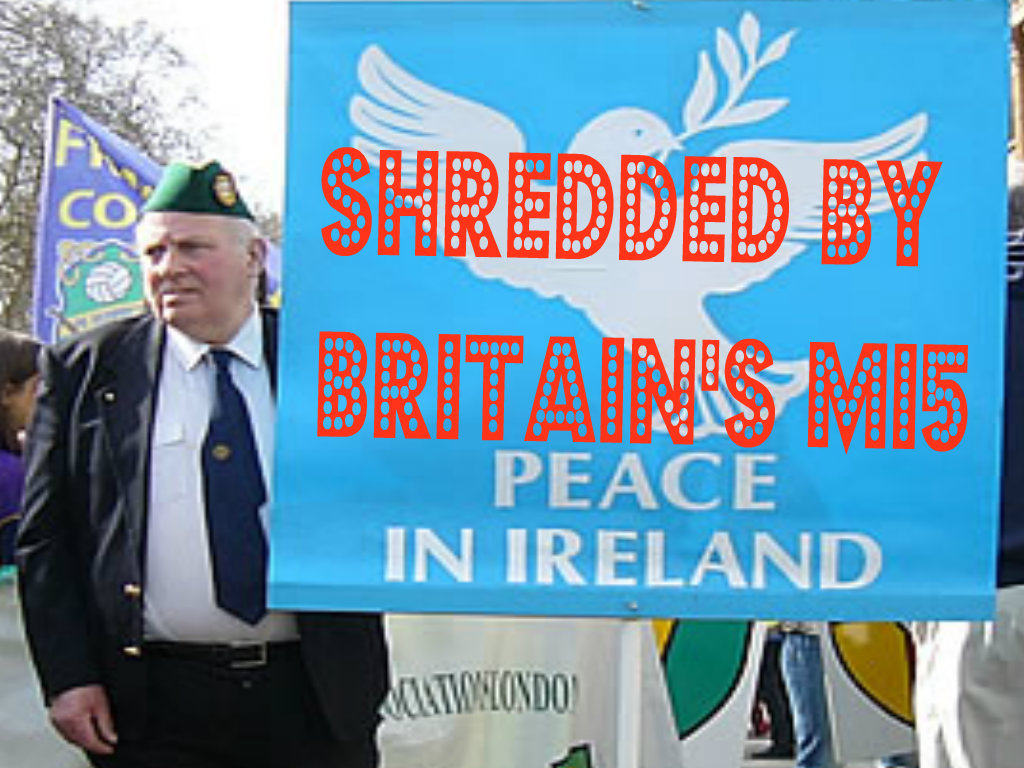
A good example of MI5's unaccountability, is the debacle around the shredding of a Queen's pardon with regard to the ongoing internment of Marian Price. Provisional Sinn Fein's director of publicity, Jim Gibney has written, that the fingerprints of MI5 are all over the internment of Ms Price, who is at the centre of a power struggle for control over the dispensation of justice, between MI5, those in the supposed British justice system, prison system, with the judiciary attempting to decipher, "concocted stories woven in the minds of those inhabiting the murky world of MI5." He claimed that a carefully planned campaign of intimidation orchestrated by MI5, is directed at David Ford, the north’s justice minister, the life sentence parole board inside the prison and the north’s judiciary.
Provisional Sinn Fein have a vested interest in the success of a Peace Proces, while many peace activists clam that MI5 have a vested interest in a return to war in Ireland, to justify their huge bloated budget and unlimited power over Her Majesty's writ and parliaments. Many human rights activists have pleaded with the regime, who are in essence, the real political masters in Britian, to end the return of internment without trial and the torture of political prisoners, which have been widely seen as a blatant, unjustifiable provocation, ending the peace process.Other activity by MI5, with the backing of the Tory Government heavily funded in the last election, by the British industrial war complex, have broken in no uncertain terms the agreements of the Peace Process in Ireland.
The shooting dead yesterday, at 7.30 a.m of a senior prison officer of Maghaberry jail while a major security alert was in progress, just a little further along the motorway, at a shopping centre in Sprucefield, near Lisburn, as bomb disposal experts were checking a car, confirms that MI5 have succeeded in finishing the Peace Process in Ireland with their return to internment. While politicians on all sides went through the synthetic motions of condemning the killing, most of them ignored in the last couple of years, the underlying work needed to address justice, to bring real peace.
Assistant Chief Constable of Britain's paramilitary police Drew Harris, said the gunman was in a Toyota Camry with a Dublin registration which drove alongside Mr Black's black Audi. "From that car it appears that shots were fired at Mr Black, almost immediately his car veered off the motorway and into a pretty deep drainage ditch. Mr Black appears to have sustained very serious and probably fatal gunshot wounds."
The car used in the attack was found burnt-out in Lurgan, Co Armagh, where many have supported the internment protest campaign. Mr Black was the 30th prison officer killed in British occupied Ireland since 1974. It is understood he worked in Long Kesh Concentration Camp when internment was introduced 40 years ago and during the 1981 IRA hunger strike, when 10 republicans died on hunger strike.
Videos on Two Transcipts Below Access Link at Bottom of the Page or at the Real News Network
Bio
Annie Machon was an intelligence officer for the UK's MI5 in the 1990s, but she left after blowing the whistle on the incompetence and crimes of the British spy agencies. She is now a writer, media commentator, political campaigner, and international public speaker on a variety of intelligence-related issues. She is also the Director of Law Enforcement Against Prohibition (LEAP) in Europe.
Transcript
PAUL JAY, SENIOR EDITOR, TRNN: Welcome to The Real News Network. I'm Paul Jay in Baltimore.
In 1997, Annie Machon, a member of MI5 British intelligence left the intelligence agencies, blowing the whistle, alongside her partner, for what she said was corruption, incompetence, and illegality. She's now a writer, a media commentator, a public speaker on a variety of intelligence-related issues. She's also the director of Law Enforcement Against Prohibition, or LEAP, in Europe. She now joins us to tell us her story. Thanks very much for joining us, Annie.
ANNIE MACHON, FMR. MI5 INTELLIGENCE OFFICER: Thank you.
JAY: So give us a little bit of background. How do you get into MI5 in the first place? And then what happened?
MACHON: I was recruited at the end of the Cold War. They were looking for a new generation of counterterrorism officers, moving away from the old political work they'd been doing up until that point. And they also at that point had just been put on a legal footing for the very first time in their 80-year history. So they reassured me that they had to obey the law, just like the rest of us.
JAY: What do you mean, for the first time in their history on a legal footing?
MACHON: Well, they were established in 1909, and until 1989 they didn't officially exist. There was no oversight. No member of Parliament could ever question what they got up to. They could do what they wanted. In fact, Peter Wright, the 1980s author of Spycatcher, said notably that they could bug and burgle their way around London with impunity. So—and they did.
JAY: And MI5 is the domestic service.
MACHON: That's right, yes. And MI6 is the international service, like the CIA. And we also have a listening post as well. So we got three key—.
JAY: So a domestic service above the law, not just the international service above the law, which was sort of the culture here for the longest time.
MACHON: Yeah, no, the domestic service could do what they want, and they did. In fact, they investigated almost a million U.K. citizens purely for their political activity, and not only the citizens: they also had files, secret files, on a number of government ministers in the 1990s. And they did this because it was the Labour government and some of those ministers in their youth had been involved in left-wing politics. So, yeah, it was—it's a strange situation where you have the spies—.
JAY: This is all justified first of all by the Second World War, and then the Cold War.
MACHON: Yes, very much so, and they got very paranoid about penetration of Soviet moles.
JAY: Well, they did such a good job kicking them out.
MACHON: Exactly, yeah, exactly. So that gave them justification to investigate what they called subversives, the political activists.
JAY: So they—with all the Soviet moles that in fact did infiltrate MI6, MI5 would have been investigating them? Or MI6 is supposed to have investigated them?
MACHON: MI5 should have been investigating them, and they failed, obviously. And, of course, all these people who were the Soviet moles were very much establishment figures. They were very posh, top-drawer. And so none of them was ever prosecuted. They were allowed to flee.
JAY: Okay. So jump us up to you get recruited. What year, and to do what?
MACHON: I actually started working there in 1991, and I left in '96, and I had three postings during that time. First of all, in fact, my very first posting was in the political section, even though they said they no longer did it. And this is iiwhen I saw these files on government ministers, because there was a general election and we had to review them. So you have a situation in a democracy where the spies have secret information on people who are supposed to be their political masters, and so it's a tail-wagging-the-dog situation.
JAY: A bit of what Hoover did in the FBI here.
MACHON: Very much so. I mean, less cross-dressing, though, within MI5.
JAY: As far as you know.
MACHON: As far as we know. Then I worked against Irish terrorism for two years. And then my final posting was to international terrorism. And it was during my very first posting that I met my former partner, a man called David Shayler, who went on to become a very notorious, very well known whistleblower in the late 1990s, and we both ended up leaving and blowing the whistle.
JAY: So what happened? First of all, when does the coin drop?
MACHON: Well, the coin dropped pretty quickly, because, of course, they lied to me during recruitment, saying that they didn't do political work.
JAY: What do you mean by political work?
MACHON: Looking at subversives, people who are radical, either very left-wing [incompr.]
JAY: So investigating people simply 'cause of their political activities.
MACHON: Exactly. And when I say investigating, I mean incredibly invasive. So they could put bugs in their properties, they could bug their phones, they could follow them around, they could send undercover people in to report on them.
JAY: And what kind of people were they targeting?
MACHON: Oh, tiny little Trotskyist groups, things like—they were called "militant tendency" or Socialist Workers Party.
JAY: Why would they bother?
MACHON: Well, indeed. It was illegal to do that, because Trotskyist groups did not represent a threat to national security.
JAY: And anyone—certainly everyone on the left knew that.
MACHON: Well, quite. So this was a problem. They were shutting down the section. So at least that sort of stopped in the mid 1990s. Unfortunately, then the role of spying on left-wing groups was taken over by the secret police, who then ran undercover cops into these groups. And there was a big scandal only last year.
JAY: It sounds a bit like some of the discussions we've been having with some of your colleagues at LEAP, Law Enforcement Against Prohibition, and they're talking about how it's sort of become self-generating that you need to create the problem to justify some of the jobs and some of the money. So it sounds like some of this left-wing spying is sort of like that. I mean, everybody knows it's not a threat, but you keep saying it is, 'cause you keep getting more work out of it.
MACHON: It's jobs for the boys, very much. And as the Cold War drew to an end and the Berlin Wall came down, suddenly the MI5 was casting around for new areas of work. That's when they focused on the IRA, the provisional IRA in Northern Ireland. They took that work off the police. And that's what I thought I'd been recruited to do, to be a counterterrorism officer. And, in fact, my second posting was to that section.
And David also moved into T Branch, as it was called, and then moved into G Branch, which was international. And we saw a sort of escalation of issues that troubled us in both those sections. I mean, certainly in the Irish section, bombs that could and should have been prevented by MI5 were detonated on the U.K. mainland, killing people, and MI5 would then lie to government to cover up their mistakes.
JAY: And these were mistakes?
MACHON: They were mistakes, yes.
JAY: I mean, sometimes there's been some suggestion they're errors of deliberate omission, that sometimes it's not so bad if a bomb goes off here or there, 'cause it again justifies even more effort to stop such things. Any whiff of that?
MACHON: There's certainly a whiff, yes. And, of course, when they were working against the IRA, it was very different from working against al-Qaeda, because the IRA had a system of issuing passwords, codewords before an explosion. So they were quite sophisticated in their PR offensive. They would put a bomb down and then warn the police so that nobody would get hurt, so they'd just have sort of the PR hit of the bomb detonating. So, yes, I think some of that might have happened as well.
But it was really in the third posting that we saw the major issues. There was, first of all, an illegal telephone tap on a very famous left-wing journalist in the U.K. on The Guardian newspaper. There was also the imprisoning and the conviction of two innocent people for conspiracy to bomb the Israeli embassy in 1994 in London, and MI5 had evidence that they were innocent, and still let them go ahead and be convicted.
JAY: Why?
MACHON: Why? That's a very good question, because MI5's assessment, after they'd looked at all the evidence around this case, was that Mossad, the Israeli intelligence agency, had carried out a controlled explosion outside their own embassy in order to, one, increase the security around all their interests in London—which they'd been pushing for for years, and MI5 kept telling them to, you know, take a hike—and also to frame these two innocent people who were involved in Palestinian support networks in London. And that network was gaining a lot of traction politically and financially. And, of course, once you finger two innocent people, the whole network just disappeared.
JAY: So you're saying this as if you know this to be true. Has this evidence risen to the public level? Has anything happened?
MACHON: Oh, absolutely. I mean, during the whistleblowing years, this was one of the things that came out. And there was indeed an appeal for the two people in prison. And they admitted that there were documents within MI5, but they weren't going to disclose them, because they didn't have to under the secrecy laws. So the two people who had to finish their sentences, they got 20 years in prison each.
JAY: They did?
MACHON: Yeah. So the judge went against all—.
JAY: They did most of 20 years?
MACHON: They did most of 20 years.
JAY: That's insane.
MACHON: It was a young woman called Samar Alami and a young man called Jawad Botmeh. And there was a huge campaign to release them and everything. It was a big, big scandal. But the judge just ignored all case law and let them rot in prison.
JAY: Alright. So was that one of the things that starts to inspire you that this is—I can't live with myself doing this?
MACHON: Pretty much, yes. I mean, it was a sort of process of boiling the frog when we were in MI5. Things got worse and worse.
JAY: So when's the moment you look around and say, okay, I'm turning into frog's legs?
MACHON: Well, that sort of came to a head, came to the boil in 1995, because David Shayler, my partner at the time, was the head of the living section in MI5. And he had an unusually close working relationship with his counterpart in MI6, the foreign intelligence agency. And he was briefed officially about a plot that MI6 was involved in—and some of his colleagues were, too; it wasn't just David. And this was basically MI6 funding a bunch of Islamic extremist terrorists in Libya. And this group had links with al-Qaeda, which was a known terrorist group even then, which MI5 was investigating. And MI6 was funding this group. And what they were doing was helping to foment a coup against Gaddafi. So the group—.
JAY: But to investigate, they just, I assume, could have phoned the CIA and asked, because the CIA had, certainly at the beginnings of al-Qaeda, at least, something to do with it.
MACHON: Absolutely, yes. I mean, you know, all the support they gave them during the Mujahideen in Afghanistan, no doubt about it. But no, MI6 always liked to talk the talk. They liked to think they were big James Bond figures. And this was an opportunity to do something, I think. And also, the quid pro quo was that if Gaddafi was toppled, this group would seize power and then would start building nice, lucrative oil contracts with British Petroleum and all the other companies. So that seemed to be what they were after.
JAY: Yeah, it worked out really well in Afghanistan.
MACHON: Yeah, I know. They never seem to learn from history. They're doomed to make the same mistakes again and again.
So this group was funded by MI6. And David was concerned about this and reported it all the way up the management chain, but sort of thought they wouldn't do it. MI6 always talked big and did little. But then, in early 1996, a lot of intelligence reports—.
JAY: [incompr.] he's in MI5 or MI6?
MACHON: He's in MI5 along with me. He's the—.
JAY: And you get wind of this MI6 plan.
MACHON: He is officially briefed by his counterpart in MI6 over a period of months. So this was building up for a while.
JAY: And he, up the food chain of MI5, says, are you guys aware of what MI6 is planning to do.
MACHON: Yeah, and nobody seemed bothered, partly because MI6 would [crosstalk]
JAY: So just to get clear, this is a plan to use al-Qaeda type groups in Libya to assassinate the leader of Libya.
MACHON: Yes, at a time when al-Qaeda was known to be an enemy of the West. So MI5 was investigating them; MI6 was funding them. And that was how crazy it was. Crucially, as well, this operation was illegal under U.K. law, because under the Intelligence Services Act 1994, MI6 can commit crimes abroad with legal impunity, but only if they get the prior written permission of their political master, the foreign secretary. In this case, they didn't get it, so it was illegal as well as immoral and unethical.
And in early 1996, Gaddafi was returning from Sirte, in Libya, to Tripoli in a cavalcade of cars, and an explosion occurred under one of the cars—obviously, the wrong one, because Gaddafi survived. But there was a security shoot-out afterwards, and innocent bystanders were gunned down. So we're looking at an illegal operation funding our terrorist enemies, which goes wrong and also kills innocent people.
JAY: Now, just to back up, MI6 doesn't have the official sanction. But is there a suggestion here this is being done without the political masters knowing?
MACHON: Yes.
JAY: So it's—I mean, this is a kind of rogue MI6 operation.
MACHON: Yes, completely rogue and completely illegal. And yet roll forward a few years, and David has blown the whistle on this and gone to prison for it. The MI6 officers involved were never even arrested, certainly not charged or convicted. They were just protected by MI6.
JAY: Why would MI6 do something like this without the political masters knowing? I mean, how much of this goes on, do you think, where they have their kind of own agenda about how the world should look?
MACHON: Well, it's very much a sort of network of old public schoolboys, so, you know, as chaps might talk casually to each other. But I think the major problem is cultural, because until 1994, MI6 had operated outside the law. It was only in 1994 the new law came in which said they should get permission to do this sort of thing. And I think by 1995 the old boys hadn't really got to grips with the fact they had to follow the law. I think it was just that simple.
I mean, it's noticeable now, of course. You roll forward to 2011 and the war in Libya, the NATO invasion, and MI6 people were on the ground in Libya helping the Benghazi rebels, and most of those rebels were the very same groups that they'd been funding in 1996 secretly. This time they were funding and training and helping them overtly.
JAY: I think it is important, I think, from what I know of the Benghazi situation, that is, one segment of the rebels, 'cause there were a lot of people involved in that rebellion that were not al-Qaeda and not linked to MI6 or, we should add, French intelligence, 'cause the French were up to their eyeballs in all of this.
MACHON: Absolutely. Yeah. Yeah.
JAY: And also, just for the sake of the record, we shouldn't jump over the fact that after this '96-'97 period you're talking about, Gaddafi made his grand bargain with Cheney and Bush and had kind of had his rapprochement, including with the British, and Gaddafi's son was running around with British lords and Rothschilds and other people.
MACHON: Well, again, there's some interesting history there, because we know (it's on the public record) that the Shayler case was one of the negotiating factors between the Gaddafi regime and the Tony Blair government, that and the Lockerbie trial, you know, the two suspects that were wanted for the trial of bombing Pan Am 103 in 1988. So we have a situation where that was one of the sort of hot potatoes that helped Gaddafi use as a lever to get a deal with Blair and come in from the cold.
JAY: Right. So let's go back to your story. So you decide you've had enough and your partner decides he's had enough. And what happens?
MACHON: Well, there's not much you can do if you're concerned about crimes inside the intelligence agencies. And in the U.K., under the Official Secrets Act, a bit like the U.S. Espionage Act, it's a crime to report a crime.
JAY: Okay. You know what? We're going to stop here, and we're going to do a part two of this interview.
MACHON: Okay.
JAY: So this is a cliffhanger. So if you want to know what happens next, you've got to watch part two of our interview with Annie Machon on The Real News Network.
Transcript 2
PAUL JAY, SENIOR EDITOR, TRNN: Welcome back to The Real News Network. We're continuing our interview with Annie Machon.
Annie was an intelligence officer for the U.K.'s MI5 in the 1990s. She left after blowing the whistle on the incompetence and crimes of the British spy agency. She's now a writer and a political speaker, a public speaker. And she's also director of Law Enforcement Against Prohibition, or LEAP, based in Europe. Thanks for joining us again, Annie.
ANNIE MACHON, FMR. INTELLIGENCE OFFICER, MI5: Thank you.
JAY: Alright. So we left off—you got to watch part one, 'cause I'm not going to summarize it. We're going to just pick up where we were. You left off with you had had enough. And then what?
MACHON: Well, after David was briefed about the Gaddafi plot and he saw it unfold, he decided he had to do something about it. So we took the decision of resigning and going to the newspapers, because under British law, the Official Secrets Act, the only people you can report a crime to legally are the heads of the agencies you're reporting on, so, of course, you can imagine how many complaints are upheld. And he had tried taking it up the management chain. They weren't interested. So he made contact with a British newspaper just before he resigned, and then we resigned. It took a long time to build the relationship of trust.
JAY: [incompr.] just clear on timing here. This is before this bomb goes off or after?
MACHON: It's—no, no. This is after the Gaddafi attack in—.
JAY: So the attack has taken place.
MACHON: In February 1996.
JAY: So the motive for doing this is you think it was illegal, there should be some accountability, you don't want it to happen again.
MACHON: Well, innocent people—.
JAY: And why do you guys stick your necks out?
MACHON: Innocent people have died. I mean, we weren't the only people resigning at the time. Many of our colleagues had equally valid reasons for leaving. They were flooding out of the agency because they were concerned about the ethics of the organization. But most of them didn't go public. They had ties and kids and mortgages and things. But yeah.
So the bomb occurs in late February, early March 1996. We resign in the summer of 1996. In the meantime, David makes contact with a national newspaper in the U.K., because he reckons if you're going to stick your neck out and go public about something, you want as much fuss as possible to push for an inquiry into this crime. It took a long time for the whistleblowing to happen, because the journalists were suspicious it might be a sting operation, and David was paranoid about being shopped by the journalists. So it took a few months. And then, finally, in summer 1997, the story started to break.
Now, the newspaper was too frightened to go with the Gaddafi plot initially.
JAY: Which paper are we talking about?
MACHON: It was The Mail on Sunday, which is a big national newspaper, and it's independently owned, crucially. So it belonged to Viscount Rothermere, who was very anti intelligence agencies. So it was a good newspaper to go with.
So, yes, the story finally breaks. They were too frightened to go with the Gaddafi plot. They wanted to research it themselves. So they start with the low-level stuff like files on government ministers, illegal phone taps.
And we flee the country. We literally have to go on the run around Europe, because we don't want to sit in our flat waiting to be arrested by the secret police. So we flew off to the Netherlands, we backpacked all around Europe for a month. And the government took out an injunction, of course, to try and gag David Shayler and gag the whole of the U.K. media to stop other stories coming out. And it all looked good, because once they did that, the whole of the national media was saying, you can't do this, we're the free press. The injunction occurred at the end of July '97. We went to bed happy.
The next morning, we woke up to the news that Princess Diana had died in Paris that night. So that was the end of any media support we could conceivably have had in our case. So we sort of found ourselves lost in Europe. And I went back after a month, knowing I'd be arrested, knowing I'd be questioned by the counterterrorism police. I found that our flat, our home had been completely ripped apart in a counterterrorism-style search. They found nothing. They also arrested David's brother, two of his best friends, on trumped up charges to put pressure on him.
I was never charged. I was never tried of anything And then I returned to France, where David had found a little farmhouse to hide in. And we spent almost a year there, where he tried to negotiate with the government.
JAY: Now, when you say "hide", they were looking for him and couldn't find him?
MACHON: Yes. Yeah. They were sort of chasing us all around Europe. And then we found this little place through a friend of a friend.
JAY: With an arrest warrant?
MACHON: Not at that point, no. It was the intelligence agencies, not the police. But we were there for about a year. And David finally got the newspapers and the BBC to come out with the Gaddafi plot story in the summer of 1998.
And after all this time hiding in France, suddenly there's an urgent extradition request from the British government to the French, saying, David Shayler's a traitor, you've got to extradite him back to us. So they arrested him and put him in prison, and he was there for a few months.
JAY: And then what happens?
MACHON: The French released him. They do not extradite people for political actions, which is what they deem whistleblowing to be. So a handy hint to anyone who has to go on the run from spy agencies: go to France.
JAY: And what happens to you?
MACHON: I'm stuck in Paris. My partner's in prison.
JAY: They haven't been chasing you. They didn't try to extradite you.
MACHON: They didn't, no. No. They wanted David because of the Gaddafi plot story. So I spend my time sort of shuttling backwards and forwards between France [crosstalk]
JAY: 'Cause he was the lead whistleblower—
MACHON: He was.
JAY: —on the Gaddafi plot story.
MACHON: Yes.
JAY: The stuff that you blew the whistle on was what?
MACHON: On a whole range of—well, mainly the political stuff, the more low-level stuff.
JAY: Going—the investigation into political activists and stuff.
MACHON: Yeah, that sort of thing. Yeah.
JAY: So then what happens? What do you do? They do extradite him eventually.
MACHON: They don't, no. They fail.
JAY: They don't. France let's him go.
MACHON: France lets him go.
JAY: But they don't—. Then what?
MACHON: Then we have—then he is safe in Paris. So we live in Paris in exile for two years. So he's there. They can't touch him, so long as he stays in France. I travel backwards and forwards between France and London trying to lobby MPs and deal with the journalists, deal with the lawyers, and at that time more evidence comes out from the CIA and from the French DGSE, which is the French CIA—actually, backing up, the fact the Gaddafi plot had happened, because the British tried to brush it aside as fantasy. And also, crucially, a document was leaked from MI6 which supported the Gaddafi plot, too.
So at this point, of course, there's another huge push for an investigation into this criminal action by MI6, and the government managed to spin its way out of having an inquiry.
JAY: So there never is an inquiry.
MACHON: There's never an inquiry. To this day, they still haven't officially taken the evidence.
JAY: And how many people were killed in that bombing?
MACHON: Eleven.
JAY: And who were they?
MACHON: Mainly bystanders. I gather two of Gaddafi's entourage were killed, too.
JAY: But just—.
MACHON: Just people standing on the street, watching the cars go by. Yeah.
JAY: So this is collateral damage, as they like to say.
MACHON: They do now, yes.
JAY: So then what? So this is never—then this is never unravelled, this issue, in terms of any kind of public accountability.
MACHON: No. No.
JAY: And has—do you think—I guess you weren't inside after this, but do you think anything changes in terms of the culture of either MI5 or MI6?
MACHON: I gather it's got worse, actually, because there was a crackdown in the wake of our going public. They very much tightened up security. They threatened anyone that we'd known in the services with prosecution if they spoke to us. And I know as well, post-9/11, of course, when the security gloves came off, that the culture spiralled out of control.
So we have a situation now where MI5 and MI6 are being investigated for involvement in torture of terrorist suspects, along with some of the American agencies, and when I was there in the 1990s they did not torture people. I mean, one, of course, it's ethically wrong, but two, they knew it was counterproductive—they'd seen it being counterproductive in the civil war in Northern Ireland in the '70s. They didn't do it.
But I think since 9/11, opinion has hardened and it—I'm sure there are many, many more people, potentially, who could blow many, many more whistles now than we ever could in the 1990s. It's just, you know, they're too frightened to.
JAY: Thanks very much for joining us.
MACHON: Thank you.
JAY: And thank you for joining us on The Real News Network.
A good example of MI5's unaccountability, is the debacle around the shredding of a Queen's pardon with regard to the ongoing internment of Marian Price. Provisional Sinn Fein's director of publicity, Jim Gibney has written, that the fingerprints of MI5 are all over the internment of Ms Price, who is at the centre of a power struggle for control over the dispensation of justice, between MI5, those in the supposed British justice system, prison system, with the judiciary attempting to decipher, "concocted stories woven in the minds of those inhabiting the murky world of MI5." He claimed that a carefully planned campaign of intimidation orchestrated by MI5, is directed at David Ford, the north’s justice minister, the life sentence parole board inside the prison and the north’s judiciary.
Provisional Sinn Fein have a vested interest in the success of a Peace Proces, while many peace activists clam that MI5 have a vested interest in a return to war in Ireland, to justify their huge bloated budget and unlimited power over Her Majesty's writ and parliaments. Many human rights activists have pleaded with the regime, who are in essence, the real political masters in Britian, to end the return of internment without trial and the torture of political prisoners, which have been widely seen as a blatant, unjustifiable provocation, ending the peace process.Other activity by MI5, with the backing of the Tory Government heavily funded in the last election, by the British industrial war complex, have broken in no uncertain terms the agreements of the Peace Process in Ireland.
The shooting dead yesterday, at 7.30 a.m of a senior prison officer of Maghaberry jail while a major security alert was in progress, just a little further along the motorway, at a shopping centre in Sprucefield, near Lisburn, as bomb disposal experts were checking a car, confirms that MI5 have succeeded in finishing the Peace Process in Ireland with their return to internment. While politicians on all sides went through the synthetic motions of condemning the killing, most of them ignored in the last couple of years, the underlying work needed to address justice, to bring real peace.
Assistant Chief Constable of Britain's paramilitary police Drew Harris, said the gunman was in a Toyota Camry with a Dublin registration which drove alongside Mr Black's black Audi. "From that car it appears that shots were fired at Mr Black, almost immediately his car veered off the motorway and into a pretty deep drainage ditch. Mr Black appears to have sustained very serious and probably fatal gunshot wounds."
The car used in the attack was found burnt-out in Lurgan, Co Armagh, where many have supported the internment protest campaign. Mr Black was the 30th prison officer killed in British occupied Ireland since 1974. It is understood he worked in Long Kesh Concentration Camp when internment was introduced 40 years ago and during the 1981 IRA hunger strike, when 10 republicans died on hunger strike.
Videos on Two Transcipts Below Access Link at Bottom of the Page or at the Real News Network
Bio
Annie Machon was an intelligence officer for the UK's MI5 in the 1990s, but she left after blowing the whistle on the incompetence and crimes of the British spy agencies. She is now a writer, media commentator, political campaigner, and international public speaker on a variety of intelligence-related issues. She is also the Director of Law Enforcement Against Prohibition (LEAP) in Europe.
Transcript
PAUL JAY, SENIOR EDITOR, TRNN: Welcome to The Real News Network. I'm Paul Jay in Baltimore.
In 1997, Annie Machon, a member of MI5 British intelligence left the intelligence agencies, blowing the whistle, alongside her partner, for what she said was corruption, incompetence, and illegality. She's now a writer, a media commentator, a public speaker on a variety of intelligence-related issues. She's also the director of Law Enforcement Against Prohibition, or LEAP, in Europe. She now joins us to tell us her story. Thanks very much for joining us, Annie.
ANNIE MACHON, FMR. MI5 INTELLIGENCE OFFICER: Thank you.
JAY: So give us a little bit of background. How do you get into MI5 in the first place? And then what happened?
MACHON: I was recruited at the end of the Cold War. They were looking for a new generation of counterterrorism officers, moving away from the old political work they'd been doing up until that point. And they also at that point had just been put on a legal footing for the very first time in their 80-year history. So they reassured me that they had to obey the law, just like the rest of us.
JAY: What do you mean, for the first time in their history on a legal footing?
MACHON: Well, they were established in 1909, and until 1989 they didn't officially exist. There was no oversight. No member of Parliament could ever question what they got up to. They could do what they wanted. In fact, Peter Wright, the 1980s author of Spycatcher, said notably that they could bug and burgle their way around London with impunity. So—and they did.
JAY: And MI5 is the domestic service.
MACHON: That's right, yes. And MI6 is the international service, like the CIA. And we also have a listening post as well. So we got three key—.
JAY: So a domestic service above the law, not just the international service above the law, which was sort of the culture here for the longest time.
MACHON: Yeah, no, the domestic service could do what they want, and they did. In fact, they investigated almost a million U.K. citizens purely for their political activity, and not only the citizens: they also had files, secret files, on a number of government ministers in the 1990s. And they did this because it was the Labour government and some of those ministers in their youth had been involved in left-wing politics. So, yeah, it was—it's a strange situation where you have the spies—.
JAY: This is all justified first of all by the Second World War, and then the Cold War.
MACHON: Yes, very much so, and they got very paranoid about penetration of Soviet moles.
JAY: Well, they did such a good job kicking them out.
MACHON: Exactly, yeah, exactly. So that gave them justification to investigate what they called subversives, the political activists.
JAY: So they—with all the Soviet moles that in fact did infiltrate MI6, MI5 would have been investigating them? Or MI6 is supposed to have investigated them?
MACHON: MI5 should have been investigating them, and they failed, obviously. And, of course, all these people who were the Soviet moles were very much establishment figures. They were very posh, top-drawer. And so none of them was ever prosecuted. They were allowed to flee.
JAY: Okay. So jump us up to you get recruited. What year, and to do what?
MACHON: I actually started working there in 1991, and I left in '96, and I had three postings during that time. First of all, in fact, my very first posting was in the political section, even though they said they no longer did it. And this is iiwhen I saw these files on government ministers, because there was a general election and we had to review them. So you have a situation in a democracy where the spies have secret information on people who are supposed to be their political masters, and so it's a tail-wagging-the-dog situation.
JAY: A bit of what Hoover did in the FBI here.
MACHON: Very much so. I mean, less cross-dressing, though, within MI5.
JAY: As far as you know.
MACHON: As far as we know. Then I worked against Irish terrorism for two years. And then my final posting was to international terrorism. And it was during my very first posting that I met my former partner, a man called David Shayler, who went on to become a very notorious, very well known whistleblower in the late 1990s, and we both ended up leaving and blowing the whistle.
JAY: So what happened? First of all, when does the coin drop?
MACHON: Well, the coin dropped pretty quickly, because, of course, they lied to me during recruitment, saying that they didn't do political work.
JAY: What do you mean by political work?
MACHON: Looking at subversives, people who are radical, either very left-wing [incompr.]
JAY: So investigating people simply 'cause of their political activities.
MACHON: Exactly. And when I say investigating, I mean incredibly invasive. So they could put bugs in their properties, they could bug their phones, they could follow them around, they could send undercover people in to report on them.
JAY: And what kind of people were they targeting?
MACHON: Oh, tiny little Trotskyist groups, things like—they were called "militant tendency" or Socialist Workers Party.
JAY: Why would they bother?
MACHON: Well, indeed. It was illegal to do that, because Trotskyist groups did not represent a threat to national security.
JAY: And anyone—certainly everyone on the left knew that.
MACHON: Well, quite. So this was a problem. They were shutting down the section. So at least that sort of stopped in the mid 1990s. Unfortunately, then the role of spying on left-wing groups was taken over by the secret police, who then ran undercover cops into these groups. And there was a big scandal only last year.
JAY: It sounds a bit like some of the discussions we've been having with some of your colleagues at LEAP, Law Enforcement Against Prohibition, and they're talking about how it's sort of become self-generating that you need to create the problem to justify some of the jobs and some of the money. So it sounds like some of this left-wing spying is sort of like that. I mean, everybody knows it's not a threat, but you keep saying it is, 'cause you keep getting more work out of it.
MACHON: It's jobs for the boys, very much. And as the Cold War drew to an end and the Berlin Wall came down, suddenly the MI5 was casting around for new areas of work. That's when they focused on the IRA, the provisional IRA in Northern Ireland. They took that work off the police. And that's what I thought I'd been recruited to do, to be a counterterrorism officer. And, in fact, my second posting was to that section.
And David also moved into T Branch, as it was called, and then moved into G Branch, which was international. And we saw a sort of escalation of issues that troubled us in both those sections. I mean, certainly in the Irish section, bombs that could and should have been prevented by MI5 were detonated on the U.K. mainland, killing people, and MI5 would then lie to government to cover up their mistakes.
JAY: And these were mistakes?
MACHON: They were mistakes, yes.
JAY: I mean, sometimes there's been some suggestion they're errors of deliberate omission, that sometimes it's not so bad if a bomb goes off here or there, 'cause it again justifies even more effort to stop such things. Any whiff of that?
MACHON: There's certainly a whiff, yes. And, of course, when they were working against the IRA, it was very different from working against al-Qaeda, because the IRA had a system of issuing passwords, codewords before an explosion. So they were quite sophisticated in their PR offensive. They would put a bomb down and then warn the police so that nobody would get hurt, so they'd just have sort of the PR hit of the bomb detonating. So, yes, I think some of that might have happened as well.
But it was really in the third posting that we saw the major issues. There was, first of all, an illegal telephone tap on a very famous left-wing journalist in the U.K. on The Guardian newspaper. There was also the imprisoning and the conviction of two innocent people for conspiracy to bomb the Israeli embassy in 1994 in London, and MI5 had evidence that they were innocent, and still let them go ahead and be convicted.
JAY: Why?
MACHON: Why? That's a very good question, because MI5's assessment, after they'd looked at all the evidence around this case, was that Mossad, the Israeli intelligence agency, had carried out a controlled explosion outside their own embassy in order to, one, increase the security around all their interests in London—which they'd been pushing for for years, and MI5 kept telling them to, you know, take a hike—and also to frame these two innocent people who were involved in Palestinian support networks in London. And that network was gaining a lot of traction politically and financially. And, of course, once you finger two innocent people, the whole network just disappeared.
JAY: So you're saying this as if you know this to be true. Has this evidence risen to the public level? Has anything happened?
MACHON: Oh, absolutely. I mean, during the whistleblowing years, this was one of the things that came out. And there was indeed an appeal for the two people in prison. And they admitted that there were documents within MI5, but they weren't going to disclose them, because they didn't have to under the secrecy laws. So the two people who had to finish their sentences, they got 20 years in prison each.
JAY: They did?
MACHON: Yeah. So the judge went against all—.
JAY: They did most of 20 years?
MACHON: They did most of 20 years.
JAY: That's insane.
MACHON: It was a young woman called Samar Alami and a young man called Jawad Botmeh. And there was a huge campaign to release them and everything. It was a big, big scandal. But the judge just ignored all case law and let them rot in prison.
JAY: Alright. So was that one of the things that starts to inspire you that this is—I can't live with myself doing this?
MACHON: Pretty much, yes. I mean, it was a sort of process of boiling the frog when we were in MI5. Things got worse and worse.
JAY: So when's the moment you look around and say, okay, I'm turning into frog's legs?
MACHON: Well, that sort of came to a head, came to the boil in 1995, because David Shayler, my partner at the time, was the head of the living section in MI5. And he had an unusually close working relationship with his counterpart in MI6, the foreign intelligence agency. And he was briefed officially about a plot that MI6 was involved in—and some of his colleagues were, too; it wasn't just David. And this was basically MI6 funding a bunch of Islamic extremist terrorists in Libya. And this group had links with al-Qaeda, which was a known terrorist group even then, which MI5 was investigating. And MI6 was funding this group. And what they were doing was helping to foment a coup against Gaddafi. So the group—.
JAY: But to investigate, they just, I assume, could have phoned the CIA and asked, because the CIA had, certainly at the beginnings of al-Qaeda, at least, something to do with it.
MACHON: Absolutely, yes. I mean, you know, all the support they gave them during the Mujahideen in Afghanistan, no doubt about it. But no, MI6 always liked to talk the talk. They liked to think they were big James Bond figures. And this was an opportunity to do something, I think. And also, the quid pro quo was that if Gaddafi was toppled, this group would seize power and then would start building nice, lucrative oil contracts with British Petroleum and all the other companies. So that seemed to be what they were after.
JAY: Yeah, it worked out really well in Afghanistan.
MACHON: Yeah, I know. They never seem to learn from history. They're doomed to make the same mistakes again and again.
So this group was funded by MI6. And David was concerned about this and reported it all the way up the management chain, but sort of thought they wouldn't do it. MI6 always talked big and did little. But then, in early 1996, a lot of intelligence reports—.
JAY: [incompr.] he's in MI5 or MI6?
MACHON: He's in MI5 along with me. He's the—.
JAY: And you get wind of this MI6 plan.
MACHON: He is officially briefed by his counterpart in MI6 over a period of months. So this was building up for a while.
JAY: And he, up the food chain of MI5, says, are you guys aware of what MI6 is planning to do.
MACHON: Yeah, and nobody seemed bothered, partly because MI6 would [crosstalk]
JAY: So just to get clear, this is a plan to use al-Qaeda type groups in Libya to assassinate the leader of Libya.
MACHON: Yes, at a time when al-Qaeda was known to be an enemy of the West. So MI5 was investigating them; MI6 was funding them. And that was how crazy it was. Crucially, as well, this operation was illegal under U.K. law, because under the Intelligence Services Act 1994, MI6 can commit crimes abroad with legal impunity, but only if they get the prior written permission of their political master, the foreign secretary. In this case, they didn't get it, so it was illegal as well as immoral and unethical.
And in early 1996, Gaddafi was returning from Sirte, in Libya, to Tripoli in a cavalcade of cars, and an explosion occurred under one of the cars—obviously, the wrong one, because Gaddafi survived. But there was a security shoot-out afterwards, and innocent bystanders were gunned down. So we're looking at an illegal operation funding our terrorist enemies, which goes wrong and also kills innocent people.
JAY: Now, just to back up, MI6 doesn't have the official sanction. But is there a suggestion here this is being done without the political masters knowing?
MACHON: Yes.
JAY: So it's—I mean, this is a kind of rogue MI6 operation.
MACHON: Yes, completely rogue and completely illegal. And yet roll forward a few years, and David has blown the whistle on this and gone to prison for it. The MI6 officers involved were never even arrested, certainly not charged or convicted. They were just protected by MI6.
JAY: Why would MI6 do something like this without the political masters knowing? I mean, how much of this goes on, do you think, where they have their kind of own agenda about how the world should look?
MACHON: Well, it's very much a sort of network of old public schoolboys, so, you know, as chaps might talk casually to each other. But I think the major problem is cultural, because until 1994, MI6 had operated outside the law. It was only in 1994 the new law came in which said they should get permission to do this sort of thing. And I think by 1995 the old boys hadn't really got to grips with the fact they had to follow the law. I think it was just that simple.
I mean, it's noticeable now, of course. You roll forward to 2011 and the war in Libya, the NATO invasion, and MI6 people were on the ground in Libya helping the Benghazi rebels, and most of those rebels were the very same groups that they'd been funding in 1996 secretly. This time they were funding and training and helping them overtly.
JAY: I think it is important, I think, from what I know of the Benghazi situation, that is, one segment of the rebels, 'cause there were a lot of people involved in that rebellion that were not al-Qaeda and not linked to MI6 or, we should add, French intelligence, 'cause the French were up to their eyeballs in all of this.
MACHON: Absolutely. Yeah. Yeah.
JAY: And also, just for the sake of the record, we shouldn't jump over the fact that after this '96-'97 period you're talking about, Gaddafi made his grand bargain with Cheney and Bush and had kind of had his rapprochement, including with the British, and Gaddafi's son was running around with British lords and Rothschilds and other people.
MACHON: Well, again, there's some interesting history there, because we know (it's on the public record) that the Shayler case was one of the negotiating factors between the Gaddafi regime and the Tony Blair government, that and the Lockerbie trial, you know, the two suspects that were wanted for the trial of bombing Pan Am 103 in 1988. So we have a situation where that was one of the sort of hot potatoes that helped Gaddafi use as a lever to get a deal with Blair and come in from the cold.
JAY: Right. So let's go back to your story. So you decide you've had enough and your partner decides he's had enough. And what happens?
MACHON: Well, there's not much you can do if you're concerned about crimes inside the intelligence agencies. And in the U.K., under the Official Secrets Act, a bit like the U.S. Espionage Act, it's a crime to report a crime.
JAY: Okay. You know what? We're going to stop here, and we're going to do a part two of this interview.
MACHON: Okay.
JAY: So this is a cliffhanger. So if you want to know what happens next, you've got to watch part two of our interview with Annie Machon on The Real News Network.
Transcript 2
PAUL JAY, SENIOR EDITOR, TRNN: Welcome back to The Real News Network. We're continuing our interview with Annie Machon.
Annie was an intelligence officer for the U.K.'s MI5 in the 1990s. She left after blowing the whistle on the incompetence and crimes of the British spy agency. She's now a writer and a political speaker, a public speaker. And she's also director of Law Enforcement Against Prohibition, or LEAP, based in Europe. Thanks for joining us again, Annie.
ANNIE MACHON, FMR. INTELLIGENCE OFFICER, MI5: Thank you.
JAY: Alright. So we left off—you got to watch part one, 'cause I'm not going to summarize it. We're going to just pick up where we were. You left off with you had had enough. And then what?
MACHON: Well, after David was briefed about the Gaddafi plot and he saw it unfold, he decided he had to do something about it. So we took the decision of resigning and going to the newspapers, because under British law, the Official Secrets Act, the only people you can report a crime to legally are the heads of the agencies you're reporting on, so, of course, you can imagine how many complaints are upheld. And he had tried taking it up the management chain. They weren't interested. So he made contact with a British newspaper just before he resigned, and then we resigned. It took a long time to build the relationship of trust.
JAY: [incompr.] just clear on timing here. This is before this bomb goes off or after?
MACHON: It's—no, no. This is after the Gaddafi attack in—.
JAY: So the attack has taken place.
MACHON: In February 1996.
JAY: So the motive for doing this is you think it was illegal, there should be some accountability, you don't want it to happen again.
MACHON: Well, innocent people—.
JAY: And why do you guys stick your necks out?
MACHON: Innocent people have died. I mean, we weren't the only people resigning at the time. Many of our colleagues had equally valid reasons for leaving. They were flooding out of the agency because they were concerned about the ethics of the organization. But most of them didn't go public. They had ties and kids and mortgages and things. But yeah.
So the bomb occurs in late February, early March 1996. We resign in the summer of 1996. In the meantime, David makes contact with a national newspaper in the U.K., because he reckons if you're going to stick your neck out and go public about something, you want as much fuss as possible to push for an inquiry into this crime. It took a long time for the whistleblowing to happen, because the journalists were suspicious it might be a sting operation, and David was paranoid about being shopped by the journalists. So it took a few months. And then, finally, in summer 1997, the story started to break.
Now, the newspaper was too frightened to go with the Gaddafi plot initially.
JAY: Which paper are we talking about?
MACHON: It was The Mail on Sunday, which is a big national newspaper, and it's independently owned, crucially. So it belonged to Viscount Rothermere, who was very anti intelligence agencies. So it was a good newspaper to go with.
So, yes, the story finally breaks. They were too frightened to go with the Gaddafi plot. They wanted to research it themselves. So they start with the low-level stuff like files on government ministers, illegal phone taps.
And we flee the country. We literally have to go on the run around Europe, because we don't want to sit in our flat waiting to be arrested by the secret police. So we flew off to the Netherlands, we backpacked all around Europe for a month. And the government took out an injunction, of course, to try and gag David Shayler and gag the whole of the U.K. media to stop other stories coming out. And it all looked good, because once they did that, the whole of the national media was saying, you can't do this, we're the free press. The injunction occurred at the end of July '97. We went to bed happy.
The next morning, we woke up to the news that Princess Diana had died in Paris that night. So that was the end of any media support we could conceivably have had in our case. So we sort of found ourselves lost in Europe. And I went back after a month, knowing I'd be arrested, knowing I'd be questioned by the counterterrorism police. I found that our flat, our home had been completely ripped apart in a counterterrorism-style search. They found nothing. They also arrested David's brother, two of his best friends, on trumped up charges to put pressure on him.
I was never charged. I was never tried of anything And then I returned to France, where David had found a little farmhouse to hide in. And we spent almost a year there, where he tried to negotiate with the government.
JAY: Now, when you say "hide", they were looking for him and couldn't find him?
MACHON: Yes. Yeah. They were sort of chasing us all around Europe. And then we found this little place through a friend of a friend.
JAY: With an arrest warrant?
MACHON: Not at that point, no. It was the intelligence agencies, not the police. But we were there for about a year. And David finally got the newspapers and the BBC to come out with the Gaddafi plot story in the summer of 1998.
And after all this time hiding in France, suddenly there's an urgent extradition request from the British government to the French, saying, David Shayler's a traitor, you've got to extradite him back to us. So they arrested him and put him in prison, and he was there for a few months.
JAY: And then what happens?
MACHON: The French released him. They do not extradite people for political actions, which is what they deem whistleblowing to be. So a handy hint to anyone who has to go on the run from spy agencies: go to France.
JAY: And what happens to you?
MACHON: I'm stuck in Paris. My partner's in prison.
JAY: They haven't been chasing you. They didn't try to extradite you.
MACHON: They didn't, no. No. They wanted David because of the Gaddafi plot story. So I spend my time sort of shuttling backwards and forwards between France [crosstalk]
JAY: 'Cause he was the lead whistleblower—
MACHON: He was.
JAY: —on the Gaddafi plot story.
MACHON: Yes.
JAY: The stuff that you blew the whistle on was what?
MACHON: On a whole range of—well, mainly the political stuff, the more low-level stuff.
JAY: Going—the investigation into political activists and stuff.
MACHON: Yeah, that sort of thing. Yeah.
JAY: So then what happens? What do you do? They do extradite him eventually.
MACHON: They don't, no. They fail.
JAY: They don't. France let's him go.
MACHON: France lets him go.
JAY: But they don't—. Then what?
MACHON: Then we have—then he is safe in Paris. So we live in Paris in exile for two years. So he's there. They can't touch him, so long as he stays in France. I travel backwards and forwards between France and London trying to lobby MPs and deal with the journalists, deal with the lawyers, and at that time more evidence comes out from the CIA and from the French DGSE, which is the French CIA—actually, backing up, the fact the Gaddafi plot had happened, because the British tried to brush it aside as fantasy. And also, crucially, a document was leaked from MI6 which supported the Gaddafi plot, too.
So at this point, of course, there's another huge push for an investigation into this criminal action by MI6, and the government managed to spin its way out of having an inquiry.
JAY: So there never is an inquiry.
MACHON: There's never an inquiry. To this day, they still haven't officially taken the evidence.
JAY: And how many people were killed in that bombing?
MACHON: Eleven.
JAY: And who were they?
MACHON: Mainly bystanders. I gather two of Gaddafi's entourage were killed, too.
JAY: But just—.
MACHON: Just people standing on the street, watching the cars go by. Yeah.
JAY: So this is collateral damage, as they like to say.
MACHON: They do now, yes.
JAY: So then what? So this is never—then this is never unravelled, this issue, in terms of any kind of public accountability.
MACHON: No. No.
JAY: And has—do you think—I guess you weren't inside after this, but do you think anything changes in terms of the culture of either MI5 or MI6?
MACHON: I gather it's got worse, actually, because there was a crackdown in the wake of our going public. They very much tightened up security. They threatened anyone that we'd known in the services with prosecution if they spoke to us. And I know as well, post-9/11, of course, when the security gloves came off, that the culture spiralled out of control.
So we have a situation now where MI5 and MI6 are being investigated for involvement in torture of terrorist suspects, along with some of the American agencies, and when I was there in the 1990s they did not torture people. I mean, one, of course, it's ethically wrong, but two, they knew it was counterproductive—they'd seen it being counterproductive in the civil war in Northern Ireland in the '70s. They didn't do it.
But I think since 9/11, opinion has hardened and it—I'm sure there are many, many more people, potentially, who could blow many, many more whistles now than we ever could in the 1990s. It's just, you know, they're too frightened to.
JAY: Thanks very much for joining us.
MACHON: Thank you.
JAY: And thank you for joining us on The Real News Network.


.jpeg)
.jpeg)




October 22, 2012 at 3:03 am |
October 22, 2012 at 8:11 am |
October 23, 2012 at 2:42 pm |
this s*** is really hitting the fan…. and there is just so much of it around!
i believe there to be a distinct possibility with “everyone holding evidence on each other” & “watching each others backs”, iin the high echelons of the rich “N” rampantly rude, incestuous, paedophile and greedy. THEY MAY START TO JUST TEAR EACH OTHERS THROATS OUT IN DROVES!!! KEEP UP THE GOOD WORK – CHANGE IS GONNA COME!!!
October 22, 2012 at 9:03 am |
October 22, 2012 at 9:19 am |
October 22, 2012 at 9:20 am |
October 22, 2012 at 9:46 am |
October 23, 2012 at 11:28 pm |
October 24, 2012 at 7:41 pm
October 24, 2012 at 8:28 pm
October 22, 2012 at 10:02 am |
October 22, 2012 at 10:02 am |
October 22, 2012 at 10:18 am |
October 22, 2012 at 10:57 am
October 22, 2012 at 11:03 am
October 22, 2012 at 11:11 am |
October 22, 2012 at 11:13 am |
October 24, 2012 at 10:14 am |
October 22, 2012 at 11:31 am |
October 22, 2012 at 11:39 am |
October 22, 2012 at 12:27 pm |
October 22, 2012 at 1:27 pm |
October 22, 2012 at 12:44 pm |
October 22, 2012 at 1:41 pm |
October 22, 2012 at 1:49 pm |
October 22, 2012 at 3:55 pm |
October 22, 2012 at 3:37 pm |
October 22, 2012 at 3:53 pm |
Speak up fully or stop spreading such poison!
October 22, 2012 at 3:54 pm |
October 22, 2012 at 3:56 pm |
Who is it then – give me a clue. I can’t find who the person was/is.”
October 23, 2012 at 8:53 pm |
October 22, 2012 at 8:03 pm |
October 27, 2012 at 3:02 am |
October 22, 2012 at 11:06 pm |
October 22, 2012 at 11:55 pm |
God speed and good luck.
October 23, 2012 at 5:41 am |
October 23, 2012 at 7:23 pm |
October 23, 2012 at 10:41 pm |
October 24, 2012 at 5:15 am |
October 24, 2012 at 7:58 am |
October 24, 2012 at 8:24 am |
October 24, 2012 at 3:46 pm |
October 24, 2012 at 4:22 pm |
October 24, 2012 at 6:07 pm |
October 24, 2012 at 10:58 pm |
maybe mr redacted has sent a carter ruck style letter.
i doubt ben wants to have a masonic law firm making him homeless.
a bad situation all around.
armchair heroic critics.
esther rancid needs to go hide for her evil doings.
October 25, 2012 at 10:11 am |
October 25, 2012 at 3:53 pm |
October 25, 2012 at 4:01 pm |
October 25, 2012 at 7:40 pm |
October 26, 2012 at 9:36 am |
October 26, 2012 at 7:02 pm |
October 27, 2012 at 2:58 am |
October 28, 2012 at 2:14 am |