Sunday, November 25, 2012

An Seanachai Eamon Kelly Aris!


Custom Search

Site Index | Kids | Kitchen | Shopping | Poetry | Weddings | Travel | Basic Irish | Quotes | Books | Music Movies | Trivia | Blessings | Jokes | Links|


News Page
History Page
Traditions, folklore, history and more. If it's Irish, it's here. Or will be!
"People will not look forward to posterity who never look backward to their ancestors."
-Edmund Burke
Home Page

Index

Kids Page
Kitchen Recipe Page


Irish Wedding


Shops Ireland


Himself/Herself

Write to Us

Readers Write..
Links/Link to Us

Advertise with us


In My Father's Time
by Mattie Lennon

It was 1959. The National Council for The Blind of Ireland gave my visually impaired mother a wireless. It was our first radio. At the time my contemporaries were clued in to the highlights of Radio Luxemburg and the Light Programme. But, always one to live in the past, I had a preference for the folk programmes on Radio Eireann. My adrenalin was really let loose by the prologue to one in particular:

The rick is thatched
The fields are bare,
Long nights are here again.
The year was fine
But now 'tis time
To hear the ballad-men.
Boul in, boul in and take a chair
Admission here is free,
You're welcome to the Rambling House
To meet the Seanachi.
The Seanachi was, of course, Eamon Kelly.

I was to follow Eamon's stories, on the air, and later in Dublin theatres, through his one-man shows, for decades.

His trademark introduction was: "In My Father's Time" or "Ye're glad I came." In between tales of "The King of England's son" and "The Earl of Baanmore" he would tell his own life-story.

And those who knew his style could always differentiate between the fact and the fiction.

He was born in Rathmore, Co. Kerry, in March 1914. In his autobiographical work "The Apprentice" he tells of how the family moved when he was six months old. He was brought to Carrigeen on Maurice O'Connor's sidecar. (Of course when he'd be wearing his Seanachi's hat he'd tell you he remembered it).

Eamon grew up in a Rambling House and in later life said: " ... my ears were forever cocked for the sound that came on the breeze. It wasn't the Blarney Stone but my father's house which filled me with wonder".

He was only a child when this country gained independence but he had his Kerry ear cocked long before that to accumulate stories such as this: " 'Will I get in this time' the sitting MP said once to one of our neighbours, coming up to polling day. 'Of course you will' the neighbour told him. 'Didn't you say yourself that it was the poor put you in the last time and aren't there twice as many poor there now?' "

Eamon didn't lick his storytelling ability off the ground. He said of his father that he was " ... a friendly person, a good talker. Neighbours and travelers were attracted like moths around a naked flame into his and my mother's kitchen". Their kitchen had " ... all the rude elements of the theatre; the storyteller was there with his comic or tragic tale, we had music, dance, song and costume".

When he left school Eamon became apprentice to his father who was a master carpenter and wheelwright.

The young apprentice missed nothing; seventy years on he could mimic a verbose mason who described how to put a plumb-board against the rising walls to "ascertain their perpendicularity".

He also began taking a correspondence course with Bennett College in England. Then it turned out that the architect of a hotel enlargement project that he was working on was the craftwork teacher at the local Technical School. Eamon enrolled for a night course. The teacher's name was Micheal O' Riada and, in his autobiography, Eamon told how he " ... was the means of changing the direction of my footsteps and putting me on the first mile of a journey that would take me far from my own parish. He taught me and others the craft of wood and in time we passed examinations set by the technical branch of the Department of Education in carpentry, joinery and cabinet making. He taught the theory of building and how to read plans: he taught solid geometry which holds the key to the angles met with in the making of a hip roof or staircase".

No matter how far from home Eamon was working he cycled two nights a week to Tech. He was soon to learn that Micheal O'Riada's interests were not confined to sawing and chiseling. He introduced his pupils to books, writers and the theatre. On the head of this Eamon went to see Louis Dalton's company, at the town hall, in "Juno and the Paycock".

"It was my first time seeing actors on a stage and the humour, the agony and the tragedy of the play touched me to the quick".

He was mesmerized by the actors and " ... their power to draw me away from the real world and almost unhinge my reason long after the curtain had come across".

Micheal O'Riada was impressed with Eamon's reaction to the theatre. He discussed O'Casey, Synge and Lennox Robinson with the young carpenter and advised him if he ever went to Dublin to go to the Abbey Theatre.

Mr. O'Riada also told him that if he kept making headway in his studies and passed the senior grade in the practical and theory papers he would enter him for a scholarship examination, to train as a manual instructor, in Dublin. Since Eamon had left school at fourteen he also had to do additional study in English, Irish and Maths. He passed his scholarship examination, and the interview in Dublin, with flying colours.

He trained and worked as a woodwork teacher for years until he became a full time actor. His first acting role was as Christy Mahon in "The Playboy of the Western World" along with the Listowel actress, Maura O'Sullivan. He would later marry, and spend the rest of his life, with Maura.

They moved to Dublin and Eamon was employed by the Radio Eireann Repertory Players and later by the Abbey Theatre Company. He drew large audiences in villages during the '50s as he traveled around Ireland with his stories. He was to spend more than 40 years as a professional actor. Working with the top actors and leading producers of his day, he performed in New York, London and Moscow.

As a storyteller, his vivid and evocative descriptions are unsurpassed. Whether it was about an emigrant-laden train gathering speed before fading from view at Countess Bridge or sparks flying when the blacksmith struck red hot iron, nobody could tell it like Eamon. Once, in the Brooklyn Academy, while telling one of his famous stories he mentioned an Irish town and drew a graphic word-picture of emigrants at the station. From the audience he heard; "Divine Jesus" and a man crying. Ever the professional, Eamon instantly changed gear, swung to comedy and in seconds had the homesick exile laughing.

Watching him on the stage, the Paps-of-Dana and Dooncorrig Lake almost materialized around you. There was a temptation to look up for the rising ground above Barradov Bridge.

In the Peacock Theatre in the 1980s, you were standing beside the young Eamon Kelly as he made a Tusk Tenon at the workbench beside his father or walked barefoot on the submerged stepping-stones with his first-love, Judy Scanlon.

As Anette Bishop described it in the Irish American Post:
"It's a case of the past returning to raise a charming blush on the cheek of the present". Everything Eamon Kelly did was tried, tested and honed to perfection. And he always expressed appreciation of the crafts, skills and talents of others. "The correct actions of a craftsman sawing, planning or mortising with the chisel were as fluid as those of an expert hurler on the playing field".

When rehearsing for Seamus Murphy's "Stone Mad", which he adapted as a one-man show, he spent days observing stonecutters at a quarry in the Dublin mountains. In the course of the show he "lettered" a stone on stage.

With little or no interest in money himself, he was always on the side of the underdog and the marginalized. He was playing S.B. O' Donnell in "Philadelphia Here I Come" on Broadway, in January 1972, when he heard the tragic news of Bloody Sunday. There and then he decided to play his part in trying to rectify man's inhumanity; he became a vegetarian.

Eamon was shy, by nature. And even in his eighties he would be, by far, the most nervous artist backstage. This was because he was a perfectionist. A year before he died I saw him in a hotel about to do a piece he had performed hundreds of times. With the utmost humility he asked a staff member about facilities to do a last minute rehearsal: "Do you have anywhere where I could talk to myself for a while?"

While the great storyteller won't ever again stand on a stage or sit by the fire of a rambling house, his voice lives on. Rego Irish Records have brought out a video "Stories of Ireland, as told by Eamon Kelly" and a cassette "Eamon Kelly, the Irish Storyteller". (You'll find Rego Records at http://www.regorecords.com)

Kerryman, Brendan O'Shea (O'Sheas Tailoring, Lower Gardiner Street, Dublin) told me the following story:

At the end of September 2001, Eamon Kelly brought a suit in to Brendan for some alterations. The suit was fifteen years old. Prior to one of his trips to America, Eamon had it made by another Dublin tailor who left the jacket minus an inside pocket and the trousers without belt-loops or a back-pocket. Now, Eamon, the perfectionist, asked his fellow-Kerryman to rectify the sartorial omissions, which he did.

When Eamon died on 24th October 2001, he had left detailed instructions with his wife, Maura, about the funeral arrangements and which suit he wanted to be laid out in. Yes, you've guessed it!

Did the man who wrote so lovingly of Con-the-tailor, who made his first Communion suit, and who had portrayed an unforgettable tailor in "The Tailor and Ansty" want to somehow, bring the work of a Kerry tailor out of this world with him? I don't know. And neither does Brendan O'Shea.

As his coffin left the church, the Congregation gave a round of applause. The show was over and this time there was no encore. The final curtain had fallen on a one-man show, performed by a man of many parts. Actor, storyteller and writer, loving husband, devoted father and great Kerryman.

Shortly before his death, while lecturing North American Literature and Theatre students in the art of storytelling, he said: "My journeying is over. If the humour takes me, I may appear in some Alhambra, where angels with folded wings will sit in the stalls, applaud politely and maybe come round after and say;' that was great' ".

As he walked into that great Rambling House in the sky, can't you imagine the opening line?: "Ye're glad I came".

NOTE: Our thanks to Mattie for his contribution; if you'd like to read more of his stories, you'll find them on his website, please click Mattie Lennon.

BIO:
Mattie Lennon was born in the first half of the last century at Kylebeg, Lacken, Blessington, Co. Wicklow. He was not at any stage called "the black sheep of the family" mainly because he was (and is) an only child. He spent the first 25 years of his life at home on a small farm. He claims to identify with Patrick Kavanagh's "burgled bank of youth" (and says he is one of the few of his generation who knows how to make a bush-harrow). As a young fellow whenever he was blamed in the wrong he would compose a derogatory ballad about his accuser. There weren't many false accusations so he wasn't very prolific.

He was nicknamed "the Poet" but emphasises that the term wasn't always complimentary. He agrees that what is said behind ones back is their standing in the community and his favourite quotation is a comment made about him by a neighbour: "Wouldn't you think someone would tell him he's an eejit, when he doesn't know himself".

He has spent most of the last thirty years in Dublin but when asked "Will you ever go back to Kylebeg"? the answer is always Joycean. When James Joyce was asked, in Trieste; "Will you ever return to Dublin?" he said; "I never left".

Mattie Lennon has written articles (mostly humorous) for The Sunday Independent, The Irish Times, The Irish Post, Irelands Own, Irelands Eye, Kerry's Eye, The Wicklow People, The Leinster Leader as well as numerous on-line publications. He claims that he was once told; "You have the perfect face for radio" and he compiled and presented his own programmes in the "Voiceover" series on RTE Radio One. He has presented ballad programmes on KIC FM and is currently doing a Saturday morning ballad show at 11.03AM, on Liffey Sound 96.4 FM. (You can listen to it on the Net. Go to www.liffeysound.com and follow the links)
He also does pre-recorded programmes for other stations. One such programme is "The Story And The Song" in which he plays a number of ballads, having first told the story behind each one.
In 2005 his One Act Play, “A Wolf By The Ears” got a public reading in Teac Siamsa, Tralee.
In 2006 he produced a DVD ,”Sunrise On The Wicklow Hills” and compiled a book of Dublin Bus-workers writings, “There’s Love And There’s Sex And There’s The 46A ”.
He was in the final of the “Eamon Kelly Story–telling Competition” at Listowel Writer’s Week in 2007.
Most years since 2000 he has been in the final of the Sean McCarthy Ballad Competition in Finuge. He still writes the occasional ballad (not all of them fit for human consumption).

Thu, Nov 15, 2012
The Islands
There are hundreds of islands around the Irish coast. Achill is the biggest, the Arans the most romantic; Skellig Michael the most dramatic and Tory the most menacing - at least in legend. The Blaskets offer the most fertile ground for literature and Clare island is the most meticulously studied. But, whichever island you may visit, you can be sure each of them has its own superlative. For example, Little Skellig off St. Finian's Bay in Co. Kerry, is known for its gigantic colony of white seabirds called gannets.
Content edited and adapted from the book "Ireland - Atmosphere & Impressions" by Dr. Christopher Moriarty.
Photo Credits:
Skellig Archway from Travel Publishing

Click for More Culture Corner.


According to Custom
by Eamon Kelly
One of the most common sources for Bridget's articles and comments. A rich store of, what else, Irish customs. Eamon Kelly has written many books and told countless stories; fascinating reading and filled to the brim with the world of Irish history and tradition.Click here for According to Custom.


Site Index | Kids | Kitchen | Shopping | Poetry | Weddings | Travel | Basic Irish
Quotes | 
Books | Music | Movies | Trivia | Blessings | Jokes | Links | 

All contents copyright © 2001 through 2011 inclusive - all rights reserved.
March 4, 2011
Irish Gifts
Rollover button Images:
Wedding LaRoseKids Reading & Kitchen Apples and Tea from All Posters prints.
The information provided on this site is offered as-is, without warranty. This site's owners, operators, authors and partners disclaim any and all liability from the information provided herein.
Any trademarks or registered trademarks on this site are the property of their respective owners. 

Petraeus Sex Scandal


Tom Barry, a former General in the IRA, talking about the need of a British withdrawl from the occupied 6 counties to secure a lasting settlement. 

In the early 70's Barry discussed tactics with IRA men including Joe Cahill who said -

"He wasnt an armchair general, he was a military genius. In the conflict he led by example. Throughout the decades, the goal of a united Ireland in his lifetime was his greatest wish. Not all that long before he died, I met him. He had one desire, he said. If he had the energy, he would love to get some men together and have another go at the British establishment, to see could he achieve his aim"


Petraeus Sex Scandal Covers More Shocking Story

By Barry Sheppard

November 25, 2012 "
Information Clearing House" - San Francisco -  The capitalist press has been overloaded with the sex scandal of General David Petraeus, former commander US troops in Iraq and Afghanistan, and his resignation as head of the CIA.
The story has morphed into something wider, drawing in other high officers.
I’ll return to the saga of the “Real Housewives of the High Command” below, but first I want to discuss a story that has received only scant attention, about one of the grunts who was on the ground in Afghanistan.
Staff Sergeant Dwight L Smith was on Christmas leave last year, and returned home to his family for the holidays. He went out jogging, when he says “something clicked”.
He went back home and got into his Hummer. He decided to kill someone, he later told police. He ran down a 65-year-old woman, Marsha Lee, at random. Witnesses saw him get out of his vehicle, and pick up Lee, injured and screaming, and threw her into the back seat.
Her naked body was found discarded in a wooded area half a mile away. Her head was bashed in with a heavy object. She had been raped.
Then he returned home. His mother said he seemed relatively normal, and they went Christmas shopping that afternoon. He was arrested that evening after police found his bloody Hummer.
Smith’s parents did previously notice his outbursts of anger, throwing laptops, and punching holes in the walls. “I know my child,” his father said. “This isn’t my kid. He was a goofy kid. This isn’t the same man that I sent over.”
What transformed this “goofy kid” into a monster? Two related things.
One was that he suffered a severe concussion in the war. Estimates are that 500,000 US soldiers have suffered concussions and other brain injuries in the wars of aggression against Iraq and Afghanistan.
Stephen Xenakis, a psychiatrtist and retired brigadier general told a New York Times reporter that the army has failed to treat soldiers who have been exposed to blasts. He compares the situation to the runaround soldiers were given for decades about damage from Agent Orange in Vietnam.
The capitalist politicians and military brass do not want to admit the scope of the problem. They want to keep a sanitised image of these wars before the public.
They are fearful that if the public knew the full truth, these wars would become even more unpopular than they already are. That is why they do not help returning soldiers with brain injuries, post-traumatic stress disorder, unemployment, and other problems, to anywhere near the extent of the problems these soldiers face needed.
The result is soldiers running amok (Smith is far from the only one), suicides, depression and other mental problems going untreated. The soldiers are cannon fodder, to use an old expression.
The other thing that transformed Smith is expressed in a letter to his father: “I’m going to be honest with you dad. I have killed a lot of men and children. Some that didn’t even do anything for me to kill them. Also some that begged for mercy.
“I have a problem. I think I got addicted to killing people. I could kill someone go to sleep wake up and forget that it ever happened. It got normal for me to be that way. I never wanted to be this way. I just took my job way too serious. I took things to the extreme.
“Anyone can tell you that I changed. It’s like being a completely different person.”
He did not mention the women he killed, probably out of shame. It is significant that he chose a woman to murder.
His story, while an extreme example, illustrates a truth about wars of occupation. Even if the US soldiers are greeted as “liberators” from an oppressive regime at first (and the idea that they were to be greeted in Iraq and Afghanistan by hugs and kisses and flowers was always a fantasy), the reality soon sets in.
The occupiers become hated by the occupied. The war becomes a war against a people. Resistance grows within the people. They begin to fight the occupiers. The occupiers cannot trust the people, and soon must start kicking down doors to find the “enemy”.
As the “enemy” increasingly is the people, it includes not only men but women and children too. Soon the occupiers are taking part in atrocities. Some go to extremes, while others are just part of regular “search and destroy” missions.
I am reminded of what a soldier told me in 1968 in Vietnam. I accompanied the Socialist Workers Party presidential candidate, Fred Halstead, to Vietnam to talk to the soldiers on the ground about the war.
One soldier, who was fiercely against the war, was anguished. He said when he was in firefights, sometimes women and even children would pull out weapons and open fire on US soldiers. They shot the women and children.
Killing ordinary Iraqis and Afghans, including women and children, and other acts of oppression, affects the mental health of the soldiers.
The politicians and the brass do not want these truths to get out, either.
The fact that Smith suffered a bad concussion and had become inured to killing men, women and children are related.
The resistance fighters do not have tanks, helicopters and jet bombers. They have small arms, including mortars, rocket-propelled grenades and homemade bombs (IEDs in army-speak). In other words, with explosives at short range, that cause concussions.
To turn to the opposite end of the military hierarchy, what do we learn from the Petraeus scandal?
A not-so-minor point is that the whole thing began with what is called a “socialite”, Jill Kelley, who is a friend of Petraeus and others in the high command, informing a friend in the FBI that a woman who turned out to be Petraeus’s mistress, had sent her emails she found to be harassing.
That the FBI agent could then launch highly invasive surveillance of Petraeus’ emails raises the obvious question: if such could be done to the head of the CIA, what about us mere mortals?
I will leave aside the salacious use the media have made of the affair, including the innuendo that the mistress used her wiles to bring down the poor honorable general, a tale that goes back to Adam and Eve.
No one in the media talks about Petraeus’s part in carrying out the huge war crimes of the invasions of Iraq and Afghanistan.
What has been exposed is that for years, the Kelleys have been regularly throwing lavish parties not only for Petraeus, but many other top generals. Champagne, caviar, cavorting with socialites — that is how the high command amuses itself while the Sergeant Smiths get blasted by mortars and kill Iraqi and Afghan men, women and children.
Barry Sheppard was a long-time leader of the US Socialist Workers Party and the Fourth International. He recounts his experience in the SWP in a two-volume book, The Party — the Socialist Workers Party 1960-1988, available fromResistance Books. R
This article was originally posted at Green Left Weekly


Saturday, November 24, 2012

Newsflash : Family Statement on Marian Price


Family Statement on Marian Price

Vote · Comment · Send · Share
McGlinchey and Price family statement issued on 22 November 2012 in relation to the ongoing imprisonment of Marian Price

We as Marian's family are appalled at the lack of urgency being displayed by the Parole Commissioners who are at present reviewing her case. There is a broadly shared view both within our family and the wider community that a stalling process is being employed to delay a determinant decision. We have all been assured that these Commissioners have the powers to deliver such a verdict and this view has been continually reinforced by the Secretaries of State past and present as well as David Ford's Department o Justice and their respective appointees.

It is now 18 months since Owen Paterson employed mechanisms to revoke a license he claimed Marian was held under. She is now imprisoned for offences dating back almost 40 years. Marian has been bailed by the courts yet since May 2011 has remained in solitary confinement in prison and presently is held in an isolated hospital unit.

As a consequence of her treatment in Maghaberry and Hydebank prison Marian's health has continued to deteriorate. The hospital staff now treating Marian's various illnesses have had an arduous task balancing highly toxic medications with other treatments. This ordeal for all involved should be not be happening. The courts have said Marian should be released on bail and all medical opinion has stated she cannot be treated in an environment that is not conductive to recovery. Marian has been in an 'outside' hospital since June and is held under guard with all the rules and regulations applied to a prison regime. The fact that she has been hospitalised by such a lengthy period without improvement and indeed marked deterioration speaks volumes about the chronic state of her health.

Our family can no longer await the pleasure of those with the power to deal expeditiously with this legal limbo. Marian has been forced to endure the brunt of game playing to the detriment of her mental and physical health. We call on those assigned to adjudicate in this travesty of a so called justice system to act now before a shameful situation becomes irredeemable.

The Parole Commissioners have not complied with the obligations apportioned to them. Marian is entitled to have a hearing within a reasonable time under Article 5 of the European Convention. The Commissioners dealing with Marian's case must discharge their statutory legal duties without interference from any source. Their delay in embarking on the pathway to a resolution of this urgent matter is tilting the scales towards further deterioration in Marian's already serious ill health.

At the same time we call on the state to produce the evidence if it exists so that Marian's legal team can defend her. The Parole Commissioners must swiftly enact the duties charged to them and after such a lengthy process come to a just and decisive ruling.
Related Link: http://irishblog-irelandblog.blogspot.com/

IRISH BWANKER COALITION


Michael D. Higgins was elected President of Ireland in 2011 but when this interview took place while he was still leader of the Labor party. As he moved from health care to tea party racism to foreign policy and back again, all Graham can do is sputter.The interview took place in Ireland. 
HIGGINS: I've spoken of my time in the Midwest. I'm going to the Greyhound bus station and hearing for the first time "poor white trash." These people, who -- you know, I was there before the Civil Rights charter came in and frankly the idea that a person would not have one job, but would have two jobs, or three jobs and work all the light hours that are there and still not be entitled to the basic protection of fundamental care is so outrageous.
So whether you agree with Obama on what he is doing and aspects of his foreign policy -- I disagree with some things about Latin and South America --
[crosstalk]
But one of the things I do agree, the idea of being a social floor, below which people wouldn't fall, that's the future. I think even the poorest people in the great country that is the United States should be entitled to basic health care --
GRAHAM: Okay --
HIGGINS: -- And I don't think they'll thank the Sarah Palin lookalikes and followers for taking it off them.
You're about as late an arrival in Irish politics as Sarah Palin is in American politics and both of you have the same tactic. The tactic is to get a large crowd, whip them up, try and discover what is the greatest fear, work on that, and feed it right back in a frenzy. And that leads you in time then when you have in fact maybe one of the most gifted Presidents elected. I happen to not agree with all of his foreign policy but you know you regard for example someone who happens to have been a professor at Harvard as somehow now very handicapped.
You don't find anything wrong at all with this Tea Party ignorance that is being brought all around the United States, which is regularly insulting people who have been democratically elected.
(applause)
GRAHAM: Deputy Higgins, I'm not going to insult you by --
HIGGINS: -- oh I think you should.
GRAHAM: --by bringing up your lack of knowledge of the Tea Party movement other than to --
HIGGINS: I lived in the United States and you know one interesting thing, Mike? You know the big difference as I listened, I lived in the Midwest, in Willie Nelson country. I was a student there at the end of the 60s, I was a professor in Illinois when they entered the 70s.
The magnificent, decent, generous people of the United States, with whom I had supper. People who I sat and ate homemade ice cream with them. The difference between them and the tiny elite who are in charge of warmongering foreign policy in the United States is just enormous.
So therefore when you go on your picnic around the country you're really not representing the decent United States people who are very proud, correctly, of the person they've elected President which they're entitled to do.
But you have the neck to say that people like me who are willing to talk to people or at least are trying to build peace are somehow or another in favor of people who want to martyr Jewish people. That is an outrageous statement. I am not antiSemitic, I am not in favor of martyr, and unlike you, I make my profession in politics and I worked in human rights. And I condemned Hamas for sending rockets. Not that that will matter to you.
Because you know what you are, and I wish you well. Keep drinking Guinness and keep ranting away, but don't suggest that those of us who are working for peace in the heat of the day are somehow interested in martyring Jews.
There's a man in the United -- you know him. I think you may have interviewed him. Mark B. Klein. He represents fourteen Jewish organizations in New York. He organized forty-five members of the House of Representatives to sign a letter condemning Barack Obama for giving Mary Robinson the Medal of Honor. Yeah.
I was debating with him on a program rather like this and I said to him "How can you conclude that Mary Robinson is anti-Semitic?" And he said -- and I said "Or Bishop Tutu, for example?" "Bishop Tutu is anti-Semitic as well!" You're going down that road. And really, it is very dangerous stuff.
The fact of the matter is -- look. Young people from the United States are traveling all over the world again. They're welcome in Europe. They're backpackers and hostels. People are talking to them. Because the image of the United States, we've got away from this warmongering is getting better.
At least forty-seven million people that the likes of you condemn to no health care in a country that I was proud to work in -- these people are going to have some health care.


Friday, November 23, 2012

Pedo Auntie Beeb Rules Hearts & Minds UK ?


The Irish community has plenty of experience, of the BBC infiltrating it both in Ireland, the USA and in their world service with programmes such as Hearts and Minds. How any parent can continue to allow the BBC to penetrate their children's hearts and minds after recent revelations, beggars belief!

 John Pilger article explains it a little better;

Understanding the BBC’s Role Requires More Than Sentiment 


November 22, 2012 "
Information Clearing House" -  In Peter Watkins' remarkable BBC film, The War Game,which foresaw the aftermath of an attack on London with a one-megaton nuclear bomb, the narrator says: "On almost the entire subject of thermo-clear weapons, there is now practically total silence in the press, official publications and on TV. Is there hope to be found in this silence?"
The truth of this statement was equal to its irony. On 24 November, 1965, the BBC banned The War Game as "too horrifying for the medium of broadcasting". This was false. The real reason was spelt out by the chairman of the BBC Board of Governors, Lord Normanbrook, in a secret letter to the Secretary to the Cabinet, Sir Burke Trend.
"[The War Game] is not designed as propaganda," he wrote, "it is intended as a purely factual statement and is based on careful research into official material... But the showing of the film on television might have a significant effect on public attitudes towards the policy of the nuclear deterrent." Following a screening attended by senior Whitehall officials, the film was banned because it told an intolerable truth. Sixteen years later, the then BBC director-general, Sir Ian Trethowan, renewed the ban, saying that he feared for the film's effect on people of "limited mental intelligence". Watkins' brilliant work was eventually shown in 1985 to a late-night minority audience. It was introduced by Ludovic Kennedy who repeated the official lie.
What happened to The War Game is the function of the state broadcaster as a cornerstone of Britain's ruling elite. With its outstanding production values, often fine popular drama, natural history and sporting coverage, the BBC enjoys wide appeal and, according to its managers and beneficiaries, "trust". This "trust" may well apply to Springwatch and Sir David Attenborough, but there is no demonstrable basis for it in much of the news and so-called current affairs that claim to make sense of the world, especially the machinations of rampant power. There are honourable individual exceptions, but watch how these are tamed the longer they remain in the institution: a "defenestration", as one senior BBC journalist describes it. 
This is notably true in the Middle East where the Israeli state has successfully intimidated the BBC into presenting the theft of Palestinian land and the caging, torturing and killing of its people as an intractable "conflict" between equals. Standing in the rubble from an Israeli attack, one BBC journalist went further and referred to "Gaza's strong culture of martyrdom". So great is this distortion that young viewers of BBC News have told Glasgow University researchers they are left with the impression that Palestinians are the illegal colonisers of their own country. The current BBC "coverage" of Gaza's genocidal misery reinforces this.
The BBC's "Reithian values" of impartiality and independence are almost scriptural in their mythology. Soon after the corporation was founded in the 1920s by Lord John Reith, Britain was consumed by the General Strike. "Reith emerged as a kind of hero," wrote the historian Patrick Renshaw, "who had acted responsibly and yet preserved the precious independence of the BBC. But though this myth persisted it has little basis in reality... the price of that independence was in fact doing what the government wanted done. [Prime Minister Stanley] Baldwin... saw that if they preserved the BBC's independence, it would be much easier for them to get their way on important questions and use it to broadcast Government propaganda."
Unknown to the public, Reith had been the prime minister's speech writer.  Ambitious to become Viceroy of India, he ensured the BBC became an evangelist of imperial power, with "impartiality" duly suspended whenever that power was threatened. This "principle" has applied to the BBC's coverage of every colonial war of the modern era: from the covered-up genocide in Indonesia and suppression of eyewitness film of the American bombing of North Vietnam to support for the illegal Blair/Bush invasion of Iraq in 2003 and the now familiar echo of Israeli propaganda whenever that lawless state abuses its captive, Palestine. This reached a nadir in 2009 when, terrified of Israeli reaction, the BBC refused to broadcast a combined charities appeal for the people of Gaza, half of whom are children, most of them malnourished and traumatised by Israeli attacks. The United Nations Rapporteur, Richard Falk, has likened Israel's blockade of Gaza to the Warsaw Ghetto under siege by the Nazis. Yet, to the BBC, Gaza - like the 2010 humanitarian relief flotilla murderously attacked by Israeli commandos - largely presents a public relations problem for Israel and its US sponsor.
Mark Regev, Israel's chief propagandist, seemingly has a place reserved for him near the top of BBC news bulletins. In 2010, when I pointed this out to Fran Unsworth, now elevated to director of news, she strongly objected to the description of Regev as a propagandist, adding, "It's not our job to go out and appoint the Palestinean spokesperson".
With similar logic, Unsworth's predecessor, Helen Boaden, described the BBC's reporting of the criminal carnage in Iraq as based on the "fact that Bush has tried to export democracy and human rights to Iraq". To prove her point, Boaden supplied six A4 pages of verifiable lies from Bush and Tony Blair. That ventriloquism is not journalism seemed not to occur to either woman.
What has changed at the BBC is the arrival of the cult of the corporate manager. George Entwistle, the briefly-appointed director general who said he knew nothing about Newsnight's false accusations of child abuse against a Tory grandee, is to receive £450,000 of public money for agreeing to resign before he was sacked: the corporate way. This and the preceding Jimmy Savile scandal might have been scripted for the Daily Mail and the Murdoch press whose self-serving hatred of the BBC has long provided the corporation with its "embattled" façade as the guardian of "public service broadcasting". Understanding the BBC as a pre-eminent state propagandist and censor by omission - more often than not in tune with its right-wing enemies - is on no public agenda and it ought to be.


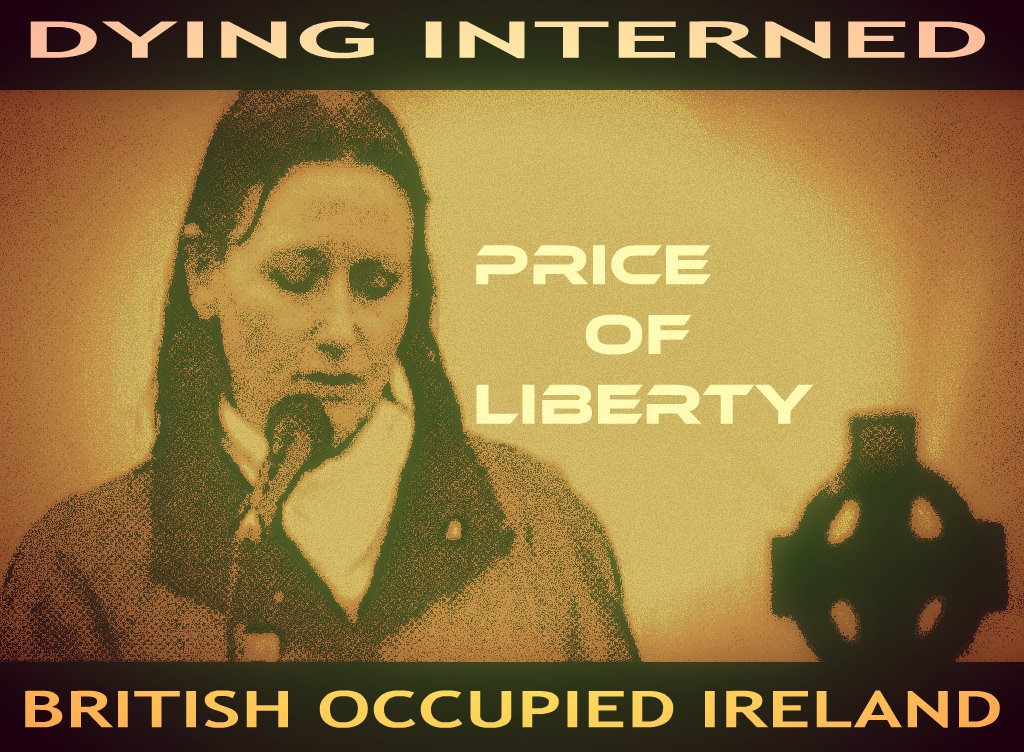
Dying Interned Marian Price Showtrial British Occupied Ireland


Dying Interned Marian Price Showtrial British Occupied Ireland

category international | crime and justice | news report author Friday November 23, 2012 08:55author by BrianClarkeNUJ - AllVoices Report this post to the editors
Secret Internment
Marian Price could not attend her latest court hearing on Wednesday because she is too ill. Her lawyer said, that she is unable to give instructions to her legal team, with her physical and mental health continuing to deteriorate. Her lawyer raised concerns about Marian being examined by anymore experts from the prosecution and defence, claiming she has been examined by 16 doctors already. Marian’s case was adjourned for another four weeks of internment without trial, until December 19 when she will have been politically interned for 19 months, camouflaged as remand, for what are in essence farcical hearings.
Liberty or Death
Liberty or Death
Marian Price could not attend her latest court hearing on Wednesday because she is too ill. Her lawyer said, that she is unable to give instructions to her legal team, with her physical and mental health continuing to deteriorate. Her lawyer raised concerns about Marian being examined by anymore experts from the prosecution and defence, claiming she has been examined by 16 doctors already. Marian’s case was adjourned for another four weeks of internment without trial, until December 19 when she will have been politically interned for 19 months, camouflaged as remand, for what are in essence farcical hearings.

Marian Price is just one of several Irish people currently politically interned in British Occupied Ireland during which time lawyers have not been allowed to see any of Britain's ‘alleged’ evidence.

• She has been kept in solitary confinement in a ‘male’ high security prison
• She is effectively interned without a trial, sentence, or release date.
• She has not been given any timescale for any investigation.
• She has not been allowed to see the evidence that the state claims to have
• Her release has been ordered on two occasions by judges. However, on both occasions the British Vice royal has overruled those decisions.
• The Vice royal claims they ‘revoked Marian’s license, ’despite Marian never being released on license. She was given a Royal Pardon.
• Marian’s Royal Pardon has ‘gone missing’ from the home office (the only time in history). The British Vice royal has taken the view that unless a paper copy can be located – it must be assumed that she does not have one. It is generally agreed that MI5 shredded her majesty's pardon.
• Despite no ‘license’ existing for her release from prison in 1980, it is the non-existent licence that is being used to keep her in prison.
• She can only be released by Theresa Villiers the current Vice royal responsible for Marian's internment.

Recently the charges against Marian were thrown out of court because of a lack of evidence. Now the very same charges have been re-instated against Marian again before the same Judge.

In secret courts, being introduced by the back door, through legislation in the House of Lords, MI5 the British secret services are pushing for secret trials, with secret evidence by secret witnesses, that the defendant's appointed lawyer is not allowed to know, see or refute. The length of sentence is also kept secret, under penalty of a long jail sentence by Britain's Official Secret's Act. This trial of Marian Price is believed to have already happened in secret, with the public hearings and showtrial being simply a public rubber stamp, for the injustice against Marian Price in of British Occupied Ireland.
Related Link: http://irishblog-irelandblog.blogspot.com/
The Pogues - Top 10 X-Rated: Birmingham Six