Sunday, March 3, 2013

BRITISH WAR CRIMES CONTINUE WOMEN'S INTERNATIONAL DAY 20... on Twitpic


27, 000 WOMEN CHILDREN MURDERED INTERNED BY BRITAIN


The Concentration Camps 
1899 - 1902

by Hennie Barnard
"They are not buried here; they are planted. And they will for ever be growing in the hearts of the Boer people."
B Barnard on Concentration Camp Day 21 May 1995 at Balmoral Concentration Camp Cemetery
  • Aliwal North
  • Balmoral
  • Barberton
  • Belfast
  • Bethulie
  • Bloemfontein
  • Brandfort
  • Heidelberg
  • Heilbron
  • Howick
  • Irene
  • Kimberley
  • Klerksdorp
  • Kroonstad
  • Krugersdorp
  • Merebank
  • Middelburg
  • Norvalspont
  • Nylstroom
  • Pietermaritzburg
  • Pietersburg
  • Pinetown
  • Port Elizabeth
  • Potchefstroom
  • Springfontein
  • Standerton
  • Turffontein
  • Vereeniging
  • Volksrust
  • Vredefort
  • Vryburg
Contents
1. Introduction2. Background
3. Course of the holocaust
3.1. The war against woman and child begins
3.2. False pretences
3.3. Planning for death
3.4. Let them die of hunger
3.5. No hygiene
3.6. Hospitals of homicide
3.7. The highest sacrifice
4. Consequences
  • 4.1 "Peace"
  • 4.2. Called up by the enemy
  • 4.3. Immortalised in our literature
  • 4.4. We may not forget
  • 4.5. Pillars of support
5. Effects
6. Summation
Their only crime
7. Sources

The Concentration Camps

1. Introduction
The concentration camps in which Britain killed 27 000 Boer women and children(24000) during the Second War of Independence (1899 - 1902) today still have far-reaching effects on the existence of the Boerevolk.
This holocaust once more enjoyed close scrutiny during the visit of the queen of England to South Africa, when ten organisations promoting the independence of the Boer Republics, presented her with a message, demanding that England redress the wrongs committed against the Boerevolk.
Family arrived at the consentration camp 
2. Background
The Second War of Independence was fought from 1899 to 1902 when England laid her hands on the mineral riches of the Zuid-Afrikaansche Republiek (Transvaal) under the false pretence of protecting the rights of the foreigners who swarmed to the Transvaal gold fields.
On the battlefield England failed to get the better of the Boers, and decided to stoop to a full-scale war against the Boer women and children, employing a holocaust to force the burghers to surrender.
3. Course of the holocaust
3.1. The war against women and children begins
Under the command of Kitchener, Milner and Roberts, more than homesteads and farms belonging to Boer people were plundered and burned down. Animals belonging to the Boers were killed in the cruelest ways possible while the women, whose men were on the battlefield, had to watch helplessly.
Killing sheepLeaving the sheep rotten
The motive behind this action was the destruction of the farms in order to prevent the fighting burghers from obtaining food, and to demoralise the Boers by leaving their women and children homeless on the open veld.
Before the blastThe blastDestroyed for king and country
However, England misjudged the steel of the Boer people. Despite their desperate circumstances, the women and children managed to survive fairly well in the open and their men continued their fight against the invader.
Women and children on the run - away from the English
More severe measures had to be taken. The English hoarded the Boer women and children into open cattle trucks or drove them on foot to concentration camps.
3.2. False pretences
To the world England pretended to act very humanely by caring for the fighting Boers' women and children in "refugee camps". An English school textbook published in 1914 in Johannesburg, but printed in England, Historical Geography: South Africa, by JR Fisher, makes the following claim:
"During the later stages of the war, the relations, women and
children, of those Boers still in the field, were fed and cared
for at the expense of Great Britain, a method of procedure which,
though humane, postponed the end of the war, at the expense of
many valuable lives and much money." 
This statement is contradicted by various sources. The Cape Argus of 21 June 1900 clearly states that the destitution of these women and children was the result of the English's plundering of farms: "Within 10 miles we (the English) burned not less than six farm homesteads. Between 30 and 40 homesteads were burned and totally destroyed between Bloemfontein and Boshoff. Many others were also burned down. With their houses destroyed, the women and children were left in the bitter South African winter in the open." The British history text book says nothing about this.
Awfully generous of the English to care for those whose houses they destroyed!
Breytenbach writes in Danie Theron: "The destruction was undertaken in a diabolic way and even Mrs Prinsloo, a 22 year old lady who gave birth to a baby only 24 hours ago in the house of Van Niekerk, was not spared. A group of rude tommies (British soldiers), amongst whom a so-called English doctor, forced their way into her room, and after making a pretence of examining her, they drove her out of the house. With the aid of her sister, she managed to don a few articles of clothing and left the house. Her mother brought a blanket to protect her against the cold. The soldiers robustly jerked the blanket out of her mother's hands and after having looted whatever they wanted to, put the house to fire. Afterwards the old man was driven on foot to Kroonstad by mounted kakies (British soldiers), while his wife and daughter (Mrs Prinsloo) were left destitute on the scorched farm."
England's claim of caring for the Boer women reminds one of somebody who boasts to have saved the life of someone he himself has pushed into the water. However, there is one vital difference: The holocaust on the Boer women and children began in all earnest once they had been forced into the concentration camps under the "care" of the British!
Family at the beginning - newly arrived with tea and bread (English Propaganda). 
Despite the English claims that the concentration camps were "voluntary refugee camps" the following questions must be asked:
- From whom did the refugees flee? Certainly not from their own husbands and sons!
- How can the fact that the "voluntary" women and children had to be dragged to the concentration camps by force be explained?
- Why should the "voluntary refugee camps" be enclosed by barbed wire fences and the inmates be overseen by armed wardens? Kimberley camp had a five meter high barbed wire fence and some camps even had two or three fences!
- Why would one of the camp commanders make the following statement quoted by Emily Hobhouse: "The wardens were under orders not to interfere with the inmates, unless they should try to escape."? What kind of "voluntary refugee" would want to escape?
Perhaps the words of the Welsh William Redmond are closer to the truth: "The way in which these wretched, unfortunate and poor women and children are treated in South Africa is barbarous, outrageous, scandalous and disgraceful."
3.3. Planning for death
The English claim of decent actions towards the Boer women and children are further contradicted by the location of the concentration camps. The military authorities, who often had to plan and erect camps for their soldiers, would certainly have been well aware of the essential requirements for such camps. Yet the concentration camps were established in the most unsuitable locations possible.
At Standerton the camp was erected on both banks of the Vaal River. It was on the Highveld, which ensured that it was extremely cold in winter and infested with mosquitoes in summer. The fact that Standerton had turf soil and a high rainfall, ensured that the camp was one big mud bath in summer, even inside the tents.
The same circumstances were experienced in camps such as Brandfort, Springfontein and Orange River. At Pretoria, the Irene Camp was located at the chilly southern side of the town, while the northern side had a much more favourable climate. Balmoral, Middelburg and other camps were also located on the south-eastern hangs of the hills to ensure that the inhabitants were exposed to the icy south easterly winds.
Merebank camp was located in a swamp where there was an abundance of various kinds of insects. Water oozed out of the ground, ensuring that everything was constantly wet and slimy.
By October 1900 there were already 58 883 people in concentration camps in Transvaal and 45 306 in the Free State.
The amenities in the camps were clearly planned to kill as many of the women and children as possible. They were accommodated in tattered reject tents which offered no protection against the elements.
Emily Hobhouse, the Cornish lady who campaigned for better conditions for the Boer women, wrote: "Throughout the night there was a downpour. Puddles of water were everywhere. They tried to get themselves and their possessions dry on the soaked ground."
(Hobhouse: Brunt of the War, page 169.)
Dr Kendal Franks reports on the Irene Camp: "In one of the tents there were three families; parents and children, a total of 14 people and all were suffering from measles."
In Springfontein camp, 19 to 20 people where crammed into one tent.
There were neither beds nor mattresses and nearly the whole camp population had to sleep on the bare ground, which was damp most of the time.
One person wrote the following plea for aid to the New York Herald: "In the name of small children who have to sleep in open tents without fire, with barely any clothes, I plea for help."
3.4. Let them die of hunger
According to a British journalist, WT Stead, the concentration camps were nothing more than a cruel torture machine. He writes: "Every one of these children who died as a result of the halving of their rations, thereby exerting pressure onto their family still on the battle-field, was purposefully murdered. The system of half rations stands exposed and stark and unshamefully as a cold-blooded deed of state policy employed with the purpose of ensuring the surrender of people whom we were not able to defeat on the battlefield."
The detainees received no fruit or vegetables; not even milk for the babies.
The meat and flour issued were crawling with maggots. Emily Hobhouse writes: "I have in my possession coffee and sugar which were described as follows by a London analyst: In the case of the first, 66% imitation, and in the case of the second, sweepings from a warehouse."
In her book, Met die Boere in die Veld (With the Boers in the field), Sara Raal states that "there were poisonous sulphate of copper, grounded glass, fishhooks, and razor blades in the rations." The evidence given on this fact is so overwhelming that it must be regarded as a historical fact.
3.5. No hygiene
The outbreak of disease and epidemics in the camps were further promoted by, inter alia, the lack of sanitary conveniences. Bloemfontein camp had only 13 toilets for more than 3 500 people. Aliwal North camp had one toilet for every 170 people.
A British physician, Dr Henry Becker, writes: "First, they chose an ill-suited site for the camp. Then they supplied so little water that the people could neither wash themselves nor their clothes. Furthermore, they made no provision for sufficient waste removal. And lastly, they did not provide enough toilets for the overpopulation they had crammed into the camps."
A report on a Ladies' Committee's visit to Bloemfontein camp stated: "They saw how the women tried to wash clothes in small puddles of water and sometimes had to use the water more than once."
3.6. Hospitals of homicide
Ill and healthy people were crammed together into unventilated areas conducive to the spreading of disease and epidemics. At first there were no medical amenities whatsoever in the camps.
Later doctors were appointed, but too few. In Johannesburg there was one doctor for every 4 000 afflicted patients.
A report on the Irene camp states that, out of a population of 1325 detainees, 154 were ill and 20 had died during the previous week. Still this camp had only one doctor and no hospital.
In some camps matters were even worse. The large Bloemfontein camp did not have a single doctor; only one nurse who could not possibly cope with the conditions. During a visit to Norvalspont camp Emily Hobhouse could not even find a trained nurse.
The later appointment of medical personnel did not improve the conditions. They were appointed for their loyalty towards the British invasion; not for their medical capability. They maltreated the Boere.
Emily Hobhouse tells the story of the young Lizzie van Zyl who died in the Bloemfontein concentration camp: "She was a frail, weak little child in desperate need of good care. Yet, because her mother was one of the 'undesirables' due to the fact that her father neither surrendered nor betrayed his people, Lizzie was placed on the lowest rations and so perished with hunger that, after a month in the camp, she was transferred to the new small hospital. Here she was treated harshly. The English disposed doctor and his nurses did not understand her language and, as she could not speak English, labelled her an idiot although she was mentally fit and normal. One day she dejectedly started calling:
LIZZIE VAN ZYL
lillyvzyl.gif (54356 bytes)
Mother! Mother! I want to go to my mother! One Mrs Botha walked over to her to console her. She was just telling the child that she would soon see her mother again, when she was brusquely interrupted by one of the nurses who told her not to interfere with the child as she was a nuisance." Shortly afterwards, Lizzie van Zyl died.
Treu, a medical assistant in the Johannesburg concentration camp, stated that patients were bullied and even lashed with a strap.
Ill people who were taken to the camp hospitals were as good as dead. One woman declared: "We fear the hospitals more than death."
The following two reports should give an idea of the inefficiency of the camp hospitals: "Often people suffering from a minor ailment were violently removed from the tents of protesting mothers or family members to be taken to hospital. After a few days they were more often than not carried to the grave."
"Should a child leave the hospital alive, it was simply a miracle."
(Both quotations from Stemme uit die Verlede - a collection of sworn statements by women who were detained in the concentration camps during the Second War of Independence.)
3.7. The highest sacrifice
In total 27 000 women and children made the highest sacrifice in the British hell camps during the struggle for the freedom of the Boerevolk.
Mrs Helen Harris, who paid a visit to the Potchefstroom concentration camp, stated: "Imagine a one year old baby who receives no milk; who has to drink water or coffee - there is no doubt that this is the cause of the poor health of the children."
Should one take note of the fact that it were the English who killed the Boers' cattle with bayonets, thereby depriving the children of their food sources, then the high fatality rate does not seem to be incidental.
Despite shocking fatality figures in the concentration camps, the English did nothing to improve the situation, and the English public remained deaf to the lamentations in the concentration camps as thousands of people, especially children, were carried to their graves.
The Welshman, Lloyd George, stated: "The fatality rate of our soldiers on the battlefields, who were exposed to all the risks of war, was 52 per thousand per year, while the fatalities of women and children in the camps were 450 per thousand per year. We have no right to put women and children into such a position."
An Irishman, Dillon, said: "I can produce and endless succession of confirmations that the conditions in most of the camps are appalling and brutal. To my opinion the fatality rate is nothing less than cold-blooded murder."
One European had the following comment on England's conduct with the concentration camps: "Great Britain cannot win her battles without resorting to the despicable cowardice of the most loathsome cure on earth - the act of striking at a brave man's heart through his wife's honour and his child's life."
The barbarousness of the English is strongly evidenced by the way in which they unceremoniously threw the corpses of children in heaps on mule carts to be transported to the cemeteries. The mourning mothers had to follow on foot. Due to illness or fatigue many of them could not follow fast enough and had to miss the funerals of their children.
According to PF Bruwer, author of Vir Volk en Vryheid, all the facts point out that the concentration camps, also known as the hell camps, were a calculated and deliberate effort by England to commit a holocaust on the Boerevolk
4. Consequences
4.1. "Peace"
As a direct result of the concentration camps, the "Peace Treaty" of Vereeniging was signed, according to which the Boer Republics came under British rule.
4.2. Called up by the enemy
It is a bitter irony that during World War I England laid claim to the same boys who survived the concentration camps to fight against Germany, which was well-disposed towards the Boerevolk.
Thereby they had to lay their lives upon the line for the second time to the benefit of England.
Kroniek van die Kampkinders (Chronicle of the camp children) by HS van Blerk describes how, after World War I, this generation were, in addition, kept out of the labour force and how they were impoverished - all simply because they were Boers.
4.3. Immortalised in our literature
In this modern world it seems as if few people realise the hardships our forefathers had to endure in order to lose our freedom only without forfeiting the honour of our people.
Therefore, it is proper to look at the reflection of the concentration camps in our literature, where the nobility of our forefathers is immortalised.
(In the translation of Afrikaans into an other language, it is unavoidable that most of the splendour of the original words will be lost, but the translator will do his utmost to at least convey the message.)
A new song to an old tune
C Louis Leipoldt (excerpt)
You, who are the hope of our people;
You, who our people can barely spare;
You, who should grow up to become a man;
You, who must perform your duty, if you can;
You, who have no part in the war;
You, who should sing and jump for joy -
You must perish in a children's camp
You must be eliminated for peace: 
Fold your hands tight together,
Close your eyes and say amen! 
Whooping-cough and consumption, without milk:
bitter for you is the fate of life!
There is your place, at the children's graves -
Two in one coffin, a wedding couple! 
Al you gain is that we will remember:
Our freedom more precious than woman or child! 
In the Concentration Camp
(Aliwal North, 1901) C Louis Leipoldt (excerpt)
You are cringing away from the gusts of the wind
The chill seeping through the hail-torn tent -
Your scanty shield against torturing torrents;
The June chill bursts over the banks of the Vaal -
And all you can hear are the coughs from your child, and the
ceaseless patter of rain on the canvas. 
A candle stub, just an inch before death
faintly flickering in a bottle
(a sty offers more comfort and rest)
But here, at night every thought is
a round of torture and tears. 
Here, the early-born child flounders
Here, the aged fades away
Here, all you can hear is wailing and sighs
Here, every second is a lifetime of dread;
Every minute leaves scars
on your soul, sacrifice without end. 
Forgive? Forget? Is it possible to forgive?
The sorrow, the despair demanded so much!
The branding iron painfully left its scar
on our nation, for ages to see, and the wound is too raw -
Too close to our heart and to deep in our souls -
"Patience, o patience, how much can you bear?" 
Leipoldt also wrote heartbreaking verses on a soap box to the memory of children who could at least be buried in this luxury:
They made you in England, little soap box
To serve as coffin for our children
They found little corpses for you, soap box
And I have witnessed you as coffin.
Equally unforgettable is AG Visser's description of an orphan in the concentration camp in his poem,
The Youngest Burgher:
The camp of women is ruled by silence and darkness
The misery kindly concealed by the night
Here and there a minute light is flickering
Where the Angel of Death is lingering. 
In this place of woe and of broken hearts
A young boy's muffled whimpers quiver through the night
Who can count all the tears, who can measure the grief
of an orphan alone in the world 
Later on in the poem De Wet describes the struggle to the escaped child who wishes to join the commando: 
Freedom demands from our ranks
Men of courage who taunt mortal danger.
But also in the camp, the mother, the nurturer
And the innocent child on her breast. 
And the reward? Perhaps on the plains
A lonesome grave doused by no tears.
Sometime, perhaps, posterity might honour our heroes...
Boy, do you feel up to it? General, I do! 
4.4. We may not forget
In total there were 31 concentration camps. In most cases, the adjoining cemeteries are in still in existence and are visited as often as possible by Boer people to mentally condition themselves to continue their struggle towards freedom.
There were concentration camps at: Irene, Barberton, Volksrust, Belfast, Klerksdorp, Pietersburg, Potchefstroom, Vereeniging, Turffontein, Balmoral, Nylstroom, Standerton, Heilbron, Kimberley, Bloemfontein, Middelburg, Kroonstad, Heidelberg, Krugersdorp, Vryburg, Vredefort, Brandfort, Springfontein, Bethulie, Norvalspont, Port Elizabeth, Aliwal North, Merebank, Pinetown, Howick and Pietermaritzburg.
4.5. Pillars of support
Amidst all the misery brought upon our people by the English, there were pillars of support: firstly the certainty that our cause was just and fair and based upon faith. However, there also were people who made major sacrifices in an effort to ease the burden of Boer women and children.
No study of the concentration camps could possibly be complete without mention of the name of Emily Hobhouse. This Cornish lady was a symbol of light and decency for Boer women and children.
Emily Hobhouse did everything within her power to assist the women and children. As a result of her efforts to persuade the invaders towards an attitude of humanity and reason, she was banned from South Africa by the British authorities.
However, the Boerevolk remains grateful towards Emily Hobhouse for her efforts and her remains are resting in a place of honour under the Women's Monument in Bloemfontein.
Other people who spoke out against the barbaric methods of England were: J Ellis (Irish), Lloyd George (Welsh), CP Scott (Scottish), William Redmond (Welsh) and Ramsey McDonald (Scottish).
5. Effects
  1. Today, the numbers of the Boerevolk are at least 3 million less that it would have been, had the English not committed genocide on the Boerevolk. This robs our people of our right to self-determination in the new so-called democratic system. (In truth, democracy means government by the people and not government by the rabble as is presently the case in South Africa.")
  2. The holocaust, together with treason committed by Afrikaners (take note: not Boere) such as Jan Smuts and Louis Botha, forced the Boerevolk to sign the peace accord of Vereeniging which deprived our volk of its freedom.
  3. The alien and inferior British culture was forced onto our people.
  4. The various indigenous peoples of South Africa were insensitively bundled into one Union without giving a thought to their respective identities and right to self-determination.
  5. As in the case of the Boerevolk, the local black nations were effectively robbed of their freedom, which gave rise to the establishment of the ANC in 1912 (two years after the foundation of the Union) to struggle for black nationalism.
  6. The British system of apartheid, which they applied all over the world (for instance also in India, Australia and New-Zealand), had to be imported to control the mixed population. The first manifestation of this were signs reading "Europeans" and "Non-Europeans". No Boer ever regarded himself as a "European". Apartheid invoked racial friction and even racial hatred which has in no means abated to this very day, and the bitter irony is that the Boerevolk, who had not been in power since 1902 and who also suffered severely under apartheid in the sense that apartheid robbed them of their land and their work-ethics, are being blamed for apartheid today.
  7. England's pretence for the invasion was the rights of the foreign miners. Yet after the war, these very same miners were treated so badly by their English and Jewish bosses that they had to resort to general strikes in 1913 and 1922 (3 and 12 years after the establishment of the British ruled Union), during which many mine-workers were shot dead in the streets of Johannesburg by the British disposed Union government. So much for the rights of the foreign miners under English rule.
  8. The efficient and equitable republican system of government of the Boer Republics was replaced with the unworkable Westminster system of government, which led to endless misery and conflict.
6. Summation
The concentration camps were a calculated and intentional holocaust committed on the Boerevolk by England with the aim of annihilating the Boerevolk and reeling in the Boer Republics.
Comparing the killing of Jews during World War 2, proportionately fewer Jews were killed than Boer women and children during the Second War of Independence.
Yet, after World War 2, England mercilessly insisted on a frantic retribution campaign against the whole German nation for the purported Jewish holocaust. To this day, Germany is being forced to pay annual compensation to the Jews, which means that Germans who were not even born at the time of World War 2, still have to suffer today for alleged atrocities committed by the Germans. Should England subject herself to the same principles applied to Germany, then England must do everything within her power to reinstitute the Boer republics and to pay annual compensation to the Boerevolk for the atrocities committed against the Boerevolk.
"Their only crime was that they stood between England and the gold of Transvaal."

INTERNATIONAL WOMEN'S DAY; 100 Years of Force Feeding Alice Paul & Marian Price


Cuardaigh agus imeachtaí Lá Idirnáisiúnta na mBan a uaslódáil

Imeachtaí Lá Cuardaigh Idirnáisiúnta na mBan de réir Tíre (1011 imeachtaí)

     Ní léiríonn tír? Bí ar an chéad a chur ar ócáid ​​.
   
1 Imeachtaí le fáil in Oileán an Ghuail, Éire
1
Dáta & am:8 Márta, 2013 7.30-11.30
Imeacht:Rally Lá Idirnáisiúnta na mBan
About:Idirnáisiúnta womenâ € ™ s Beidh Lá, an 8ú Márta, Rally le haghaidh Praghas Marian bheidh ar siúl ag an Séadchomhartha Chearta Sibhialta, An tSráid Mhór ag 7.30pm.
Ionad:Oileán an Ghuail, Éire, Oileán an Ghuail
Eagraíocht:Ceartas do Praghas Marian: Taispeántas ómós a thabhairt do gach bean a d'fhulaing an éagóir, díghrádú agus denigration mar phríosúnaigh phoblachtacha na hÉireann.
Eolas:Cliceáil anseo


The American suffragists more than a hundred years ago were led by activist Alice Paul along with Lucy Burns and others. She led a campaign for women's liberation, when she was 
arrested seven times, imprisoned three times, protesting the treatment of fellow  political prisoners with hunger strikes, marches and demonstrations They were successful with in the passage of the Nineteenth Amendment in the U.S. Constitution in 1920. Women worldwide owe these freedom fighters a great debt.


Today in British Occupied Ireland, Marian Price lies dying in an isolated hospital unit, after previously being tortured in solitary confinement for more than a year, in an all male prison. She was also on a hunger strike previously with her sister Dolours, who died a fortnight ago, as a result of a hunger strike, that lasted over 200 days, being force fed for 167 of them. Marian is also currently in both mental and physical agony, as a result of her treatment at the hands of the British. She too will probably die soon at the hands of her British torturers.


Marian Price who was also force fed 400 times like Alice Paul, as depicted in the video above, described her ordeal at the hands of her British male tortures as follows;
"Four male prison officers tie you so tightly can't struggle. You clench your teeth to try to keep your mouth closed but they push a metal spring device around your jaw to prise it open. They force a wooden clamp with a hole in the middle into your mouth. Then, they insert a big rubber tube down that. They hold your head back. You can't move. They throw whatever they like into the food mixer – orange juice, soup, or cartons of cream if they want to beef up the calories. They take jugs of this gruel from the food mixer and pour it into a funnel attached to the tube. The force-feeding takes 15 minutes but it feels like forever. You're in control of nothing. You're terrified the food will go down the wrong way and you won't be able to let them know because you can't speak or move. You're frightened you'll choke to death."

In a recent exchange in the Irish Parliament Deputy Clare Daly said: "We were among a cross-party delegation that went to Maghaberry Prison where we visited both Martin Corey and Marian Price in recent weeks. The health of Marian Price in particular is a cause of grave concern. We all have a role in putting pressure, not just on the British authorities but also on the Northern Ireland Administration. Deputy O’Sullivan is correct; the Minister, Mr. Ford, could release the two individuals on compassionate grounds at the stroke of a pen...I am shocked that the media have not taken it up to a greater extent. The cases involve two people who have been in prison for almost two and three years, respectively. They do not know the charges against them. Their solicitors are not entitled to the evidence against them.

In the case of Marian Price’s parole commission hearing, a representative is being appointed on her behalf to represent her. This is a person she cannot meet, who cannot discuss matters with her or talk to her. This person will attend her hearing, which will be held behind closed doors, which she herself is not allowed to attend. If that was taking place in a tin-pot African dictatorship, we would be banging our drums demanding justice. It is happening on this island and it is absolutely unlawful and disgraceful. I echo the point made previously on whether we can get an official from the southern Government to be a public voice at the hearing. Could we demand that the case is held in public and that Marian Price and her solicitor could attend? Could we begin to address the issues in the broader European Union community because it is a serious erosion of human rights?

Deputy Ms. Daly added: "People who have done something wrong and have broken the law, should of course be brought to justice and to trial. This is the opposite case where people are imprisoned for a period of years whose cases have been heard in open court. They have been found to have no case to answer and then secret evidence has been introduced behind closed doors. That is a fundamental attack on human rights and civil rights for everyone in Irish society and beyond.

We do not know that the royal pardon did not cover the sentences because the official excuse is that the pardon has gone missing. Therefore, how do we know what was specified in it?
.
Why does Martin Corey have to go to the Supreme Court? An open court has already said he has no case to answer. These are serious matters. It is 41 years since Bloody Sunday when people marched against internment. Now there is a new Administration and a new power structure but people are in prison who do not know the reason they are there. The Northern Ireland Minister for Justice could release those two people at the stroke of a pen. I hope that when we have next month’s ministerial Question Time, we do not have to raise the two cases in question because if Marian Price is not released soon on compassionate grounds, given her ill health, it will lead to a seriously destabilising situation in the North for the foreseeable future."

All who are genuinely interested in peace in Ireland, need to do more before Marian dies, which will create the end of the 'peace process' in Occupied Ireland. The Tory British Government and their sponsors of the industrial war complex are hell bent on this, simply because there is no money in peace.The internment without trial, torture and murder by default of Marian Price, an icon of Irish resistance to British oppression in Ireland, will re-create the war theatre of the last 40 years in Ireland, to market British counter insurgency equipment and techniques, in a shop window of the BBC world service, with daily News bulletins to their 'tin-pot dictators' clients of compliant Commonwealth neo-colonies worldwide, with their manufactured reactionary violence, coupled with BBC propaganda based on their version of the 9/11- 7/7 narrative. The BBC propaganda narrative on British Occupied Ireland is about as reliable, as their report of the fall of the third tower block on 9/11, as it clearly still stood in the background of the report.

Deputy Seán Crowe in the parliamentary debate said: "There has been some discussion of this but I want to add a few points. The nature of these cases involves unseen and unknown evidence, so it is difficult for people to defend themselves when they do not know what evidence has been presented against them. The common denominator is the involvement of shadowy figures in the background from MI5 and MI6 who are not friends of the Irish peace process. The Minister said he would get the report of the delegation that visited Marian Price. That delegation has stated that her health is getting worse and we know she is only allowed to exercise in a corridor late at night, with no access to the fresh air or the environment. She is also concerned that there is talk of closing the wing she is on and returning her to what she described as the dungeon. She said that part of the problem with the dungeon was that she was refused access to medication. The Red Cross has been refused access to Hydebank where she is being held. Will the Minister raise that with the British Government?"

Deputy Clare Daly: I appreciate that the Tánaiste has raised those matters but all of us need to do more. We were among a cross-party delegation that went to Maghaberry Prison, where we visited both Martin Corey and Marian Price in recent weeks. The health of Marian Price in particular is a cause of grave concern. We all have a role in putting pressure, not just on the British authorities but also on the Northern Ireland Administration. Deputy O’Sullivan is correct; the Minister, Mr. Ford, could release the two individuals on compassionate grounds at the stroke of a pen.

Bernadette Devlin McAliskey, however stated that the British minister Ford, tried his utmost to prevent Marian seeing her sister Dolours, before she was buried, two weeks ago. In fact Ford attempted to block all media from reporting the facts around this case to the extent, that the judge stated in court, that this Minister for British injustice had no understanding of law whatsoever, while rebuking him in the most derogatory of terms, describing him as the Minster for Lilliput. Others see him as just another sock-puppet of the British executive, created by MI5's secret services, who perverted the course of justice, by destroying the Royal Prerogative, that along with two recent court orders, demanded the release of Marian Price.The courts also ordered the release of another political internee but again the British secret services of MI5 with their sock-puppets Viceroyal Villiers and Ford overruled them.

Friday, March 1, 2013

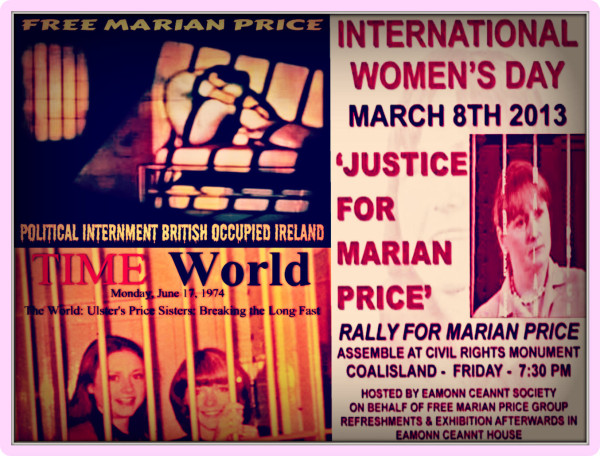
INTERNATIONAL WOMEN'S DAY MARIAN PRICE RALLY


Marian Price Rally Friday the 8th of March 2013

A Rally in Coalisland on International Women’s Day the 8th March, will be held at the Civil Rights Monument, Main Street at 7.30pm. 


There has been considerable British disinformation, with regard to this event, to confuse and divide supporters of Marian, who has been politically interned without trial (as far as her lawyers are aware) for almost two years in British Occupied Ireland. 

She will be spending her second International Women’s Day, in an isolated hospital unit, after previously tortured in solitary confinement. She was also  previously on a hunger strike, that lasted over 200 days, being force fed for 167 of them.

Put aside party politics, whether you are woman, child or man, show your solidarity with Marian Price, with one United Irish and female International voice on International Women's Day, FREE MARIAN PRICE NOW !. 

The rally is organized by the non-aligned Free Marian Group in Coalisland, who will also hold an exhibition afterwards, to pay tribute to all women who suffered injustice, degradation and denigration as Irish republican prisoners of British colonial occupation.

For people travelling to Coalisland from Belfast, a bus will leave Conway Mill at 6 pm.


ALL International Support ! regardless of sex, race, creed or political party are very welcome !


Marian Price Mural on International Wall Belfast

Bradley Manning Tells Court Public Have the Right to Know About US War Crimes


Bradley Manning Tells Court Public Have the Right to Know About US War Crimes


More at The Real News

Thursday, February 28, 2013

BANKSTERS REILLY HEALTHCARE


Yesterday after the Department of Health announced it was scrapping disabled mobility allowances, Minister for Health, James Reilly experienced some mobility issues himself, when inspecting a brand new, private, state-of-the-art mental health facility, situated on the old Grangegorman site in Dublin, which used to serve over 2,000 patients. 
Dr Reilly with his Minister of State Kathleen Lynch, were trapped when their lift jammed. The media in the lobby filmed hospital officials busily trying to open the doors and free Reilly who was on a propaganda stunt,  with a couple of cultivated, chosen, journalists. Other photographers who tried the stairs, hoping to film the flustered Reilly exiting, were quickly  forced back by one of Reilly's heavies forcing them back. After about half an hour the two Government lunatics, were released despite the objections of most ordinary Dubliners who wanted the keys thrown away.
 HSE official Anne O’Connor described Reilly's detention, as a “brief involuntary detention,” while Minister for Health Reilly wanted to know “who is responsible for the lift?." Someone said, that like the Irish State, the lunatics are running the asylum, while another quipped that all these buffoon, fat bastard, Irish Ministers, Reilly, Cowan, Harney, Gilmore, etc. etc.are just City of London bankster floozies and fall guys.


Britain is to challenge an EU agreement to slash bankers' bonuses at a meeting of European finance ministers next week after Boris Johnson condemned the proposal as a "deluded measure".
Amid fears that the EU agreement could deal a hammer blow to the City of London, David Cameron said EU regulations needed to be flexible enough to allow international banks to operate in Britain and the rest of the European Union.
George Osborne or the Treasury minister Greg Clark will represent Britain at the meeting next week to relay what No 10 described as real concerns about the proposal.
The agreement in Brussels came as the Royal Bank of Scotland posted losses of more than £5bn after paying out more than £600m in bonuses. No 10 said it had imposed cash limits of £2,000 on bonuses at RBS and Lloyds and was giving a greater say to shareholders in all banks.
The prime minister's spokesman said: "Bonuses are very significantly down on where they were in 2010. So you are seeing real responsibility and restraint."
Johnson highlighted deep British unease about the bonus agreement hammered out in Brussels on Wednesday night between officials from the EU's 27 member states, MEPs and the European commission by dismissing it as the most preposterous idea in Europe in two millennia. Under the agreement, bankers' bonuses would be capped broadly at a year's salary, although they could be doubled if a majority of shareholders agreed.
The London mayor said: "People will wonder why we stay in the EU if it persists in such transparently self-defeating policies. Brussels cannot control the global market for banking talent. Brussels cannot set pay for bankers around the world.
"The most this measure can hope to achieve is a boost for Zurich and Singapore and New York at the expense of a struggling EU. This is possibly the most deluded measure to come from Europe since Diocletian tried to fix the price of groceries across the Roman empire."
Diocletian, the 51st Roman emperor, introduced the edict on maximum prices in AD 301.
The prime minister made clear the government's unease at a meeting of Nordic leaders in the Latvian capital of Riga. "We do have in the UK – and not every other European country has this – we have major international banks that are based in the UK but have branches and activities all over the world, and we need to make sure that regulation put in place in Brussels is flexible enough to allow those banks to continue competing and succeeding while being located in the UK. So we'll look carefully at what the outcome of the negotiations was before working out the approach we'll take at Ecofin [the meeting of EU finance ministers] next week."
Downing Street made clear Britain was prepared to water down the proposal at the meeting, though any final decision will be made by qualified majority voting in which no member state has a national veto.
Cameron's spokesman said Britain had taken important steps to rein in remuneration, such as deferred payments, which has seen £300m clawed back from Barclays bonuses and 3,000 RBS employees also experiencing "clawback" as a result of the Libor investigations.
He said: "The UK believes it has some of the toughest remuneration requirements in the world. They are incentivising long-term behaviour – the idea of deferred payments, with a significant proportion in shares that can be clawed back over a period of time. At the heart of this is aligning the incentives with long-term performance and stability.
"Alongside that we of course also want a successful financial sector in the UK. There are very successful UK-based firms that compete across the world. They are an asset to the UK. When we are looking at what further regulations may be appropriate we will want to consider the impact on competitiveness.
"This idea of a cap – one of the things we have been pointing out as a potential consequence of this type of approach, if you cap variable pay – bonuses – you can see big increases in basic pay. And of course basic pay is not subject to clawback because it is paid out straight away."
Cameron said Britain was taking a responsible approach because it was implementing the Vickers proposal to ringfence the retail side of banks away from the investment side.
"We are absolutely clear that we must be able to implement the Vickers plan in the UK, which in some ways is tougher than regulations that are being put in place in other European countries. We want to have this proper ringfence between retail banks and investment banks, and the rules must allow that to happen – I think that is very important."
The spokesman added: "We do continue to have real concerns about them [these proposals] and we will continue to be discussing them with EU partners in the coming days ahead of the Ecofin."


Irish Hospitals to Lose Wards and Staff in €721m HSE Cuts


Major changes to small hospital services and a massive reduction in staff numbers are outlined in a series of HSE plans aimed at reducing health spending by €721 million this year.
PAUL CULLEN, Health Correspondent
The cuts include the closure of Mallow General Hospital’s emergency department, with emergency surgery being moved to Cork University Hospital. Also in Co Cork, the casualty unit at Bantry General Hospital will be replaced by a 12-hour urgent care centre operating seven days a week.
The plans confirm the HSE’s intention to shed almost 4,000 posts this year, although some regions warn this target may be difficult to achieve. Some 750 posts are to go in Dublin North-East and more than 1,300 in Dublin Mid-Leinster.
Plans to remove medical cards from 40,000 people are also confirmed; this will be achieved by changing eligibility limits in a way that has yet to be announced.
However, the HSE is providing for an overall increase of 60,000 in the number of medical cards issued because of high unemployment and demographic changes.
Minister for Health James Reilly said it was clear that the cost of services had to be cut in the current economic climate.
“I think you’ll find that the new regional budgets will have a lot of positive news in them for the regions,” he told reporters in Dublin yesterday. “I think the way that the new budget has been done has protected a lot of the services that we need to protect.”
Regional plans 
The proposals are outlined in four regional plans, three plans for hospital groups and a national operational plan published by the HSE yesterday. Politicians and other interests in each region were briefed before publication.
According to the national operational plan, the extension of free GP care to people with long-term illnesses, which was promised in the first year of Government, may not now happen until the end of the year. Some €383 million is to be cut from the budget for community schemes such as medical cards.
The document also says “alternative options” will be identified for dealing with low-urgency 999 ambulance calls. Cost savings of €2 million will be sought from the ambulance service through new rosters and the elimination of “cost-ineffective” work practices.
In mental health, 102 acute inpatient beds will be closed, although inpatient services for children and adolescents are being increased.
Capital projects 
Among the capital projects due to be completed this year are a 44-bed psychiatric unit at Beaumont Hospital and accommodation for 54 residents at Grangegorman.
Sinn Féin health spokesman Caoimhghín Ó Caoláin TD said “no amount of spin” from the HSE in the regional plans could hide the fact of €721 million in cuts.
In his own area, HSE Dublin North-East, staff numbers were being cut by 750 and nursing home beds by 55, he said.
The regional plans commit the HSE to implementing the small hospitals framework, which is expected to lead to further rationalisation of acute services in smaller hospitals.

Bernadette Devlin McAliskey to Stand ?


End Impunity! from Spartacus on Vimeo.

There is considerable speculation that Bernadette Devlin McAliskey will stand for the mid-Ulster constituency to challenge the British Government of DUP/PSF in Occupied Ireland. Below is a  C.V by Wikipedia of Ms. Devlin McAliskey.


"Bernadette Devlin McAliskey

From Wikipedia, the free encyclopedia
Bernadette Devlin McAliskey
A mural by the Bogside Artists in Derry's Bogside, depicting Devlin
Member of Parliament
for Mid Ulster
In office
1969–1974
Preceded byGeorge Forrest
Succeeded byJohn Dunlop
Majority18,213
Personal details
Born23 April 1947 (age 65)
CookstownCounty Tyrone, Northern Ireland
NationalityIrish
Political partyIndependent (1970-1974),
(1976-1977),
(1978-present)
Other political
affiliations
Unity (1969-1970),
Independent Socialist Party (1977-1978),
Irish Republican Socialist Party(1974-1976)
Spouse(s)Michael McAliskey
ChildrenRóisín Elizabeth McAliskey
Deirdre McAliskey
Alma materQueens University of Belfast
Josephine Bernadette Devlin McAliskey (born 23 April 1947, in County Tyrone, Northern Ireland), usually known as Bernadette Devlin or Bernadette McAliskey, is an Irish socialist and republican political activist and former militant. She served as a British Member of Parliament from 1969 to 1974 for the Mid Ulster constituency. She lost her seat to John Dunlop of the then-Vanguard Progressive Unionist Party, after coming third in a four-sided contest in the general election of February 1974.[1]

Contents

  [hide

[edit]Political beginnings

1970 newsreel film about the Ulster conflict featuring Bernadette Devlin
Devlin was born in Cookstown, County Tyrone and raised as a Roman Catholic. She attended St Patrick's Girls Academy inDungannon.[2] She was studying Psychologyat Queen's University Belfast in 1968 when she took a prominent role in a student-ledcivil rights organisation, People's Democracy.[3] Devlin was subsequently excluded from the university.[3] She stood unsuccessfully against James Chichester-Clark in the Northern Ireland general election of 1969. When George Forrest, the MP for Mid Ulster, died, she fought the subsequent by-election on the "Unityticket, defeating a female Unionist candidate, Forrest's widow Anna, and was elected to the Westminster Parliament. At age 21, she was theyoungest MP at the time, and remains the youngest woman elected.[3]
Devlin stood on the slogan "I will take my seat and fight for your rights" – signalling her rejection of the traditional Irish republican tactic of abstentionism (being absent from Westminster). She made her maiden speech on her 22nd birthday, within an hour of taking her seat.[4]

[edit]The Troubles

[edit]The Battle of the Bogside

After engaging, on the side of the residents, in the Battle of the Bogside, she was convicted of incitement to riot in December 1969, for which she served a short jail term.[5] After being re-elected in the 1970 general election, Devlin declared that she would sit in Parliament as an independent socialist.[6]

[edit]Bloody Sunday

Having witnessed the events of Bloody Sunday, Devlin was infuriated that she was later consistently denied the floor in Parliament, despite the fact that parliamentary convention decreed that any MP witnessing an incident under discussion would be granted an opportunity to speak about it therein.[7]
Devlin slapped Reginald Maudling, the Home Secretary in the Conservative government, across the face when he stated in the House of Commons that the Paras had fired in self-defence on Bloody Sunday.[3] She was suspended from Parliament for six months as a result of the incident.[8]

[edit]IRSP

McAliskey helped to form the Irish Republican Socialist Party along with Seamus Costello in 1974.[citation needed] This was a revolutionary socialist breakaway from Official Sinn Féin and paralleled the Irish National Liberation Army's split from the Official Irish Republican Army.[9] She served on the party's national executive in 1975, but resigned when a proposal that the INLA become subordinate to the party executive was defeated.[10][dead link] In 1977, she joined the Independent Socialist Party, but it disbanded the following year.[11]

[edit]Support for hunger strike prisoners

She stood as an independent candidate in support of the prisoners on the blanket protest and dirty protest at Long Kesh prison in the1979 elections to the European Parliament in Northern Ireland, and won 5.9% of the vote.[12] She was a leading spokesperson for the Smash H-Block Campaign, which supported the 1981 Irish Hunger Strike in 1980 and 1981.

[edit]Injured in loyalist shooting

On 16 January 1981, she and her husband were shot by members of the Ulster Freedom Fighters, who broke into their home inCoalislandCounty Tyrone.[13][14] The gunmen shot McAliskey a total of seven times in front of her children.[15] British soldiers were watching the McAliskey home at the time, but failed to prevent the assassination attempt.[3][16] An army patrol of the 3rd Battalion, The Parachute Regiment heard the shots and rushed to McAliskey's house. The paramilitaries had torn out the telephone and while the wounded couple were being given first aid by the troops, a soldier ran to a neighbour's house, commandeered a car, and drove to the home of a councillor to telephone for help. The couple were taken by helicopter to hospital in nearby Dungannon for emergency treatment and then to the Musgrave Park Hospital in Belfast under intensive care. Three attackers, including Ray Smallwoods, captured by the army patrol, were subsequently jailed.[17][18]

[edit]Dáil Éireann elections

In 1982, she twice failed in an attempt to be elected to the Dublin North–Central constituency of Dáil Éireann.[19]

[edit]Denied entry into the US

In 2003, she was barred from entering the United States and deported on the grounds that the State Department had declared that she "poses a serious threat to the security of the United States"[20], — apparently referring to her conviction for incitement to riot in 1969 — although she protested that she had no terrorist involvement and had frequently been permitted to travel to the United States in the past.[20][21][22]

[edit]Personal life

In 1971, while still unmarried, she gave birth to a daughter Róisín.[3] This cost her a great deal of support in Roman Catholic areas.[23]She married Michael McAliskey on 23 April 1973, which was her 26th birthday.[citation needed]
On 12 May 2007, she was guest speaker at éirígí's first Annual James Connolly commemoration in Arbour Hill, Dublin.[24] She currently coordinates a not-for-profit community development organisation based in Dungannon, the South Tyrone Empowerment Programme,[25]and works with migrant workers to improve their treatment in Northern Ireland.[3]
In 1969 director and producer John Goldschmidt made the documentary film Bernadette Devlin for ATV, which was shown on ITV and on CBS's 60 Minutes and included footage of Devlin during the Battle of the Bogside. Another documentary, Bernadette: Notes on a Political Journey, directed by Leila Doolan, was released in 2011.[26] At the 2008 Cannes Film Festival a biopic of Devlin was announced,[3] but Devlin stated that "[t]he whole concept is abhorrent to me" and the film was not made."