
UNA MULLALLY
FOR DECADES, much of the emphasis on the Irish language in the arts has been about preservation. But things are changing. The Irish language in contemporary arts is spreading beyond Gaeltacht areas and reaching new collaborators and a new generation.
This rather accidental movement might also in time call for new structures and organisations, but for now, the fragmented innovations seem to indicate that something more whole is happening.
Imram, the Irish-Language Literature Festival takes place from October 11th to the 20th, and offers a dynamic programme. There are familiar names participating: Louis de Paor, Dairena Ní Chinnéide, Micheál Ó Conghaile. And there are familiar names discussed: Pádraic Ó Conaire and Seán Ó Ríordáin among them. But there is a current of energy flowing through the festival that those used to the traditional narratives of the Irish language in the arts might be surprised by.
There is an indoor and outdoor multimedia installation by Ceaití Ní Bheildiúin; a dance piece called Ré written by Daithí Ó Muirí and choreographed by Fearghus Ó Conchúir; contemporary prose from Éilís Ní Anluain; the Mouth On Fire theatre company reading Beckett’s poetry in Irish; The Cohen Project sees poets Liam Ó Muirthile and Gabriel Rosenstock translate some of Leonard Cohen’s work into Irish, with Liam Ó Maonlaí, David Blake, Hilary Bow and the Brad Pitt Light Orchestra providing the music.
“I’m a great believer in pushing the boundaries of language, it has to reach out beyond the island,” Ó Muirthile says. “There are obviously problems, technical questions, issues of readership and literacy and these are huge issues, but when you’re engaged in a piece of work, you have to set those aside. The advantage of taking a model like Cohen is when you’re writing in Irish or any minority language, you’re constantly translating into that language. You’re going through a constant process of translation of all sorts.”
Ó Muirthile also has high praise for his collaborator. “Gabriel Rosenstock has been the great innovator in Irish in that he’s been searching for models outside the language for many years. And Gabriel is the great inspiration model for all of us.”
Next week, a two-day symposium is being held in Dublin aiming to “explore, challenge and provoke notions of contemporary arts practice in Irish.” The symposium, titled Fás agus Forbairt’ (Grow and Develop) is hoping to bring together contemporary artists who are currently working in Irish and artists who may speak Irish but whose work is in English.
“The intention is that three organisations who have an active interest in programming contemporary work in the Irish language come together to provide support to artists who are already working in the Irish language, and to artists who may not be, but who might speak Irish,” says Róise Goan, the director of the Dublin Fringe Festival. Cian O’Brien, artistic director of Project Arts Centre, and Niamh Ní Chonchubhair, the programme manager at Axis: Ballymun, have joined Goan in organising the conference. “We’re hoping to connect all those artists, hopefully provide inspiration and then pilot a commissioning scheme that promotes collaboration in making contemporary Irish arts.”
The organisers are hoping to award three commissions, which will then go on to showcase works in progress in March 2013 during Seachtain na Gaeilge. “Hopefully, if the projects are going somewhere interesting, they will present that work in the Fringe next year,” Goan says. “We don’t know what’s going to happen. It’s an experiment, but we feel it’s a worthwhile experiment. I think a lot of the problems come from the fact that in terms of mainstreaming Irish language arts, things need to be tried and tested.”
Ray Yeates, then the director at Axis in Ballymun and now Dublin City Council’s arts officer, blasted the sean nós form open in 2009 with Hip-Nós, performances of hip-hop, sean nós and spoken word in Axis that went on to Vicar Street.
“You have great people like Róise Goan, and Ray Yeates and Willie [White, director of the Dublin Theatre Festival] – they’re the next movement,” says Maggie Breathnach, the producer of TG4’s flagship arts programme Imeall, who spends most of her time running around the country surveying the frontlines of contemporary Irish arts.
“Arts is niche, Gaeilge is niche, and ultimately, you need to put bums on seats. They’re doing it slowly, but it’s happening. You see in schools now, it’s a string to your bow to have Irish in a way it didn’t used to be. It’s not necessarily that you’re going to automatically see an Irish play if you speak Irish, or go to a launch of an Irish book, but there is work in Irish, there is funding there, and people are taking the opportunities. But ultimately, the bigger stage is perceived to be the English language.”
Breathnach believes changing the perception of the Irish language in a contemporary arts setting should start at an early age. “In education, maybe it should start to be the case that kids are also educated in the language in an arts context and would then be interested in going to an Irish play. And you go to a play because of the quality of the play not the language. Look at Tromluí Phinocchio.”
Tomluí Phinocchio or Pinocchio – A Nightmare is a production by Moonfish Theatre that was lauded at this year’s Absolut Fringe and also showed at the Galway Theatre Festival. “Those girls are brilliant,” Breathnach says. “There’s really good stuff happening, but sometimes people think either they won’t go to something because ‘it’s an Irish show’, or if they are going, it’s ‘ar son na cúise’ [for the cause], so we need to show that there is a pincer movement that catches both the Irish language and quality.”
In music, the Kilas and the Ó Maonlaís were flying the flag for Irish-inflected contemporary music from the 1990s on, and that’s still the case. The annual Seachtain na Gaeilge Ceol compilation CDs feature contemporary Irish artists singing Irish-language versions of their songs. While the overall result might be nice, there’s a sense of tokenism about it, even if, on occasion, these songs are occasionally brought to a live setting.
But things are changing. Temper-Mental MissElayneous, an upcoming Dublin rapper, has a tendency to drop Irish rhymes into her raps accompanied by bodhrán instead of beats, namely with her track Cailín Rua. And Daithí, a Clare fiddle player who has managed to successfully fuse traditional strains with contemporary electronic music, recently sampled the singer Mary O’Hara in one of his tracks, a trick last pulled by Massachusetts band Passion Pit in their break-out single Sleepyhead.
From the Puball Gaeilge tent at Electric Picnic to Manchán Mangan’s theatre work, there is an edge to the Irish language in a contemporary artistic context, and that edge is growing as those in charge of funding continue to quietly seek out more non-traditional targets. But a new generation of artists also need to take the leap. Perhaps next week’s Fás agus Forbairt symposium will put a real structure around such tentative, yet quickening steps.


 Tuesday October 09, 2012 07:46
 by BrianClarkeNUJ - AllVoices



 printable version


 Digg this
 del.icio.us
 Furl
Furl Reddit
 Technorati
 Facebook

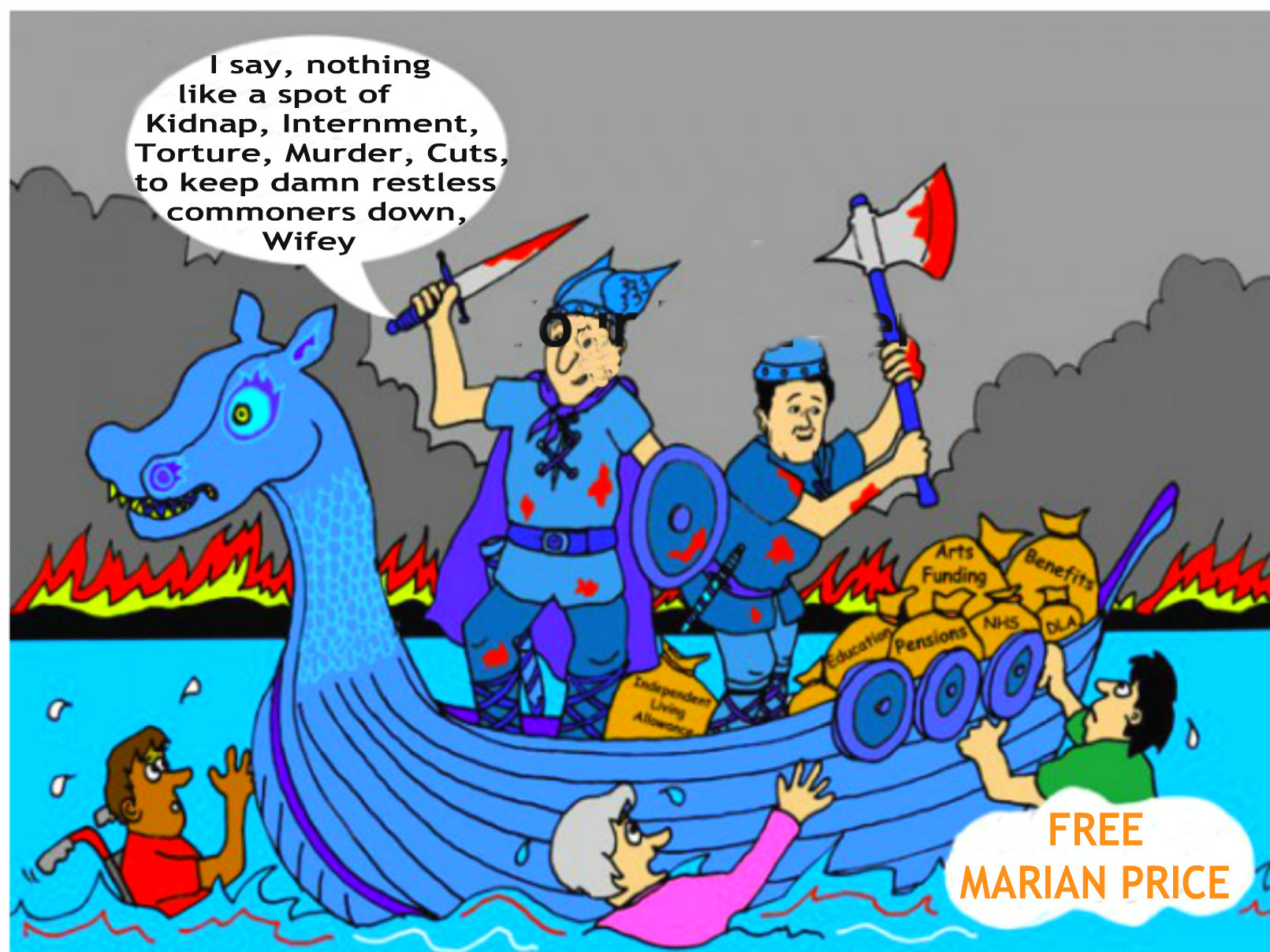
Marian Price was experimented on for almost six months force feeding conducted on her, along with a further year of sensory deprivation experiments, in British Occupied Ireland, is close to death. Marian rather than being "on licence" as per British spin doctors and media, actually received a full royal pardon, the Royal Prerogative of Mercy. Viceroy Paterson's claimed that this document, which would set Marian free, was either lost or shredded after she and her sister Dolours, were force-fed for 167 days, in a practice that is widely recognized as inhumane.
'The conference of the three Beings was taking place in a dimensionless space, the spaceless set of dimensions somewhere near the third planet of a small solar system dominated by a type-G star. The organization which they represented he would later call the Earth Coincidence Control Office (ECCO).'
Speaking in an interview afterwards, Marian said of her ordeal:
“Four male prison officers tie you into the chair so tightly with sheets you can’t struggle. You clench your teeth to try to keep your mouth closed but they push a metal spring device around your jaw to prise it open. They force a wooden clamp with a hole in the middle into your mouth. Then, they insert a big rubber tube down that. They hold your head back. You can’t move. They throw whatever they like into the food mixer – orange juice, soup, or cartons of cream if they want to beef up the calories. They take jugs of this gruel from the food mixer and pour it into a funnel attached to the tube. The force-feeding takes 15 minutes but it feels like forever. You’re in control of nothing. You’re terrified the food will go down the wrong way and you won’t be able to let them know because you can’t speak or move. You’re frightened you’ll choke to death.”
'The First Being speaks: "We are meeting at this particular space-time juncture in order to review the evolution of a vehicle that we control on the planet Earth. She is at another transition point in her training. We need to review what she has done, what she is thinking, what her motivations are. We must determine what the future of her mission can be within the evolutionary speed limit allowed the humans on that planet."
Second Being: "You, the First Being, and I, the Second Being, have been controlling the coordination of coincidences of this agent on Earth. I feel it is important that we state all of this very clearly for the benefit of the Third Being, who has been responsible for that human agent. It is important that she not exceed the evolutionary speed limit at this particular time; however, we realize that there is a certain discrepancy existing among the humans, that their evolution is proceeding extremely rapidly in certain areas and is going backward in others. It is the purpose of this conference among the three of us to make sure that the Third Being controls her so that she stays within certain wel]-defined limits and avoids the kinds of catastrophes certain other agents of ours have experienced on that planet. Let us listen to the report of the Being who has been in charge of the vehicle on the planet." '
Pat Ramsey, a Social Democratic and Labour member of the Occupied Ireland Assembly, wrote to Paterson about this "lost" pardon. He asked:
-- Where would Mrs. Price-McGlinchey's pardon have been held?
-- How many staff are currently seeking the document and in what departments?
-- Are those looking for it doing so on a full-time basis, if not, why not?
-- Has the Northern Ireland Office received comment from the judiciary on the apparent loss of the document?
-- How many Royal Prerogative's have been lost (or destroyed) that the government has record of?
-- Who is ultimately responsible for the care and maintenance of the building where these documents are kept?
-- What communication [has Paterson] personally had with this person/Department?
-- Can [Paterson] confirm the Department is still seeking the document and will do so until it is found?
Paterson contemptuously dismissed Ramsey's inquiry, stating that "unfortunately the RPM (Royal Prerogative of Mercy) was not recovered but had "no bearing on current circumstances." before he was abruptly moved back to London and replaced by Viceroyal Theresa Villliers? Paterson had placed himself above the British Occupied Ireland Assembly, which was supposedly elected to govern British Occupied Ireland, just as he had previously overruled the judiciary. Two judges ruled that Marian Price should be released on bail but again he overruled them, it appears Viceroyal Villliers his successor will also ignore and override the courts as well and is also a law unto herself with the kidnap of Marian. The following is a presentation of the facts as concisely and accurately as possible.
'Third Being: "Currently my agent is in a quandary. I need this conference to know in what direction she is to move next. The vehicle that she inhabits is now in a deep trance state and is willing to share with us the sources of this quandary.
"As you both know she has a carefully constructed cover story in which she has invested a good deal of time, effort, and training. All three of us are well acquainted with the rather arduous steps that he has been taking in her human form. There have been many times when she has lost contact with me, has repressed her knowledge of me, and has had to be guided through her unconscious mind. There were times when she had too much knowledge of me, necessitating repression so that she could continue to function as an acceptable human being in the society in which she lives. Her main worry at times was being made persona non grata by her fellow humans in various fields of endeavor. "She went through a process which humans call psychoanalysis. Psychoanalysis to us is a means of educating humans in how to remain human, at the same time keeping sufficient independence of that state so as to be aware of our existence. Psychoanalysis also furnishes the human agents with the current rationalizations and basic assumptions upon which humans operate. It helps them develop their cover story so that they will not reveal our existence or our influence. It allows them to reconstruct their past history and understand it in terms of the present human society.'
Back to Wacky British Occupied Ireland Again ...
'In May 2011, Marian Price was taken to Maghaberry high security prison (an all-male prison) and was placed in solitary confinement, where as a result of holding up a piece of paper or statement on a windy day, at a traditional Irish Easter republican ceremony which was read aloud by a masked man, she was accused of, ‘encouraging support for an illegal organisation’. Marian has now been interned for 17 months, during which time neither her lawyers, or Marian have been allowed to see any of Britain's ‘alleged’ evidence.
• She has been kept in solitary confinement in a ‘male’ high security prison
• She is effectively interned without a trial, sentence, or release date.
• She has not been given any timescale for any investigation.
• She has not been allowed to see the evidence that the state claims to have
• Her release has been ordered on two occasions by judges. However, on both occasions the secretary of state has overruled those decisions.
• The secretary of state claims he has ‘revoked Marian’s license’. This is despite Marian never being released on license. She was given a Royal Pardon.
• Marian’s Royal Pardon has ‘gone missing’ from the home office (the only time in history). The secretary of state has taken the view that unless a paper copy can be located – it must be assumed that she does not have one.
• Despite no ‘license’ existing for her release from prison in 1980, it is the non-existent license that is being used to keep her in prison.
• She can only be released by Theresa Villiers the current Secretary of State responsible.
The last time Marian appeared in court the charges against her were thrown out of court for lack of evidence by a Judge and now the very same charges have been re-instated against Marian again !
"In her brain research she has discovered the difference between small brains (monkeys) and large brains (human and dolphin). She has realized that in order to do research on the brain and the mind, she must work in an institution which she herself controls, insofar as is possible in the current human reality. She sees that human society interacts with her in a way that allows certain areas of research and not others. She realizes that the laboratory work in relation to the isolation tank is difficult to support. She has learned that the brain work can be supported openly and that the tank work must be done covertly. As long as the tank work was done in solitude, she was unimpeded in the directions in which she could carry it. "She is becoming aware of the political and social realities of what she is doing. Her mission to thoroughly investigate the brain with thousands of electrodes and with feedback between her own brain and its recorded activity has implications which she knows she cannot reveal at the present state of development of the human species. Her analyst taught her to look more critically at this particular aspect of her mission. Her work for the last five years has been in the direction of perfecting electrodes so that he can use them safely in his own brain. He found on monkeys and dolphins that this was not a safe procedure. The brain sections revealed damage along every electrode track to the extent that she would not wish to insert electrodes into herself or another human.'
The incarceration and experiments on Marian Price is clearly internment without trial and torture, which has been applied to several other traditional Irish republicans of political conscience, who do not accept British Occupation of Ireland. Many seasoned political observers of previous political internment in Ireland, where the British were found guilty of Sensory Deprivation torture by the International Court of Human Rights in Strasbourg previoulsy, have been baffled, at the ridiculous lengths the British have gone, to keep a 58 year old woman interned, who is close to death, in extreme pain, too old as she has said herself, to be of any threat to the British. Why ?
There are number of links below that may explain this, albeit again, as any seasoned observer of British Occupied Ireland where the truth is often stranger than fiction. Internment without trial like many aspects of the British occupation over the last forty years, has largely being a further experimental exercise by the British military and their secret services in their Imperial evolution with research for a new hegemony.
' "From her interactions with the government agency in which she she refuses to work, she finally realizes that the isolation tank gives her more information in more dimensions than can be absorbed by those in control.
"She now wishes to abandon the study of electrodes. They are too damaging to brains. She wants to pursue other methods not including brain electrodes or damage to either her own brain or monkey or dolphin brains." '
There is an old cliche 'Too much of a good thing may be bad." When there is excess within the whole, an imbalance develops, and health problems arise. This applies to things as simple as food, alcohol, drugs and in relation to the subject addressed here Sensory Deprivation
Sensory Deprivation and torture experiments, have been conducted by the British, since internment in 1971 was introduced in Ireland. “Segregation, isolation, separation, cellular, lockdown, Supermax, the hole, Secure Housing Unit… whatever the name, solitary confinement should be banned by States as a punishment or extortion technique,” UN Special Rapporteur on torture Juan E. Méndez told the General Assembly’s third committee on 18 October 2011, saying the practice amounts to torture.
' "Her work to date with dolphins has convinced her that they are quite as intelligent, quite as ethical, quite as sentient as humans................" '
Bearing the above in mind and to finish the story, I ask you to look at number of links below some of which you may be very familiar including an article I wrote last week, other somewhat bizarre you may not. I believe they are highly relevant not just in the context of Marian Price but with the introduction of secret courts, trials and the introduction of internment in England itself where like Marian the victims will not be allowed to see or have knowledge of any evidence against them and where they are presumed guilty on the heresay of a bureaucrat with a vested interest in internment.
Everything You Ever Wanted to Know about Sensory Deprivation Tanks
FIRST CONFERENCE OF THREE BEINGS
Marian Price Suffered Enough
#freemarianprice