Iceland’s Economy now growing faster than the U.S. and EU after arresting corrupt bankers
So Iceland decided not to follow the rest of the world by bailing out the bankers. Instead, they chose to arrest them. Now their economy is recovering faster than the EU and the United States. Hmmmm.
Remember when the United States government told the American people that immediate action was required to save the banks, and save our nation from complete collapse? An action in the form of Billions of dollars of National Debt? Yeah, we remember that! Now Trillions of dollars in National debt later, we are in the same position we were in 4 years ago, just more debt. As a matter of fact Federal Reserve Chairmen Ben Bernanke has called for yet another stimulus that will add more debt onto the mountain we already have.
At the start of the world wide 2008 economic collapse, Iceland was in worse shape than almost any other country in the world. Now they are one of the fastest growing economies in the world.
Imagine what America would be like today if we bailed out the victims of poor banking practices, while punishing the bankers who were responsible?
After watching this video tell us what you think? Was Iceland off their rocker for sending the bankers to jail, or on to something that America should have done as well?
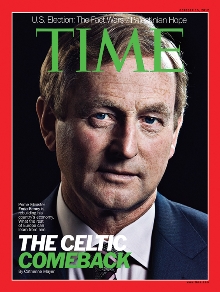
That pat on the back to our "glorious leader Enda" in Time Magazine fails to come to terms BIG TIME with the reality on the ground here in Ireland.
Just in case you have forgotten what has happened to all of us since Enda and Eamonn got in power:
More than 400.000 thousand people on the live register.
Thousands of people migrating to Australia and Canada and many other places each month.
Cuts to the weakest groups in our society, people with special needs, carers, basically people without voice in our society because of their small numbers.
Cuts on salaries and pay freezes.
Increases in direct and indirect taxes plus introduction of HOUSEHOLD TAX and WATER Charges coming up soon.
Demolition of the Health system.
Introduction of Students fees.
Increase in suicides
Increase in alcoholism, drugs intake and homelessness.
Soup kitchens and charities are under pressure trying to cope with the vast amount of the new homeless and the poor.
I suppose now its pretty obvious why Enda is at the cover of TIME magazine!
Yes. It's because the Elite who have wanted to do all these things for ages want to reward Enda for selling out his own people so very efficiently into serfdom.
The excerpt just below is from an e-mail sent yesterday to Prime Minister Enda Kenny TD:
"Finally, I would like to remind you that -- as I tried to stress to you and your colleagues this morning -- I am very firmly convinced that my particular case represents just a very, very tiny proportion of the overall 'government corruption, crime, cover-ups, and impunity' phenomenon which I believe -- as a direct result of my own completely independent, lengthy, and ongoing investigations (since mid 1998) into such matters -- continues to run completely wild, and to be more or less totally and dangerously out of control in many important respects at the present time: from the viewpoint of humanity as a whole."
The great only appear great because we are on our knees.
Let us rise.- Connolly - Eirigi !
It is worth remembering that both the influence of Connolly and the part that Labour played in the Irish National Revolution ensured that the Democratic Programme of the Irish Republic, agreed at the first sitting of the first D·il (Irish Parliament) on January 21st 1919, read:
We declare in the words of the Irish Republican Proclamation the right of the people of Ireland to the ownership of Ireland...we declare that the nation's sovereignty extends ..[to] all its resources, all the wealth and all the wealth-producing processes within the Nation, ... declare it is the duty of the Nation that every citizen shall have opportunity to spend his or her strength and faculties in the service of the people. In return for willing service, we, in the name of the Republic, declare the right of every citizen to an adequate share of the Nation's labour...
It shall also devolve upon the National Government to seek ... a standard of Social and Industrial Legislation with a view to a general and lasting improvement in the conditions under which the working classes live and labour...
We declare and we desire our country to be ruled in accordance with the principles of Liberty, Equality, and Justice for all...
If this seems radical the draft democratic programme was more so. It included the passage:
It shall be the purpose of the Government to encourage the organisation of the people/citizens into Trade Unions and Co-operative Societies with a view to the control and administration of the industries by the workers engaged in those industries.18
These passages from one of the founding documents of the Irish Republic give an indication of the revolutionary intentions of many republican activists during the Irish National Revolution, a revolution that involved widespread working class militancy with Soviets being declared in Cork and Limerick and workers frequently seizing their workplaces. All this when 5 years previously the seeds of a socialist movement scarcely existed in Ireland!
This shows how close Ireland came to the Social Revolution that Connolly dreamed of and gave his life for. This revolution can't be achieved by means of a lobby, or a parliament or a coup d'etat. This revolution will only be achieved when the ordinary people of the world, us, the working class, get up off our knees and take back what is rightfully ours; namely, everything.
(1) Evict the corrupt Fianna Fáil/Green Party/Progressive Democrat Government!
(2) Stop the bail out of the banks. Let them go bankrupt and let the depositors secure what they can of their savings. The duty is on government to protect the small investors.
(3) Jail those who got us into this situation. That includes bankers and property sharks irrespective of which of them is a relative or a friend of a politician.
(4) Instead of bailing out banks invest the money in productive industry under either public or communal management.
(5) Purchase the property on the bank books at minimal cost or seize it outright and give it to local authorities to meet housing need.
(6) Announce a national emergency and get communities to organise now for food security and to agree carbon descent planning.
(7) Nationalise the Corrib and all carbon reserves and invest heavily in Wind Energy production units along the northwest coast.
(8) Employ unemployed construction workers in building canteens in all Irish schools and infrastructure to deal with the coming environmental crisis.
(9) Harmonise VAT on an all-Ireland level to prevent distortions in the national economy – this will be likely revenue neutral.
(10) Raise a wealth tax to pay for any shortfall in public finances and plan towards paying off the national debt altogether.
Does this appear eminently sensible? It is. It's not an explicitly marxist solution but that is not what is needed right now and cannot be promoted among the people. The reason that even the left are not proposing this minimum programme is their innate right opportunism, their adaption to neoliberalist economic theory and their cooptation within the structures of power.
NAMA is bailout for the greediest and most corrupt – Ó Caoláin
September 17, 2009
Sinn Féin Dáil leader Caoimhghín Ó Caoláin TD has described NAMA as a “bailout for the greediest and the most corrupt in Irish society”. He said the biggest losers would be the unemployed, ordinary mortgage holders and the least well off who will be hit by savage Budget cuts. He called for nationalisation of the main banks and the development of a State bank.
Speaking in the Dáil, Deputy Ó Caoláin said:
“There is no doubt whatsoever about who Fianna Fáil and the Greens are serving with this rotten Bill. It is a bailout for the greediest and the most corrupt in Irish society – the bankers and the speculators whose boundless avarice has devastated the Irish economy.
“Throughout the Celtic Tigers years, Fianna Fáil-led Governments pampered this elite group. They allowed them to benefit from massive tax breaks at unknown cost to the State. They allowed them to determine the State’s housing policy – a policy which was no policy but to let the market drive everything. And boy did that market drive. It drove property prices to unreal and unsustainable levels.
“It drove a frenzy of greed for profitable property, inducing many who could not afford to do so, to borrow to buy in the grossly inflated market. It drove debt to levels previously unknown in this country. It was fuelled by cheap loans supplied by a banking system corrupted by the culture of greed that saw massive salaries, bonuses and perks lavished at all senior levels in the financial institutions. And finally the locomotive was driven into a wall and we are now left to deal with the train wreck that is the Irish economy.
“Who are the biggest losers in all of this? Not the bankers and the property speculators who did the crime because they will never do the time. Not the politicians who facilitated them because no-one in Fianna Fáil or the PDs and now the Green Party ever admit any responsibility for anything and they are never made to pay the price for their disastrous policies and disastrous management.
“No, the real losers in all of this are over 400,000 unemployed people in this State, they are the families saddled with massive mortgages, many of whom are being evicted from their homes, they are the people who never had the chance of a decent home during the Celtic Tiger years, they are the weaker sections of the community who are about to be punished most by the savage Budget cuts now in preparation.”
Setting out Sinn Féin’s proposals to address the banking crisis, Deputy Ó Caolain said:
“Sinn Féin believes the only way to deal with the current crisis is to nationalise the two main banks, AIB and BoI, with the potential of turning these two banks into a state bank. This will offer far greater security for the taxpayer. Bad loans can be dealt with in the context of nationalisation and the state can make informed decisions about whether these loans should be foreclosed or managed. We may need to set up a bad bank to deal with the toxic loans within the nationalised system. The government can then decide on a process of recapitalization and restructuring, and deliver the management control that will ensure resumed lending.
“The restructured banking sector envisaged by Sinn Féin goes far beyond just restoring normality to the system. There was nothing normal about a sector that systematically overcharged customers, was complicit in tax evasion and routinely withdrew access to financial services from working class and rural areas because of profit pursuit. As well as intense regulation of the sector, Sinn Féin wants to see a banking system that contributes to the greater good of an economy that serves society as a whole. We also want to see all those who participated in and encouraged the practices that brought about the current crisis held to account and criminal convictions pursued.
“Nationalisation is preferable to repeated recapitalisation, which is excessively costly for the taxpayer yet leaves the government with no real say over how those banks are run. It also deals with any potential losses that could be incurred by the taxpayer, having left the banks in private lands and bought the bad loans off their balance sheets.
“If recapitalisation of a state bank or the nationalised banks is required this could be funded through national bonds which (unlike bank bonds) would be guaranteed. EBS, Irish Nationwide and Irish Life and Permanent must be examined to see if they can function with recapitalisation and the State taking a stake alone or need to have their business wound up and/or transferred to the other two banks.” ENDS
Full text of Deputy Ó Caoláin’s speech follows:
National Asset Management Agency Bill 2009
Caoimhghín Ó Caoláin TD, Sinn Féin Dáil leader
I want to begin by urging the Fianna Fáil/Green Government to do its duty to the people and to make a commitment here and now that if this legislation is passed by the Houses of the Oireachtas it will support a Petition to the President under Article 27 of the Constitution to put the NAMA Bill before the people in a referendum.
by the Houses of the Oireachtas if it “contains a proposal of such national importance that the will of the people thereon ought to be ascertained”. If ever there was such a Bill then this is definitely it.
So here now is the real challenge to Fianna Fáil backbenchers and the Green Party. If the Government will not put this Bill to the people and if you, the backbenchers and the Greens, are as exercised as you claim to be about this Bill then go to the country – either in a referendum on NAMA or pull the plug on this disgraceful, discredited and bankrupt Government and allow the people to vote in a General Election.
The people are watching this debate and they are watching how those they elect are serving them – or if they are serving them at all.
But there is no doubt whatsoever about who Fianna Fáil and the Greens are serving with this rotten Bill. It is a bailout for the greediest and the most corrupt in Irish society – the bankers and the speculators whose boundless avarice has devastated the Irish economy.
Throughout the Celtic Tigers years, Fianna Fáil-led Governments pampered this elite group. They allowed them to benefit from massive tax breaks at unknown cost to the State. They allowed them to determine the State’s housing policy – a policy which was no policy but to let the market drive everything. And boy did that market drive. It drove property prices to unreal and unsustainable levels.
It drove a frenzy of greed for profitable property, inducing many who could not afford to do so, to borrow to buy in the grossly inflated market. It drove debt to levels previously unknown in this country.
It was fuelled by cheap loans supplied by a banking system corrupted by the culture of greed that saw massive salaries, bonuses and perks lavished at all senior levels in the financial institutions.
And finally the locomotive was driven into a wall and we are now left to deal with the train wreck that is the Irish economy.
Who are the biggest losers in all of this? Not the bankers and the property speculators who did the crime because they will never do the time. Not the politicians who facilitated them because no-one in Fianna Fáil or the PDs and now the Green Party ever admit any responsibility for anything and they are never made to pay the price for their disastrous policies and disastrous management.
No, the real losers in all of this are over 400,000 unemployed people in this State, they are the families saddled with massive mortgages, many of whom are being evicted from their homes, they are the people who never had the chance of a decent home during the Celtic Tiger years, they are the weaker sections of the community who are about to be punished most by the savage Budget cuts now in preparation.
All of this need not have happened. There were many of us, including Sinn Féin, who urged a different direction. Trade unionists, people in the community and voluntary sector, other parties of the left, economists with a social conscience urged policies based on the principle of equality and driven by need, not greed.
Over a decade ago, in November 1998, in our Pre-Budget Submission, we in Sinn Féin pointed out that the banks here enjoyed a return on their equity that was double the European average, making them among the most profitable banks in the industrialised world.
We said that ultimately the banks should be nationalised so that the Irish people would be the true beneficiaries. We also proposed an increase in Corporation Tax for Irish retail banks with resulting tax funds earmarked for community and local development projects in the most disadvantaged areas throughout the State.
Of course, instead of this, we saw bank profits continuing to soar, a belated, limited and short-lived bank levy, successive banking scandals which ripped off the customers and the taxpayers and, as we now know, collusion between the banks and the property speculators as they inflated the property bubble.
Now the same corporate criminals are to be bailed out by this Government using the people’s money. That’s what NAMA is in a nutshell. It is supposed to address the crisis caused by a corrupt system but NAMA itself may well turn out to be the source of the next decade’s tribunals.
Higher taxes are coming, something the establishment parties have railed against for years - but they won't be to pay for better public services. They will be disappearing into the NAMA black hole created by a Government refusing to take the obvious step of nationalisation to address the banking problem.
The basic concept of NAMA is flawed and this legislation to introduce it is flawed through and through.
The focus point for most commentators has been the price NAMA will pay for toxic loans it transfers from the banks onto the taxpayers' balance sheet. This is the argument around what discount NAMA should get on the €77 billion worth of bad loans on the banks' balance sheets.
Will the Minister advise the House how much of that €77 billion was used in the actual purchase of sites and land banks and employed in actual development works? In other words how much of this €77 billion is accrued unpaid interest?
The legislation says that for these loans NAMA will not pay current market value - what would be repaid to the banks if the properties the loans are on were sold immediately. Instead it will come up with estimates based on 'long-term economic value'. The moves by ACC Bank against the developer Liam Carroll have actually done the Irish taxpayer a huge service. After being dragged to the courts, Carroll had to admit that if forced to repay his loans he would only be able to repay a quarter of their worth. That is based on the fire sale of his properties at their current market value.
Whatever price is paid for the bad loans, risk will transfer from shareholders and creditors to the taxpayer. This transfer of risk creates a real danger of 'moral hazard' in the future - that is, the banks engaging in risky lending behaviour because there are no consequences.
NAMA is incapable of meeting the twin objectives of achieving the best value for the taxpayer and exposing the taxpayer to the least risk possible. The debt to which NAMA is exposing the taxpayer is €54 billion - a third of our GDP, and that’s before we re-capitalise. And make no mistake about it these financial institutions will need to be recapitalized.
The Irish taxpayers’ expense far exceeds the bank-related debt taken on by Sweden in its bad loan management in the '90s - 8% of its GDP. This will have implications for our sovereign credit rating - we have already been downgraded by several ratings agencies - and will incur increased debt servicing costs, potentially in the region of billions annually.
This legislation contains numerous problems. These include a reliance on the banks acting in 'good faith' to give all the information on the loans to NAMA. The Minister for Finance is to have sole power to appoint NAMA board members. NAMA will be empowered to 'work with developers' to finish projects, potentially lending them taxpayers' money to do so. NAMA will also have compulsory purchase order powers to help developers complete projects if there are so-called 'ransom strips' or contested land in the way. Power is given to the Minister for Finance to overturn 'independent' valuations of loans made by NAMA.
And then there are the operational concerns. NAMA won't have the expertise to reclaim debts, as it is not used to working in this sphere and the staff it recruits may still be loyal to their former bank employers. There is the prospect of developers’ loans being nursed for decades while ordinary loan-holders are forced to pay back their debts or face repossession. NAMA will be another huge Government cost at a time when other organisations of significant public importance are being amalgamated or abolished. As for the notion that a levy will be introduced on the banks if NAMA makes a shortfall - we don't know how a 'shortfall' will be defined, much less what the levy would be.
The Government has put forward NAMA as an alternative to nationalisation but almost all commentators are agreed that even after NAMA, nationalisation might still be the outcome. That is because even after the loans are taken off the books of the banks, there is nothing to guarantee against more loans becoming impaired as interest rates increase. Further liquidity problems may arise, so the State will go down the route of equity capital shares that may be so large that banks are nationalised by proxy.
The Government claims that cleaning out the banks via NAMA will bring about a return to normal bank practice and lending. We are told we need NAMA for the economy to return to normal and anybody anti-NAMA is either politically and economically naïve, anti-patriotic, or both. But this rests on the assumption that private bankers are committed to restoring our economy through providing credit and that they will place this above the interests of bank shareholders. Will banks lend when they manage to get their hands on cash via the NAMA-issued transfer bonds?
A code of conduct for banks covered under the State guarantee scheme on lending to small and medium enterprises was published by the Financial Regulator last February and took effect in March - but SMEs say the banks continue to deny loans and credit.
It's not certain what 'normal' is when it comes to banks' lending practices, but it is certain that banks do not fulfill the role of public investment. Historically banks lend too much and too easily in booms and lend too little and too cautiously in recessions.
My colleague Sinn Féin Finance spokesperson Arthur Morgan has rightly asked where is the NAMA for ordinary people? When homes and small businesses are being repossessed the length and breadth of the state, when people are facing negative equity and economic hardship, the Government can stand over bailing out banks and developers alone.
The Department of Finance's Guide to NAMA exposes the fundamentally flawed thinking behind NAMA. Frequently Asked Question no. 2 reads: "How can you justify this further bail-out of the banks for assets and not prevent banks from increasing mortgage rates?"
The answer:
"It is true that the banks in most instances will not be paid the current market value but will be paid a price which is in accordance with the long-term economic value of each asset. With regard to mortgage rates, the interest rates reflect commercial market realities as banks must pay more to access funds in wholesale retail markets. The Government has no role to play in the commercial day-to-day operation of banks here and believes that it is important that the banking sector has a market presence and operates within market discipline and constraints."
Surely if banks were operating in normal market conditions with discipline and constraints they would not be under a blanket state guarantee and in the middle of shifting all their bad loans off their books onto the taxpayers' heads at a bargain price for themselves?
One of the most incredible aspects of NAMA is that it is outsourcing the property management aspect to private development firms. Had it been used as a property management company, the State could have used land seized on defaulted loans for vital infrastructure, social housing provision or tourism development.
We now have the crazy situation where people throughout the country are sitting in homes and business premises in negative equity, and worse, are being evicted as their property is repossessed. The property managed by NAMA should be available to local authorities to house people evicted as a result of banks moving against them. However, the NAMA-owned property, paid for by taxpayers, is to be managed by private development companies - tenders have already been put out to attract such companies. This revelation is highly suspicious and will lead many to believe that the taxpayer is again being deceived and robbed by the Government, banks and developers.
Sinn Féin believes the only way to deal with the current crisis is to nationalise the two main banks, AIB and BoI, with the potential of turning these two banks into a state bank. This will offer far greater security for the taxpayer. Bad loans can be dealt with in the context of nationalisation and the state can make informed decisions about whether these loans should be foreclosed or managed. We may need to set up a bad bank to deal with the toxic loans within the nationalised system. The government can then decide on a process of recapitalization and restructuring, and deliver the management control that will ensure resumed lending.
The current upheaval in banking will undoubtedly have an impact on the staffing numbers at the banks. While a clear-out of those at the highest levels of the banks whose reckless mismanagement brought about the current banking crisis is required, Sinn Féin recognizes that the vast majority of bank employees played no role in the corruption and bad management that pervaded the sector. The Government should work with the IBOA and other trade unions representing these workers to ensure the retention of the maximum possible number of jobs in banking and to ensure that employees who lose their jobs receive proper redundancy packages and the opportunity to retrain.
The restructured banking sector envisaged by Sinn Féin goes far beyond just restoring normality to the system. There was nothing normal about a sector that systematically overcharged customers, was complicit in tax evasion and routinely withdrew access to financial services from working class and rural areas because of profit pursuit. As well as intense regulation of the sector, Sinn Féin wants to see a banking system that contributes to the greater good of an economy that serves society as a whole. We also want to see all those who participated in and encouraged the practices that brought about the current crisis held to account and criminal convictions pursued.
Nationalisation is preferable to repeated recapitalisation, which is excessively costly for the taxpayer yet leaves the government with no real say over how those banks are run. It also deals with any potential losses that could be incurred by the taxpayer, having left the banks in private lands and bought the bad loans off their balance sheets.
If recapitalisation of a state bank or the nationalised banks is required this could be funded through national bonds which (unlike bank bonds) would be guaranteed. EBS, Irish Nationwide and Irish Life and Permanent must be examined to see if they can function with recapitalisation and the State taking a stake alone or need to have their business wound up and/or transferred to the other two banks.
The issue of ordinary bank shareholders is a sensitive matter. While many of these shareholders benefited quite well during the boom period for the banks, many reinvested dividends in order to secure their future and have lost much of their pensions. However, the interests of the taxpayer/public shareholders cannot be held hostage to the interests of private shareholders. The most appropriate way to protect vulnerable shareholders/pensioners is to ensure that no cuts take place to State pensions or other social protections and that the State pension is increased. In doing so you protect equally those who have lost life savings through risky investments and those who never had the money to make investments or build up a private pension in the first place.
Sinn Féin opposed the Financial Measures (Miscellaneous Provisions) Bill 2009 which sought to grant the Minister for Finance the power to extend the guarantee beyond 2010. While other states ran guarantees for longer while securing their banking systems, none had the extensive guarantee with the lack of appropriate conditions that we have. A blanket guarantee is not the way forward for the banking system.
We believe that the Public Accounts Committee should be tasked with carrying out a full investigation of malpractice in the Irish banking system over the last decade. Its findings should inform better regulation of the banking sector. Malpractice and even criminality by the banks led to this crisis. Yet there have been no arrests, no fines, no admissions or findings of guilt. All those responsible must be investigated and prosecuted where the evidence warrants.
The Minister for Justice must disclose to the Dáil if there are current investigations being undertaken by either Gardaí or the Criminal Asset Bureau and the public must be kept informed of criminal proceedings being taken against those guilty of corporate malpractice. Those at the highest level of the banks over the last number of years and suspected of culpability in mismanagement and fraud must be removed from their positions and new management installed in the nationalised banks.
Other measures should include:
Whistleblowers legislation to cover workers in the financial services and banking sectors.
Intensify regulation of the banking sector and make it independent.
Enhance the role of credit unions through reform of legislation to allow them to expand their work as community-based not-for-profit services supporting social and economic development.
Legislate for the right to a bank account, as has been done in the Netherlands, France and other states, to enable people without a bank account to open an account at a financial institution of their choice.
Enable An Post to provide basic banking services, including a basic bank account. Basic bank accounts are simple, low cost, 'no frills' current accounts designed for those who are financially excluded.
Provide greater support to MABS to deal with the increase in personal debt and those seeking help in addressing personal financial crises.
Emergency action on banking is required. But it is emergency action to rescue the peoples' economy, not a rescue for the bankers and developers who have devastated it. Providing fresh capital is only part of the solution. Even more important is providing new leadership at the banks, leadership which puts the public interest first. We need a banking system that serves the people.
NAMA has nothing to do with improving Irish society. The ultimate point of it is to socialize debt and privatize profit. This Bill should be rejected. This Government should be rejected. Let the people have their say.
The mountain people come and go
For wool to weave or seed to sow,
White flour to bake a wedding cake,
Red spirits for a stranger's wake.
No man can call his soul his own
Who has the Devil's spoon on loan.
And so behind his web of bales,
Horse halters, barrels, pucan sails
The gombeen like a spider sits,
Surfeited; and for all his wits,
As poor as one who never knew
The treasure of the early dew.
-- Joseph Campbell
Ireland's Famine gombeen men and women, originally were Irish fixers, loan sharks, enablers who did the dirty work of absentee landlords and the British priviliged establishment in Ireland while millions starved of hunger and died. Politicians, cute hures, journalists, economists, bankers, etc.. The island is still plagued with them today.
Generally, "gombeen" is now often used as an adjective, referring to the mindset possessed by those engaged in leech like activities such as profiting from their neighbour's misfortunes. In Irish politics, its definition has become less precise and it can also imply pettiness and close-mindedness.
Cute hures on the otherhand, does not just refer to the overweight fat imbeciles at the top of the Irish political tree or their obese female version of gombeen man. It was born out of the compliance of a certain class of people, such as politicians, journalists, economists, etc., only too willing to lick arse for money and facilitate the exploitation of ordinary people, principally by banking today, for which they receive rich commissions (bribes).
Today we have another gombeen Taoiseach, who has said spending cuts in Ireland, are the only way to ensure that international bankers will lend the Govt the money needed to run the country. He's a liar and so are the other 90 per cent of the politicians in the country,including the fake opposition, who pretend to debate it. Oh yes, he and his ilk will get well paid to facilitate a drip down banking financial loan system, with nothing left for the people of no property but hardship, hunger and early graves.
Below is an article of just one alternative, for real recovery and a quality life for all.
Why Capitalism Fails
The man who saw the meltdown coming had another troubling insight: it will happen again
By Stephen Mihm
September 14, 2009 "Boston Globe" -- Since the global financial system started unraveling in dramatic fashion two years ago, distinguished economists have suffered a crisis of their own. Ivy League professors who had trumpeted the dawn of a new era of stability have scrambled to explain how, exactly, the worst financial crisis since the Great Depression had ambushed their entire profession.
Amid the hand-wringing and the self-flagellation, a few more cerebral commentators started to speak about the arrival of a "Minsky moment," and a growing number of insiders began to warn of a coming "Minsky meltdown."
"Minsky" was shorthand for Hyman Minsky, a hitherto obscure macroeconomist who died over a decade ago. Many economists had never heard of him when the crisis struck, and he remains a shadowy figure in the profession. But lately he has begun emerging as perhaps the most prescient big-picture thinker about what, exactly, we are going through. A contrarian amid the conformity of postwar America, an expert in the then-unfashionable subfields of finance and crisis, Minsky was one economist who saw what was coming. He predicted, decades ago, almost exactly the kind of meltdown that recently hammered the global economy.
In recent months Minsky's star has only risen. Nobel Prize-winning economists talk about incorporating his insights, and copies of his books are back in print and selling well. He's gone from being a nearly forgotten figure to a key player in the debate over how to fix the financial system.
But if Minsky was as right as he seems to have been, the news is not exactly encouraging. He believed in capitalism, but also believed it had almost a genetic weakness. Modern finance, he
argued, was far from the stabilizing force that mainstream economics portrayed: rather, it was a system that created the illusion of stability while simultaneously creating the conditions for an inevitable and dramatic collapse.
In other words, the one person who foresaw the crisis also believed that our whole financial system contains the seeds of its own destruction. "Instability," he wrote, "is an inherent and inescapable flaw of capitalism."
Minsky's vision might have been dark, but he was not a fatalist; he believed it was possible to craft policies that could blunt the collateral damage caused by financial crises. But with a growing number of economists eager to declare the recession over, and the crisis itself apparently behind us, these policies may prove as discomforting as the theories that prompted them in the first place. Indeed, as economists re-embrace Minsky's prophetic insights, it is far from clear that they're ready to reckon with the full implications of what he saw.
In an ideal world, a profession dedicated to the study of capitalism would be as freewheeling and innovative as its ostensible subject. But economics has often been subject to powerful orthodoxies, and never more so than when Minsky arrived on the scene.
That orthodoxy, born in the years after World War II, was known as the neoclassical synthesis. The older belief in a self-regulating, self-stabilizing free market had selectively absorbed a few insights from John Maynard Keynes, the great economist of the 1930s who wrote extensively of the ways that capitalism might fail to maintain full employment. Most economists still believed that free-market capitalism was a fundamentally stable basis for an economy, though thanks to Keynes, some now acknowledged that government might under certain circumstances play a role in keeping the economy - and employment - on an even keel.
Economists like Paul Samuelson became the public face of the new establishment; he and others at a handful of top universities became deeply influential in Washington. In theory, Minsky could have been an academic star in this new establishment: Like Samuelson, he earned his doctorate in economics at Harvard University, where he studied with legendary Austrian economist Joseph Schumpeter, as well as future Nobel laureate Wassily Leontief.
But Minsky was cut from different cloth than many of the other big names. The descendent of immigrants from Minsk, in modern-day Belarus, Minsky was a red-diaper baby, the son of Menshevik socialists. While most economists spent the 1950s and 1960s toiling over mathematical models, Minsky pursued research on poverty, hardly the hottest subfield of economics. With long, wild, white hair, Minsky was closer to the counterculture than to mainstream economics. He was, recalls the economist L. Randall Wray, a former student, a "character."
So while his colleagues from graduate school went on to win Nobel prizes and rise to the top of academia, Minsky languished. He drifted from Brown to Berkeley and eventually to Washington University. Indeed, many economists weren't even aware of his work. One assessment of Minsky published in 1997 simply noted that his "work has not had a major influence in the macroeconomic discussions of the last thirty years."
Yet he was busy. In addition to poverty, Minsky began to delve into the field of finance, which despite its seeming importance had no place in the theories formulated by Samuelson and others. He also began to ask a simple, if disturbing question: "Can ‘it' happen again?" - where "it" was, like Harry Potter's nemesis Voldemort, the thing that could not be named: the Great Depression.
In his writings, Minsky looked to his intellectual hero, Keynes, arguably the greatest economist of the 20th century. But where most economists drew a single, simplistic lesson from Keynes - that government could step in and micromanage the economy, smooth out the business cycle, and keep things on an even keel - Minsky had no interest in what he and a handful of other dissident economists came to call "bastard Keynesianism."
Instead, Minsky drew his own, far darker, lessons from Keynes's landmark writings, which dealt not only with the problem of unemployment, but with money and banking. Although Keynes had never stated this explicitly, Minsky argued that Keynes's collective work amounted to a powerful argument that capitalism was by its very nature unstable and prone to collapse. Far from trending toward some magical state of equilibrium, capitalism would inevitably do the opposite. It would lurch over a cliff.
This insight bore the stamp of his advisor Joseph Schumpeter, the noted Austrian economist now famous for documenting capitalism's ceaseless process of "creative destruction." But Minsky spent more time thinking about destruction than creation. In doing so, he formulated an intriguing theory: not only was capitalism prone to collapse, he argued, it was precisely its periods of economic stability that would set the stage for monumental crises.
Minsky called his idea the "Financial Instability Hypothesis." In the wake of a depression, he noted, financial institutions are extraordinarily conservative, as are businesses. With the borrowers and the lenders who fuel the economy all steering clear of high-risk deals, things go smoothly: loans are almost always paid on time, businesses generally succeed, and everyone does well. That success, however, inevitably encourages borrowers and lenders to take on more risk in the reasonable hope of making more money. As Minsky observed, "Success breeds a disregard of the possibility of failure."
As people forget that failure is a possibility, a "euphoric economy" eventually develops, fueled by the rise of far riskier borrowers - what he called speculative borrowers, those whose income would cover interest payments but not the principal; and those he called "Ponzi borrowers," those whose income could cover neither, and could only pay their bills by borrowing still further. As these latter categories grew, the overall economy would shift from a conservative but profitable environment to a much more freewheeling system dominated by players whose survival depended not on sound business plans, but on borrowed money and freely available credit.
Once that kind of economy had developed, any panic could wreck the market. The failure of a single firm, for example, or the revelation of a staggering fraud could trigger fear and a sudden, economy-wide attempt to shed debt. This watershed moment - what was later dubbed the "Minsky moment" - would create an environment deeply inhospitable to all borrowers. The speculators and Ponzi borrowers would collapse first, as they lost access to the credit they needed to survive. Even the more stable players might find themselves unable to pay their debt without selling off assets; their forced sales would send asset prices spiraling downward, and inevitably, the entire rickety financial edifice would start to collapse. Businesses would falter, and the crisis would spill over to the "real" economy that depended on the now-collapsing financial system.
From the 1960s onward, Minsky elaborated on this hypothesis. At the time he believed that this shift was already underway: postwar stability, financial innovation, and the receding memory of the Great Depression were gradually setting the stage for a crisis of epic proportions. Most of what he had to say fell on deaf ears. The 1960s were an era of solid growth, and although the economic stagnation of the 1970s was a blow to mainstream neo-Keynesian economics, it did not send policymakers scurrying to Minsky. Instead, a new free market fundamentalism took root: government was the problem, not the solution.
Moreover, the new dogma coincided with a remarkable era of stability. The period from the late 1980s onward has been dubbed the "Great Moderation," a time of shallow recessions and great resilience among most major industrial economies. Things had never been more stable. The likelihood that "it" could happen again now seemed laughable.
Yet throughout this period, the financial system - not the economy, but finance as an industry - was growing by leaps and bounds. Minsky spent the last years of his life, in the early 1990s, warning of the dangers of securitization and other forms of financial innovation, but few economists listened. Nor did they pay attention to consumers' and companies' growing dependence on debt, and the growing use of leverage within the financial system.
By the end of the 20th century, the financial system that Minsky had warned about had materialized, complete with speculative borrowers, Ponzi borrowers, and precious few of the conservative borrowers who were the bedrock of a truly stable economy. Over decades, we really had forgotten the meaning of risk. When storied financial firms started to fall, sending shockwaves through the "real" economy, his predictions started to look a lot like a road map.
"This wasn't a Minsky moment," explains Randall Wray. "It was a Minsky half-century."
Minsky is now all the rage. A year ago, an influential Financial Times columnist confided to readers that rereading Minsky's 1986 "masterpiece" - "Stabilizing an Unstable Economy" - "helped clear my mind on this crisis." Others joined the chorus. Earlier this year, two economic heavyweights - Paul Krugman and Brad DeLong - both tipped their hats to him in public forums. Indeed, the Nobel Prize-winning Krugman titled one of the Robbins lectures at the London School of Economics "The Night They Re-read Minsky."
Today most economists, it's safe to say, are probably reading Minsky for the first time, trying to fit his unconventional insights into the theoretical scaffolding of their profession. If Minsky were alive today, he would no doubt applaud this belated acknowledgment, even if it has come at a terrible cost. As he once wryly observed, "There is nothing wrong with macroeconomics that another depression [won't] cure."
But does Minsky's work offer us any practical help? If capitalism is inherently self-destructive and unstable - never mind that it produces inequality and unemployment, as Keynes had observed - now what?
After spending his life warning of the perils of the complacency that comes with stability - and having it fall on deaf ears - Minsky was understandably pessimistic about the ability to short-circuit the tragic cycle of boom and bust. But he did believe that much could be done to ameliorate the damage.
To prevent the Minsky moment from becoming a national calamity, part of his solution (which was shared with other economists) was to have the Federal Reserve - what he liked to call the "Big Bank" - step into the breach and act as a lender of last resort to firms under siege. By throwing lines of liquidity to foundering firms, the Federal Reserve could break the cycle and stabilize the financial system. It failed to do so during the Great Depression, when it stood by and let a banking crisis spiral out of control. This time, under the leadership of Ben Bernanke - like Minsky, a scholar of the Depression - it took a very different approach, becoming a lender of last resort to everything from hedge funds to investment banks to money market funds.
Minsky's other solution, however, was considerably more radical and less palatable politically. The preferred mainstream tactic for pulling the economy out of a crisis was - and is - based on the Keynesian notion of "priming the pump" by sending money that will employ lots of high-skilled, unionized labor - by building a new high-speed train line, for example.
Minsky, however, argued for a "bubble-up" approach, sending money to the poor and unskilled first. The government - or what he liked to call "Big Government" - should become the "employer of last resort," he said, offering a job to anyone who wanted one at a set minimum wage. It would be paid to workers who would supply child care, clean streets, and provide services that would give taxpayers a visible return on their dollars. In being available to everyone, it would be even more ambitious than the New Deal, sharply reducing the welfare rolls by guaranteeing a job for anyone who was able to work. Such a program would not only help the poor and unskilled, he believed, but would put a floor beneath everyone else's wages too, preventing salaries of more skilled workers from falling too precipitously, and sending benefits up the socioeconomic ladder.
While economists may be acknowledging some of Minsky's points on financial instability, it's safe to say that even liberal policymakers are still a long way from thinking about such an expanded role for the American government. If nothing else, an expensive full-employment program would veer far too close to socialism for the comfort of politicians. For his part, Wray thinks that the critics are apt to misunderstand Minsky. "He saw these ideas as perfectly consistent with capitalism," says Wray. "They would make capitalism better."
But not perfect. Indeed, if there's anything to be drawn from Minsky's collected work, it's that perfection, like stability and equilibrium, are mirages. Minsky did not share his profession's quaint belief that everything could be reduced to a tidy model, or a pat theory. His was a kind of existential economics: capitalism, like life itself, is difficult, even tragic. "There is no simple answer to the problems of our capitalism," wrote Minsky. "There is no solution that can be transformed into a catchy phrase and carried on banners."
It's a sentiment that may limit the extent to which Minsky becomes part of any new orthodoxy. But that's probably how he would have preferred it, believes liberal economist James Galbraith. "I think he would resist being domesticated," says Galbraith. "He spent his career in professional isolation."
Stephen Mihm is a history professor at the University of Georgia and author of "A Nation of Counterfeiters"

 national | anti-capitalism | news report
  Friday October 05, 2012 20:42
 by Costas Avramidis
 printable version


 Digg this
 del.icio.us
 Furl
Furl Reddit
 Technorati
 Facebook


View Comments Titles Only
save preference
Comments (3 of 3)
Jump To Comment: 1 2 3"Finally, I would like to remind you that -- as I tried to stress to you and your colleagues this morning -- I am very firmly convinced that my particular case represents just a very, very tiny proportion of the overall 'government corruption, crime, cover-ups, and impunity' phenomenon which I believe -- as a direct result of my own completely independent, lengthy, and ongoing investigations (since mid 1998) into such matters -- continues to run completely wild, and to be more or less totally and dangerously out of control in many important respects at the present time: from the viewpoint of humanity as a whole."
A copy of the full text of the e-mail in question, which was sent simultaneously to (among others) a sizable international selection of senior politicians and lawyers, can be viewed at:
http://www.humanrightsireland.com/UnitedNations/5Octobe...l.htm
Related Link:
"Government corruption, crime, cover-ups, and impunity, Republic of Ireland ..."
http://tinyurl.com/93v73gw
Iceland’s Economy now growing faster than the U.S. and EU after arresting corrupt bankers:
with the link below, puts Kenny's praises in perspective.
Low lie the Fields of Gombeen Irish Politics