Closed Material Procedures (CMP) have already been used in ordinary civil cases in Britain, on the instructions of the USA while British invented concentration camps are being prepared for ordinary Americans and British commoners within the special relationship, between the UK and US secret government. The process already has Royal Assent from April 25th earlier this year. It is just a matter of time, before secret courts are the norm across all of the Britain, after being first tested on Irish guinea pigs in the political laboratory of the Scum State of British Occupied Ireland. Closed Material Procedures or “CMPs” means that the accused or their lawyers cannot take any part of their trial. The British government and its lawyers however are allowed to be present during the CMP.
a)
The commoner's lawyer cannot be present
b)
The commoner may be told if they won or lost but not why.
c)
The commoner cannot see the evidence the government is relying upon which is said to be national security sensitive information,
d)
The commoner cannot know the government’s case or their evidence,
e)
The commoner cannot challenge the evidence or the government’s case
In a democracy the individual is called a citizen but in the British monarchy, they are her majesty's property and are known as a British commoner. British Occupied Ireland is known as a Scum State for the reasons mentioned as follows, in the Urban Dictionary :
A Police State without basic human rights and extreme injustice,with secret courts, secret evidence and secret sentences, that executes lawyers and journalists.
As in states such as British Occupied Ireland, where there is no rule of law, because it is overruled by an unelected British Viceroyal. There is no right to a fair trial in the instance of Martin Corey for example people are politically interned without trial. There is no due process, in fact there is no process at all, the British Viceroyal overrules any process, setting aside basic standards of universal justice. It is a British neo-colonial Scum State where British police and the British Army murder innocent people, operating from loyalist farms.
The commoner may be told whether they have won or lost, but not the full reasons why. Brigadier Frank Kitson's recommendation to blend sociological 'normalisation', political policy and legal elasticity is currently operated in the Scum State of British Ocupied Ireland already. He recommended the Law and the Courts to be used as just another part of the British Army's arsenal. He advocated: "The Law should be used as just another weapon in the government’s arsenal, and in this case it becomes little more than a propaganda cover for the disposal of unwanted members of the public. For this to happen efficiently, the activities of the legal services have to be tied into the war effort in as discreet a way as possible."
Currently the best known example of several internees of the secret courts the British Scum Sate, is Martin Corey. On the 9th of July 2012, Judge Treacy ordered Martin Corey’s immediate release from political internment, stating his human rights had been violated. This was overruled by the un-elected English Viceroyal, who ordered the internment of the Irishman, against whom there is no evidence of wrongdoing, that could possibly lead to charges in an open court of law.
However secret evidence, in secret courts, that neither the his defense or the general public have a right to access has secretly convicted him.This evidence has been provided by the British secret service MI5, who were involved in gun running, the murder of lawyers Pat Finucane, Rosemary Nelson and colluded in the ethnic cleansing hundreds of innocent Irish civilians, as documented in the war crimes of the recently released book, Lethal Allies.
One of the many tricks of British monarchic protocol, is to make their snub obscure enough, as in this instance, to make their American guests feel lesser beings by catching them off guard, without the victims realizing it is calculated. The purpose of British monarchy snobbery, is to make Americans, particularly blacks and Irish Americans feel like lesser beings!
We can be certain that this is not a chance occurrence. Buckingham Palace entrapped the American President by allowing their band to start early, to allow their British Queen to ignore a toast by the US President and let the World know, once and for all, who is really the boss in the world and in what they call the unique UK - US master-slave relationship.The protocol in the video was a gentle reminder to the Americans of who the master is.
It really is a very public and calculated insult to all Americans that only the educated would understand.Every Irish person understands it, we have had these bastards for neighbours, from time immemorial, invading our lands. The Queen's stiff upper lip allowed Obama to suffer the shaming of the US in silence along with his personal humiliation. This was not the way to treat a special guest and sadly it was accomplished with such calculating finesse, that it passed over the American audience, as it was meant to.
With the Queen her Viceroyal in British Occupied Ireland and other lesser royals, pomp, protocol and etiquette are the principal activity they focus on. President Obama probably thought the music was an addition to his great words, while the Queen took priority were HER song above what British Royals would class as a mere American commoner.
Americans, particularly black and Irish would be well advised should to stay clear of the British Monarchy. They will always be made to look like peasants and stupid if they pander to the Monarchy.Americans, be they black or Irish should try to be proud of their ancestors and history while conducting themselves accordingly. After all, wasn't it the Irish, the Blacks and French that took Americas side during their war of Independence against Britain?
The BBC televised this subtle humiliation of America around the world with their BBC world service fooling many networks including US ones to not make any mention of what they sold as a gaffe to the American public knowing full well, that the rest of the world as a result of their experiences with British colonialism, were well aware of its significance. Some mentioned it but did not show the chastened American President's face, after he was snubbed and America humiliated by the British Royal..
United States is a British Colony
The trouble with history is, we weren't there when it took place and it can be changed to fit someones belief and/or traditions, or it can be taught in the public schools to favor a political agenda, and withhold many facts. I know you have been taught that we won the Revolutionary War and defeated the British, but I can prove to the contrary. I want you to read this paper with an open mind, and allow yourself to be instructed with the following verifiable facts. You be the judge and don't let prior conclusions on your part or incorrect teaching, keep you from the truth.
I too was always taught in school and in studying our history books that our freedom came from the Declaration of Independence and was secured by our winning the Revolutionary War. I'm going to discuss a few documents that are included at the end of this paper, in the footnotes. The first document is the first Charter of Virginia in 1606 (footnote #1). In the first paragraph, the king of England granted our fore fathers license to settle and colonize America. The definition for license is as follows.
"In Government Regulation. Authority to do some act or carry on some trade or business, in its nature lawful but prohibited by statute, except with the permission of the civil authority or which would otherwise be unlawful." Bouvier's Law Dictionary, 1914.
Keep in mind those that came to America from England were British subjects. So you can better understand what I'm going to tell you, here are the definitions for subject and citizen.
"In monarchical governments, by subject is meant one who owes permanent allegiance to the monarch." Bouvier's Law Dictionary, 1914.
"Constitutional Law. One that owes allegiance to a sovereign and is governed by his laws. The natives of Great Britain are subjects of the British government. Men in free governments are subjects as well as citizens; as citizens they enjoy rights and franchises; as subjects they are bound to obey the laws. The term is little used, in this sense, in countries enjoying a republican form of government." Swiss Nat. Ins. Co. v. Miller, 267 U.S. 42, 45 S. Ct. 213, 214, 69 L.Ed. 504. Blacks fifth Ed.
I chose to give the definition for subject first, so you could better understand what definition of citizen is really being used in American law. Below is the definition of citizen from Roman law.
"The term citizen was used in Rome to indicate the possession of private civil rights, including those accruing under the Roman family and inheritance law and the Roman contract and property law. All other subjects were peregrines. But in the beginning of the 3d century the distinction was abolished and all subjects were citizens; 1 sel. Essays in Anglo-Amer. L. H. 578." Bouvier's Law Dictionary, 1914.
The king was making a commercial venture when he sent his subjects to America, and used his money and resources to do so. I think you would admit the king had a lawful right to receive gain and prosper from his venture. In the Virginia Charter he declares his sovereignty over the land and his subjects and in paragraph 9 he declares the amount of gold, silver and copper he is to receive if any is found by his subjects. There could have just as easily been none, or his subjects could have been killed by the Indians. This is why this was a valid right of the king (Jure Coronae, "In right of the crown," Black's forth Ed.), the king expended his resources with the risk of total loss.
If you'll notice in paragraph 9 the king declares that all his heirs and successors were to also receive the same amount of gold, silver and copper that he claimed with this Charter. The gold that remained in the colonies was also the kings. He provided the remainder as a benefit for his subjects, which amounted to further use of his capital. You will see in this paper that not only is this valid, but it is still in effect today. If you will read the rest of the Virginia Charter you will see that the king declared the right and exercised the power to regulate every aspect of commerce in his new colony. A license had to be granted for travel connected with transfer of goods (commerce) right down to the furniture they sat on. A great deal of the king's declared property was ceded to America in the Treaty of 1783. I want you to stay focused on the money and the commerce which was not ceded to America.
This brings us to the Declaration of Independence. Our freedom was declared because the king did not fulfill his end of the covenant between king and subject. The main complaint was taxation without representation, which was reaffirmed in the early 1606 Charter granted by the king. It was not a revolt over being subject to the king of England, most wanted the protection and benefits provided by the king. Because of the kings refusal to hear their demands and grant relief, separation from England became the lesser of two evils. The cry of freedom and self determination became the rallying cry for the colonist. The slogan "Don't Tread On Me" was the standard borne by the militias.
The Revolutionary War was fought and concluded when Cornwallis surrendered to Washington at Yorktown. As Americans we have been taught that we defeated the king and won our freedom. The next document I will use is the Treaty of 1783, which will totally contradict our having won the Revolutionary War.
I want you to notice in the first paragraph that the king refers to himself as prince of the Holy Roman Empire and of the United States. You know from this that the United States did not negotiate this Treaty of peace in a position of strength and victory, but it is obvious that Benjamin Franklin, John Jay and John Adams negotiated a Treaty of further granted privileges from the king of England. Keep this in mind as you study these documents. You also need to understand the players of those that negotiated this Treaty. For the Americans it was Benjamin Franklin Esgr., a great patriot and standard bearer of freedom. Or was he? His title includes Esquire.
An Esquire in the above usage was a granted rank and Title of nobility by the king, which is below Knight and above a yeoman, common man. An Esquire is someone that does not do manual labor as signified by this status, see the below definitions.
"Esquires by virtue of their offices; as justices of the peace, and others who bear any office of trust under the crown....for whosever studieth the laws of the realm, who studieth in the universities, who professeth the liberal sciences, and who can live idly, and without manual labor, and will bear the port, charge, and countenance of a gentleman, he shall be called master, and shall be taken for a gentleman." Blackstone Commentaries p. 561-562
"Esquire - In English Law. A title of dignity next above gentleman, and below knight. Also a title of office given to sheriffs, serjeants, and barristers at law, justices of the peace, and others." Blacks Law Dictionary fourth ed. p. 641
Benjamin Franklin, John Adams and John Jay as you can read in the Treaty were all Esquires and were the signers of this Treaty and the only negotiators of the Treaty. The representative of the king was David Hartley Esqr..
Benjamin Franklin was the main negotiator for the terms of the Treaty, he spent most of the War traveling between England and France. The use of Esquire declared his and the others British subjection and loyalty to the crown.
In the first article of the Treaty most of the kings claims to America are relinquished, except for his claim to continue receiving gold, silver and copper as gain for his business venture. Article 3 gives Americans the right to fish the waters around the United States and its rivers. In article 4 the United States agreed to pay all bona fide debts. If you will read my other papers on money you will understand that the financiers were working with the king. Why else would he protect their interest with this Treaty?
I wonder if you have seen the main and obvious point? This Treaty was signed in 1783, the war was over in 1781. If the United States defeated England, how is the king granting rights to America, when we were now his equal in status? We supposedly defeated him in the Revolutionary War! So why would these supposed patriot Americans sign such a Treaty, when they knew that this would void any sovereignty gained by the Declaration of Independence and the Revolutionary War? If we had won the Revolutionary War, the king granting us our land would not be necessary, it would have been ours by his loss of the Revolutionary War. To not dictate the terms of a peace treaty in a position of strength after winning a war; means the war was never won. Think of other wars we have won, such as when we defeated Japan. Did McArther allow Japan to dictate to him the terms for surrender? No way! All these men did is gain status and privilege granted by the king and insure the subjection of future unaware generations. Worst of all, they sold out those that gave their lives and property for the chance to be free.
When Cornwallis surrendered to Washington he surrendered the battle, not the war. Read the Article of Capitulation signed by Cornwallis at Yorktown.
Jonathan Williams recorded in his book, Legions of Satan, 1781, that Cornwallis revealed to Washington during his surrender that "a holy war will now begin on America, and when it is ended America will be supposedly the citadel of freedom, but her millions will unknowingly be loyal subjects to the Crown."...."in less than two hundred years the whole nation will be working for divine world government. That government that they believe to be divine will be the British Empire."
All the Treaty did was remove the United States as a liability and obligation of the king. He no longer had to ship material and money to support his subjects and colonies. At the same time he retained financial subjection through debt owed after the Treaty, which is still being created today; millions of dollars a day. And his heirs and successors are still reaping the benefit of the kings original venture. If you will read the following quote from Title 26, you will see just one situation where the king is still collecting a tax from those that receive a benefit from him, on property which is purchased with the money the king supplies, at almost the same percentage:
-CITE-
26 USC Sec. 1491
HEAD-
Sec. 1491. Imposition of tax
-STATUTE-
There is hereby imposed on the transfer of property by a citizen or resident of the United States, or by a domestic corporation or partnership, or by an estate or trust which is not a foreign estate or trust, to a foreign corporation as paid-in surplus or as a contribution to capital, or to a foreign estate or trust, or to a foreign partnership, an excise tax equal to 35 percent of the excess of -
(1) the fair market value of the property so transferred, over
(2) the sum of -
(A) the adjusted basis (for determining gain) of such property in the hands of the transferor, plus
(B) the amount of the gain recognized to the transferor at the time of the transfer.
-SOURCE-
(Aug. 16, 1954, ch. 736, 68A Stat. 365; Oct. 4, 1976, Pub. L. 94-455, title X, Sec. 1015(a), 90 Stat. 1617; Nov. 6, 1978, Pub. L. 95-600, title VII, Sec. 701(u)(14)(A), 92 Stat. 2919.)
-MISC1-
AMENDMENTS
1978 - Pub. L. 95-600 substituted 'estate or trust' for 'trust' wherever appearing.
1976 - Pub. L. 94-455 substituted in provisions preceding par.
(1) 'property' for 'stocks and securities' and '35 percent' for '27 1/2 percent' and in par.
(1) 'fair market value' for 'value' and 'property' for 'stocks and securities' and in par.
(2) designated existing provisions as subpar. (A) and added subpar. (B).
EFFECTIVE DATE OF 1978 AMENDMENT
Section 701(u)(14)(C) of Pub. L. 95-600 provided that: 'The amendments made by this paragraph (amending this section and section 1492 of this title) shall apply to transfers after October 2, 1975.'
EFFECTIVE DATE OF 1976 AMENDMENT
Section 1015(d) of Pub. L. 94-455 provided that: 'The amendments made by this section (enacting section 1057 of this title, amending this section and section 1492 of this title, and renumbering former section 1057 as 1058 of this title) shall apply to transfers of property after October 2, 1975.'
A new war was declared when the Treaty was signed. The king wanted his land back and he knew he would be able to regain his property for his heirs with the help of his world financiers. Here is a quote from the king speaking to Parliament after the Revolutionary War had concluded.
(Six weeks after) the capitulation of Yorktown, the king of Great Britain, in his speech to Parliament (Nov. 27, 1781), declared "That he should not answer the trust committed to the sovereign of a free people, if he consented to sacrifice either to his own desire of peace, or to their temporary ease and relief, those essential rights and permanent interests, upon the maintenance and preservation of which the future strength and security of the country must forever depend." The determined language of this speech, pointing to the continuance of the American war, was echoed back by a majority of both Lords and Commons.
In a few days after (Dec. 12), it was moved in the House of Commons that a resolution should be adopted declaring it to be their opinion "That all farther attempts to reduce the Americans to obedience by force would be ineffectual, and injurious to the true interests of Great Britain." The rest of the debate can be found in (footnote 4). What were the true interests of the king? The gold, silver and copper.
The new war was to be fought without Americans being aware that a war was even being waged, it was to be fought by subterfuge and key personnel being placed in key positions. The first two parts of "A Country Defeated In Victory," go into detail about how this was done and exposes some of the main players.
Every time you pay a tax you are transferring your labor to the king, and his heirs and successors are still receiving interest from the original American Charters.
The following is the definition of tribute (tax).
"A contribution which is raised by a prince or sovereign from his subjects to sustain the expenses of the state. A sum of money paid by an inferior sovereign or state to a superior potentate, to secure the friendship or protection of the latter." Blacks Law Dictionary forth ed. p. 1677
As further evidence, not that any is needed, a percentage of taxes that are paid are to enrich the king/queen of England. For those that study Title 26 you will recognize IMF, which means Individual Master File, all tax payers have one. To read one you have to be able to break their codes using file 6209, which is about 467 pages. On your IMF you will find a blocking series, which tells you what type of tax you are paying. You will probably find a 300-399 blocking series, which 6209 says is reserved. You then look up the BMF 300-399, which is the Business Master File in 6209. You would have seen prior to 1991, this was U.S.-U.K. Tax Claims, non-refile DLN. Meaning everyone is considered a business and involved in commerce and you are being held liable for a tax via a treaty between the U.S. and the U.K., payable to the U.K.. The form that is supposed to be used for this is form 8288, FIRPTA - Foreign Investment Real Property Tax Account, you won't find many people using this form, just the 1040 form. The 8288 form can be found in the Law Enforcement Manual of the IRS, chapter 3. If you will check the OMB's paper - Office of Management and Budget, in the Department of Treasury, List of Active Information Collections, Approved Under Paperwork Reduction Act, you will find this form under OMB number 1545-0902, which says U.S. withholding tax-return for dispositions by foreign persons of U.S. real property interests-statement of withholding on dispositions, by foreign persons, of U.S. Form #8288 #8288a. These codes have since been changed to read as follows; IMF 300-309, Barred Assement, CP 55 generated valid for MFT-30, which is the code for 1040 form. IMF 310-399 reserved, the BMF 300-309 reads the same as IMF 300-309. BMF 390-399 reads U.S./U.K. Tax Treaty Claims. The long and short of it is nothing changed, the government just made it plainer, the 1040 is the payment of a foreign tax to the king/queen of England. We have been in financial servitude since the Treaty of 1783.
Another Treaty between England and the United States was Jay's Treaty of 1794 (footnote 5). If you will remember from the Paris Treaty of 1783, John Jay Esqr. was one of the negotiators of the Treaty. In 1794 he negotiated another Treaty with Britain. There was great controversy among the American people about this Treaty.
In Article 2 you will see the king is still on land that was supposed to be ceded to the United States at the Paris Treaty. This is 13 years after America supposedly won the Revolutionary War. I guess someone forgot to tell the king of England. In Article 6, the king is still dictating terms to the United States concerning the collection of debt and damages, the British government and World Bankers claimed we owe. In Article 12 we find the king dictating terms again, this time concerning where and with who the United States could trade. In Article 18 the United States agrees to a wide variety of material that would be subject to confiscation if Britain found said material going to its enemies ports. Who won the Revolutionary War?
That's right, we were conned by some of our early fore fathers into believing that we are free and sovereign people, when in fact we had the same status as before the Revolutionary War. I say had, because our status is far worse now than then. I'll explain.
Early on in our history the king was satisfied with the interest made by the Bank of the United States. But when the Bank Charter was canceled in 1811 it was time to gain control of the government, in order to shape government policy and public policy. Have you never asked yourself why the British, after burning the White House and all our early records during the War of 1812, left and did not take over the government. The reason they did, was to remove the greatest barrier to their plans for this country. That barrier was the newly adopted 13th Amendment to the United States Constitution. The purpose for this Amendment was to stop anyone from serving in the government who was receiving a Title of nobility or honor. It was and is obvious that these government employees would be loyal to the granter of the Title of nobility or honor.
The War of 1812 served several purposes. It delayed the passage of the 13th Amendment by Virginia, allowed the British to destroy the evidence of the first 12 states ratification of this Amendment, and it increased the national debt, which would coerce the Congress to reestablish the Bank Charter in 1816 after the Treaty of Ghent was ratified by the Senate in 1815.
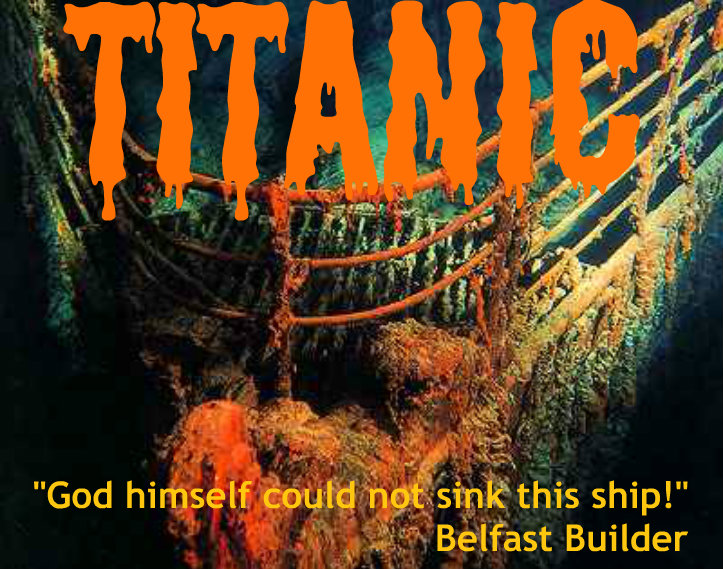
" God himself could not sink this ship!" After the British Holocaust visited on Ireland in 1845 which cost the lives of millions( I use the word MILLIONS, carefully researched) of Irish lives, from 1848 to 1950 almost another six million people left Ireland. It has continued ever since, its called ethnic cleansing by some, forced emigration by others and "see another part of the world" by an Irish minister of the current fascist Government in Ireland. The result is that most of the real Irish are overseas and whats left on the small island today is a poor spiritless mostly imitation of anything Gaelic or free.
God himself could not sink this ship!
" God himself could not sink this ship!"
After the British Holocaust visited on Ireland in 1845 which cost the lives of millions( I use the word MILLIONS, carefully researched) of Irish lives, from 1848 to 1950 almost another six million people left Ireland. It has continued ever since, its called ethnic cleansing by some, forced emigration by others and "see another part of the world" by an Irish minister of the current Nazi Government in Ireland. The result is that most of the real Irish are overseas and whats left on the small island today is a poor spiritless mostly imitation of anything Gaelic or free.
From the late 1800s millions of immigrants came to America and spread out to form American cities. Ann Moore arrived from Ireland on January 1, 1892; she was the first person to enter the United States through Ellis Island. She was first of more than 12 million people, who entered the United States between 1892 and 1954 through Ellis Island immigration centre. Everyone other than what they then called Indians in North American came from somewhere else as an immigrant or a descendant of immigrants.
I personally grew up in the West of Ireland on a farm, where the culture of the letter from Amerikay was very important. It often included subsistence money or was accompanied with a parcel of clothes. Very important, while eking out a living in the poverty of the west of Ireland, still suffering the hangover of a holocaust, in the lonely vacuum of a land emptied of its spirit and people by starvation and emigration. We cursed the English with a vengance for it, while Americkay was held in very high regard, with its culture of being a place of refuge and its tradition of generous letters and job creators in Ireland.
As a teenager growing up in the isolated, empty countryside of the west of Ireland, in a culture of strict Catholicism the American film, music, TV with writers like Steinbeck it felt exhilarating and like liberating stuff. This came to climax, with the visit of the very Irish American President Jack Kennedy. Since the murder of the Kennedys and the passing of the age innocence in the States, things started to slowly and subtly change. As we always try with any good friends, to be patient and give them the benefit of the doubt until further clarity, as most Irish people have done and still do with our friends in the USA.
It is therefore with a very heavy and reluctant heart, that I publish below a couple of links, that confirm for me without any shadow of doubt what I have long suspected. The US of A has changed, changed utterly. I see fascism where I once saw freedom. I see wanton murder where I once saw liberation. I see mean cynicism where I once saw generous idealism. The American Dream has died for me, to be replaced as place of corporatocracy, horror, fascist gitmo and apocalypse.
Below are the links which may very well be censored in our current climate of fascism.
HILLARY CLINTON ADMITS THE US GOVERNMENT CREATED AL-QAEDA
The mountain people come and go
For wool to weave or seed to sow,
White flour to bake a wedding cake,
Red spirits for a stranger's wake.
No man can call his soul his own
Who has the Devil's spoon on loan.
And so behind his web of bales,
Horse halters, barrels, pucan sails
The gombeen like a spider sits,
Surfeited; and for all his wits,
As poor as one who never knew
The treasure of the early dew.
-- Joseph Campbell
Ireland's Famine gombeen men and women, originally were Irish fixers, loan sharks, enablers who did the dirty work of absentee landlords and the British priviliged establishment in Ireland while millions starved of hunger and died. Politicians, cute hures, journalists, economists, bankers, etc.. The island is still plagued with them today.
Generally, "gombeen" is now often used as an adjective, referring to the mindset possessed by those engaged in leech like activities such as profiting from their neighbour's misfortunes. In Irish politics, its definition has become less precise and it can also imply pettiness and close-mindedness.
Cute hures on the otherhand, does not just refer to the overweight fat imbeciles at the top of the Irish political tree or their obese female version of gombeen man. It was born out of the compliance of a certain class of people, such as politicians, journalists, economists, etc., only too willing to lick arse for money and facilitate the exploitation of ordinary people, principally by banking today, for which they receive rich commissions (bribes).
Today we have another gombeen Taoiseach, who has said spending cuts in Ireland, are the only way to ensure that international bankers will lend the Govt the money needed to run the country. He's a liar and so are the other 90 per cent of the politicians in the country,including the fake opposition, who pretend to debate it. Oh yes, he and his ilk will get well paid to facilitate a drip down banking financial loan system, with nothing left for the people of no property but hardship, hunger and early graves.
Below is an article of just one alternative, for real recovery and a quality life for all.
Why Capitalism Fails
The man who saw the meltdown coming had another troubling insight: it will happen again
By Stephen Mihm
September 14, 2009 "Boston Globe" -- Since the global financial system started unraveling in dramatic fashion two years ago, distinguished economists have suffered a crisis of their own. Ivy League professors who had trumpeted the dawn of a new era of stability have scrambled to explain how, exactly, the worst financial crisis since the Great Depression had ambushed their entire profession.
Amid the hand-wringing and the self-flagellation, a few more cerebral commentators started to speak about the arrival of a "Minsky moment," and a growing number of insiders began to warn of a coming "Minsky meltdown."
"Minsky" was shorthand for Hyman Minsky, a hitherto obscure macroeconomist who died over a decade ago. Many economists had never heard of him when the crisis struck, and he remains a shadowy figure in the profession. But lately he has begun emerging as perhaps the most prescient big-picture thinker about what, exactly, we are going through. A contrarian amid the conformity of postwar America, an expert in the then-unfashionable subfields of finance and crisis, Minsky was one economist who saw what was coming. He predicted, decades ago, almost exactly the kind of meltdown that recently hammered the global economy.
In recent months Minsky's star has only risen. Nobel Prize-winning economists talk about incorporating his insights, and copies of his books are back in print and selling well. He's gone from being a nearly forgotten figure to a key player in the debate over how to fix the financial system.
But if Minsky was as right as he seems to have been, the news is not exactly encouraging. He believed in capitalism, but also believed it had almost a genetic weakness. Modern finance, he
argued, was far from the stabilizing force that mainstream economics portrayed: rather, it was a system that created the illusion of stability while simultaneously creating the conditions for an inevitable and dramatic collapse.
In other words, the one person who foresaw the crisis also believed that our whole financial system contains the seeds of its own destruction. "Instability," he wrote, "is an inherent and inescapable flaw of capitalism."
Minsky's vision might have been dark, but he was not a fatalist; he believed it was possible to craft policies that could blunt the collateral damage caused by financial crises. But with a growing number of economists eager to declare the recession over, and the crisis itself apparently behind us, these policies may prove as discomforting as the theories that prompted them in the first place. Indeed, as economists re-embrace Minsky's prophetic insights, it is far from clear that they're ready to reckon with the full implications of what he saw.
In an ideal world, a profession dedicated to the study of capitalism would be as freewheeling and innovative as its ostensible subject. But economics has often been subject to powerful orthodoxies, and never more so than when Minsky arrived on the scene.
That orthodoxy, born in the years after World War II, was known as the neoclassical synthesis. The older belief in a self-regulating, self-stabilizing free market had selectively absorbed a few insights from John Maynard Keynes, the great economist of the 1930s who wrote extensively of the ways that capitalism might fail to maintain full employment. Most economists still believed that free-market capitalism was a fundamentally stable basis for an economy, though thanks to Keynes, some now acknowledged that government might under certain circumstances play a role in keeping the economy - and employment - on an even keel.
Economists like Paul Samuelson became the public face of the new establishment; he and others at a handful of top universities became deeply influential in Washington. In theory, Minsky could have been an academic star in this new establishment: Like Samuelson, he earned his doctorate in economics at Harvard University, where he studied with legendary Austrian economist Joseph Schumpeter, as well as future Nobel laureate Wassily Leontief.
But Minsky was cut from different cloth than many of the other big names. The descendent of immigrants from Minsk, in modern-day Belarus, Minsky was a red-diaper baby, the son of Menshevik socialists. While most economists spent the 1950s and 1960s toiling over mathematical models, Minsky pursued research on poverty, hardly the hottest subfield of economics. With long, wild, white hair, Minsky was closer to the counterculture than to mainstream economics. He was, recalls the economist L. Randall Wray, a former student, a "character."
So while his colleagues from graduate school went on to win Nobel prizes and rise to the top of academia, Minsky languished. He drifted from Brown to Berkeley and eventually to Washington University. Indeed, many economists weren't even aware of his work. One assessment of Minsky published in 1997 simply noted that his "work has not had a major influence in the macroeconomic discussions of the last thirty years."
Yet he was busy. In addition to poverty, Minsky began to delve into the field of finance, which despite its seeming importance had no place in the theories formulated by Samuelson and others. He also began to ask a simple, if disturbing question: "Can ‘it' happen again?" - where "it" was, like Harry Potter's nemesis Voldemort, the thing that could not be named: the Great Depression.
In his writings, Minsky looked to his intellectual hero, Keynes, arguably the greatest economist of the 20th century. But where most economists drew a single, simplistic lesson from Keynes - that government could step in and micromanage the economy, smooth out the business cycle, and keep things on an even keel - Minsky had no interest in what he and a handful of other dissident economists came to call "bastard Keynesianism."
Instead, Minsky drew his own, far darker, lessons from Keynes's landmark writings, which dealt not only with the problem of unemployment, but with money and banking. Although Keynes had never stated this explicitly, Minsky argued that Keynes's collective work amounted to a powerful argument that capitalism was by its very nature unstable and prone to collapse. Far from trending toward some magical state of equilibrium, capitalism would inevitably do the opposite. It would lurch over a cliff.
This insight bore the stamp of his advisor Joseph Schumpeter, the noted Austrian economist now famous for documenting capitalism's ceaseless process of "creative destruction." But Minsky spent more time thinking about destruction than creation. In doing so, he formulated an intriguing theory: not only was capitalism prone to collapse, he argued, it was precisely its periods of economic stability that would set the stage for monumental crises.
Minsky called his idea the "Financial Instability Hypothesis." In the wake of a depression, he noted, financial institutions are extraordinarily conservative, as are businesses. With the borrowers and the lenders who fuel the economy all steering clear of high-risk deals, things go smoothly: loans are almost always paid on time, businesses generally succeed, and everyone does well. That success, however, inevitably encourages borrowers and lenders to take on more risk in the reasonable hope of making more money. As Minsky observed, "Success breeds a disregard of the possibility of failure."
As people forget that failure is a possibility, a "euphoric economy" eventually develops, fueled by the rise of far riskier borrowers - what he called speculative borrowers, those whose income would cover interest payments but not the principal; and those he called "Ponzi borrowers," those whose income could cover neither, and could only pay their bills by borrowing still further. As these latter categories grew, the overall economy would shift from a conservative but profitable environment to a much more freewheeling system dominated by players whose survival depended not on sound business plans, but on borrowed money and freely available credit.
Once that kind of economy had developed, any panic could wreck the market. The failure of a single firm, for example, or the revelation of a staggering fraud could trigger fear and a sudden, economy-wide attempt to shed debt. This watershed moment - what was later dubbed the "Minsky moment" - would create an environment deeply inhospitable to all borrowers. The speculators and Ponzi borrowers would collapse first, as they lost access to the credit they needed to survive. Even the more stable players might find themselves unable to pay their debt without selling off assets; their forced sales would send asset prices spiraling downward, and inevitably, the entire rickety financial edifice would start to collapse. Businesses would falter, and the crisis would spill over to the "real" economy that depended on the now-collapsing financial system.
From the 1960s onward, Minsky elaborated on this hypothesis. At the time he believed that this shift was already underway: postwar stability, financial innovation, and the receding memory of the Great Depression were gradually setting the stage for a crisis of epic proportions. Most of what he had to say fell on deaf ears. The 1960s were an era of solid growth, and although the economic stagnation of the 1970s was a blow to mainstream neo-Keynesian economics, it did not send policymakers scurrying to Minsky. Instead, a new free market fundamentalism took root: government was the problem, not the solution.
Moreover, the new dogma coincided with a remarkable era of stability. The period from the late 1980s onward has been dubbed the "Great Moderation," a time of shallow recessions and great resilience among most major industrial economies. Things had never been more stable. The likelihood that "it" could happen again now seemed laughable.
Yet throughout this period, the financial system - not the economy, but finance as an industry - was growing by leaps and bounds. Minsky spent the last years of his life, in the early 1990s, warning of the dangers of securitization and other forms of financial innovation, but few economists listened. Nor did they pay attention to consumers' and companies' growing dependence on debt, and the growing use of leverage within the financial system.
By the end of the 20th century, the financial system that Minsky had warned about had materialized, complete with speculative borrowers, Ponzi borrowers, and precious few of the conservative borrowers who were the bedrock of a truly stable economy. Over decades, we really had forgotten the meaning of risk. When storied financial firms started to fall, sending shockwaves through the "real" economy, his predictions started to look a lot like a road map.
"This wasn't a Minsky moment," explains Randall Wray. "It was a Minsky half-century."
Minsky is now all the rage. A year ago, an influential Financial Times columnist confided to readers that rereading Minsky's 1986 "masterpiece" - "Stabilizing an Unstable Economy" - "helped clear my mind on this crisis." Others joined the chorus. Earlier this year, two economic heavyweights - Paul Krugman and Brad DeLong - both tipped their hats to him in public forums. Indeed, the Nobel Prize-winning Krugman titled one of the Robbins lectures at the London School of Economics "The Night They Re-read Minsky."
Today most economists, it's safe to say, are probably reading Minsky for the first time, trying to fit his unconventional insights into the theoretical scaffolding of their profession. If Minsky were alive today, he would no doubt applaud this belated acknowledgment, even if it has come at a terrible cost. As he once wryly observed, "There is nothing wrong with macroeconomics that another depression [won't] cure."
But does Minsky's work offer us any practical help? If capitalism is inherently self-destructive and unstable - never mind that it produces inequality and unemployment, as Keynes had observed - now what?
After spending his life warning of the perils of the complacency that comes with stability - and having it fall on deaf ears - Minsky was understandably pessimistic about the ability to short-circuit the tragic cycle of boom and bust. But he did believe that much could be done to ameliorate the damage.
To prevent the Minsky moment from becoming a national calamity, part of his solution (which was shared with other economists) was to have the Federal Reserve - what he liked to call the "Big Bank" - step into the breach and act as a lender of last resort to firms under siege. By throwing lines of liquidity to foundering firms, the Federal Reserve could break the cycle and stabilize the financial system. It failed to do so during the Great Depression, when it stood by and let a banking crisis spiral out of control. This time, under the leadership of Ben Bernanke - like Minsky, a scholar of the Depression - it took a very different approach, becoming a lender of last resort to everything from hedge funds to investment banks to money market funds.
Minsky's other solution, however, was considerably more radical and less palatable politically. The preferred mainstream tactic for pulling the economy out of a crisis was - and is - based on the Keynesian notion of "priming the pump" by sending money that will employ lots of high-skilled, unionized labor - by building a new high-speed train line, for example.
Minsky, however, argued for a "bubble-up" approach, sending money to the poor and unskilled first. The government - or what he liked to call "Big Government" - should become the "employer of last resort," he said, offering a job to anyone who wanted one at a set minimum wage. It would be paid to workers who would supply child care, clean streets, and provide services that would give taxpayers a visible return on their dollars. In being available to everyone, it would be even more ambitious than the New Deal, sharply reducing the welfare rolls by guaranteeing a job for anyone who was able to work. Such a program would not only help the poor and unskilled, he believed, but would put a floor beneath everyone else's wages too, preventing salaries of more skilled workers from falling too precipitously, and sending benefits up the socioeconomic ladder.
While economists may be acknowledging some of Minsky's points on financial instability, it's safe to say that even liberal policymakers are still a long way from thinking about such an expanded role for the American government. If nothing else, an expensive full-employment program would veer far too close to socialism for the comfort of politicians. For his part, Wray thinks that the critics are apt to misunderstand Minsky. "He saw these ideas as perfectly consistent with capitalism," says Wray. "They would make capitalism better."
But not perfect. Indeed, if there's anything to be drawn from Minsky's collected work, it's that perfection, like stability and equilibrium, are mirages. Minsky did not share his profession's quaint belief that everything could be reduced to a tidy model, or a pat theory. His was a kind of existential economics: capitalism, like life itself, is difficult, even tragic. "There is no simple answer to the problems of our capitalism," wrote Minsky. "There is no solution that can be transformed into a catchy phrase and carried on banners."
It's a sentiment that may limit the extent to which Minsky becomes part of any new orthodoxy. But that's probably how he would have preferred it, believes liberal economist James Galbraith. "I think he would resist being domesticated," says Galbraith. "He spent his career in professional isolation."
Stephen Mihm is a history professor at the University of Georgia and author of "A Nation of Counterfeiters"
US intelligence bureau the FBI has confirmed that it is holding an Irish citizen suspected of a range of offences including sexual solicitation, sexual extortion, lewd sexual conduct and cunnilingus.
Patrick Murphy has so far been held for 72 hours without access to relatives, his family or a lawyer, but FBI sources have stressed that this is for reasons of state security, given that Murphy is " the second most dangerous criminal in New York".
A Bureau spokesman this morning confirmed that, despite continual grilling, Murphy had so far refused to speak. "He's one tough customer, that's for sure," noted the grim-faced G-man. "But he'll break eventually, they always do."
The FBI has also countered claims that they are holding the wrong individual. "Nope, the name on the computer matches the name on his passport," asserted an intelligence officer in mirrored sunglasses. "Absolutely no doubt about it."
Murphy is charged with soliciting an escort who had been with him in the Mayflower hotel. He allegedly then used cash from an ATM, in an elaborate ruse to bribe the escort for sexual favours. It is believed he was attempting to build a vast criminal empire of prostitution. Agents claim, that he abused one of their associates in 1999 for "not cleaning the toilet seat after him", when he visited New York.
However, Murphy"s distraught mother is convinced that this is a case of mistaken identity. His hysterical mother told: reporters "There's no way he did all the things they say he did. How could he? He's only nine months old."
While FBI interrogators concede that their suspect's silence may be due in part to his tender years, they are sticking to their belief that little Patrick is their man. It is believed the escorts phone was wiretapped by the FBI on another matter, at the Mayfair Hotel and the lewd suggestive evidence has been taped.
"I'll say it again," gasped an exasperated Fed. "The man we're looking for has the same name as the person we are holding. Therefore they are the same person. And to suggest that this guy is not capable of running a brutal criminal regime is to ignore the facts. Patrick Murphy is the name of the man who laundered more than $65 billion with one of the most respectable firms trading on the New York stock exchange last year. The firm was almost put out of business. Patrick Murphy is the name of the infant we are holding. End of story."
When it was suggested to the FBI that they were illegally using anti-terror legislation to hold the infant, they countered that their records show, that a Patrick Murphy also visited Fallujah back in 1999 and may be carrying chemical agents once used by Saddam Hussein.
If convicted, Murphy faces 100,000 years in jail without hope of parole.


 Wednesday May 09, 2012 11:09
 by BrianClarkeNUJ - AllVoices