Sunday, January 20, 2013

BRITISH STILL EXPORT TORTURE TECHNIQUES FROM LABORATORY OCCUPIED IRELAND


                                                       Britain's Abu Ghraib


In many a time, in many a land,
With many a gun in many a hand,
They came by the night, they came by the day,
They came with their guns to take us away,

With their knock on the door, knock on the door,
Here they come to take one more.
Look over the oceans, look over the lands,
Look over the leaders with blood on their hands,
And open your eyes and see what they do,
When they knock over there friend, they're knocking for you,
With their knock on the door, knock on the door,
Here they come to take one more.
Words and Music by Phil Ochs and Appleseed Music ASCAP


'They can jail the revolutionary
but not the revolution'
— CHE GUEVARA.


British Occupied Ireland with the treatment of political internees such as Marian Price, Martin Corey and many others, has become a human-rights-free zone.The quarantine of many Irish political prisoners is a familiar concealment. When placed in a human rights context, British Occupied Ireland is often described in terms of the British government‘s denial of human rights to political prisoners but equally important the denial of their Irish humanity and identity.

British Occupied Ireland has been a laboratory for their dehumanization, while they use their media, such as the BBC world service, to refer to prisoners of conscience, as terrorists, to ostracize them from what it means to be human and allow the British the physical and mental treatment of Irish political prisoners, abhorrent to human beings.Thus they accomplish through cultural erasure, through the creation of the terrorist narrative; legal erasure and physical erasure through torture.

While the dimensions of dehumanization are distinct, they are interrelated. All are connected by law and specifically by human rights.The British have created the preconditions for state power activity, so brutal, as to deprive Irish political prisoners of the ability to be human or have any human rights.They stand exposed to the violence of the British state, unmediated, unprotected by any human rights, reducing political internees to a state of bare life without humanity. What is evolving is the Irish have no right, to have rights, a vacuum enabling extreme British state violence, placing the internment of Marian Price, at the center of a struggle not just for rights, but for humanity that includes you and me.


On the 18th January 1978, the Government of the Republic of Ireland brought an application against Britain, before the Commission of International Human Rights in Strasbourg (ii) that various interrogation practices--in particular the so-called 'five techniques', which included wall- standing, hooding and deprivation of sleep and food--and other practices to which suspects were subjected amounted to torture and inhuman or degrading treatment contrary to Article 3...The Commission unanimously found that the five techniques did constitute a practice of torture and that other practices amounted to inhuman and degrading treatment.

On the same day the Parker report was published on 2 March 1972, the United Kingdom Prime Minister stated in Parliament, that its torture techniques in British Occupied Ireland would not be used ever again in future. The Prime Minister's statement, directives expressly prohibiting the use of the techniques, whether singly or in combination, which were then issued to their forces by the Government. 

At a hearing before British Courts on 8 February 1977, the British Attorney-General declared that the 'five techniques' would not in any circumstances be reintroduced either collectively or individually. Yet still the torture goes on worldwide with Marian Price and others secretly interned without trial in British Occupied Ireland, while hundreds more claims are in the pipeline as Iraqis become aware that they are able to bring proceedings against the UK in the London courts.

British troops face fresh charges of Iraq war torture and killings

Allegations to be unveiled in high court of 'systemic' policy of abuse from 2003 to 2008
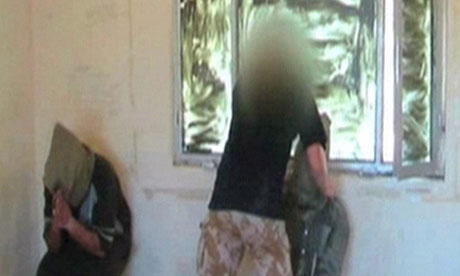
Baha Mousa inquiry
A still from video of a British soldier screaming abuse at hooded Iraqi detainees played to the public inquiry into the death of of Baha Mousa. Photograph: PA
Britain will face fresh charges of breaching international law over the alleged torture and killing of prisoners during the war in Iraq, which began almost exactly 10 years ago. The allegations will be unveiled in the high court, when Britain will stand accused of a "systemic" policy of abuse committed over five years, from 2003 to 2008.
At a hearing scheduled over three days from 29 January, lawyers for 180 Iraqis who claim they are victims of abuse, or that their family members were unlawfully killed, will place a file of statements before two judges presiding over the court in London accusing British soldiers and intelligence officers of unlawful interrogation practices. These include hooding and the use of "stress positions", sexual abuse, beating and religious abuse of illegally detained prisoners. In some cases, the testimonies allege, the torture led to the death of the prisoner.
The statements were compiled during meetings with victims and relatives, mostly in Lebanon, by human rights lawyer Phil Shiner of the Public Interest Lawyers group, based in Birmingham.
The court will rule on whether the abuses were isolated incidents of which commanders, senior ministry officials and politicians were unaware, as the government insists, or "systemic" and authorised as policy. The MoD contends that any general problems of detention and interrogation were dealt with by an inquiry into the death of Baha Mousa, an innocent hotel worker killed while in British custody in Basra in 2003, and continuing internal investigations by its own Iraq Historic Allegations Team.
But the author of a book on the killing of Baha Mousa, Andrew Williams – a law professor at the University of Warwick – says: "What happened to Baha Mousa, and how the army and the government responded to his death is emblematic of a whole system in operation … a callous culture that … permeated far up the command chain, both military and government".
Shiner says of his evidence that the Baha Mousa inquiry "may have shone a torch into a dark corner" but what is before the court next week is more like "a stadium in which we will switch on the floodlights.
"We've got the training materials", he says, "we've got the policy documents. Violence was endemic to the state practices and part of the state practices".
His counsel team, led by Michael Fordham QC, will present five so-called "state practices" they claim were "unlawful, right to the top", including illegal interrogation techniques taught at the army intelligence facility at Chicksands, north of London, unlawful detention and unlawful use of lethal force
Shiner's files are deeply shocking. Insults to Islam and sexual depravity feature frequently in the statements: a soldier is alleged to have masturbated over a prisoner, another to have committed sodomy with his finger; female interrogators are claimed to have stripped and feigned seduction in exchange for "information".
Most of the alleged incidents took place while prisoners were in custody, though some occurred during "strike operations" on people's homes, with suspects and their families allegedly subjected to abuse and crude violence. Prisoners who died in custody were invariably said to have done so due to "natural causes", despite beatings and kickings.
The hearing comes just weeks away from the 10th anniversary of the Iraq invasion, and will be counted as a measure of how far Britain can reckon with its own legacy in Iraq. South African archbishop emeritus Desmond Tutu last year urged in this newspaper that the then prime minister Tony Blair and others should be prosecuted by the international criminal court over the legality and conduct of the invasion.
"This is the crucial moment of decision", says Williams. "This is our last chance to get to the truth of what happened. This is what we demand of others, but we do not demand it of ourselves. What kind of message does that give the world about who we are?"
• This article was amended on 20 January 2013 to correct errors in the editing and production process that attributed quotes from Phil Shiner to Prof Andrew Williams

Ireland is an Irish Island


Unlike land frontiers, coastlines cannot be altered at the stroke of a pen. The Ulster Unionist movement have tried to redefine the boundary of the word “Ireland” which stubbornly remains in use for the entire island worldwide. Ireland is one of the clearest physical entities in the world, particularly when the earth is viewed from space. To say otherwise ii a nonsense. Free Irish people can say so with absolute confidence.


Unlike land frontiers, coastlines cannot be altered at the stroke of a pen. Northern Ireland.means exactly what it says, of itself it means nothing, no more no less, it is simply Irish. Ireland’s status as an island is thus a politically immovable frontier. Its extent is fixed by the sea in perpetuity and any partition leaves an unviable state of British poppycock.. In addition, the island as a “natural” political unit has both an economic logic and is a matter of basic common sense.


Ethnic nationalism is a rare dubious luxury in our contemporary world but in Ireland no such frontier is possible in the long run. It is impossible to define an ethnic Irish identity, because the geographical and historical Irish identity, is in absolute conflict with it and cannot be changed to match, unless the British bomb the coastline or drain the Irish Sea.. Ethnic nationalism is doomed to failure because “Huns“ cannot submit to an Irishness based on the ethnic “Taig“ identity, neither can they escape it until they have a Spiritual Awakening, from their political and cultural neurosis.

Saturday, January 19, 2013

FREEDOM CENSORED The Power of Choice


Thousands attend anti-abortion vigil in Dublin - Where were all these born again pro-life virgins, when tens of thousands of Irish children were being raped ?


Link The Power of Choice 

Friday, January 18, 2013

NEWS YOU WON'T FIND ON THE BBC


Last week the Obama regime warned the British government that it was a violation of US interests for the UK to pull out of the European Union or reduce its ties to the EU in any way.

In other words, the sovereignty of Great Britain is not a choice to be made by the British government or people. The decision is made by Washington in keeping with Washington’s interest.

The British are so accustomed to being Washington’s colony that deputy prime minister Nick Clegg and a group of UK business executives quickly lined up with Washington.
This leaves Great Britain in a quandary. The British economy, once a manufacturing powerhouse, has been reduced to the City of London, Britain’s equivalent to Wall Street. London, like New York, is a world financial center of which there are none in Europe. Without its financial status, there wouldn’t be much left of the UK.

It is because of the City’s financial importance that the UK, alone of the EU member states, kept the British pound as its currency and did not join the euro. Because the UK has its own currency and central bank, the UK was spared the sovereign debt crisis that has plagued other EU member states. The Bank of England, like the Federal Reserve in the US, was able to bail out its own banks, whereas other EU states sharing a common currency could not create money, and the European Central Bank is prohibited by its charter (at Germany’s insistence) from bailing out member states.

The quandary for the UK is that the solution to the sovereign debt crisis toward which the EU is moving is to strip the member governments of their fiscal sovereignty. For the individual countries, the spending, taxing and, thereby, deficit or surplus positions of the member countries’ budgets will be set by EU central authority. This would mean the end of national sovereignty for European countries.

For Britain to remain an EU member while retaining its own currency and central bank would mean special status for Great Britain. The UK would be the only member of the EU that remained a sovereign country. What are the chances that the UK will be permitted such exceptional status? Is this acceptable to Germany and France?

If the British are to fold themselves into Europe, they will have to give up their currency, central bank, their law, and their economic status as a world financial center and accept governance by the EU bureaucracy. The British will have to give up being somebody and become nobody.

It would, however, free the UK from being Washington’s puppet unless the EU itself is Washington’s puppet.

According to reports, sometime this year Scotland, a constituent part of the UK, is to vote on leaving the UK and becoming an independent country. How ironic that as the UK debates its dismemberment the country itself faces being merged into a multi-national state.
Paul Craig Roberts was Assistant Secretary of the Treasury for Economic Policy and associate editor of the Wall Street Journal. He was columnist for Business Week, Scripps Howard News Service, and Creators Syndicate. He has had many university appointments. His internet columns have attracted a worldwide following.

LET THEM EAT ASS


Declaration Of The Rights Of Man And Of Citizens By The National Assembly Of France

The representatives of the people of France, formed into a National Assembly, considering that ignorance, neglect, or contempt of human rights, are the sole causes of public misfortunes and corruptions of Government, have resolved to set forth in a solemn declaration, these natural, imprescriptible, and inalienable rights: that this declaration being constantly present to the minds of the members of the body social, they may be forever kept attentive to their rights and their duties; that the acts of the legislative and executive powers of Government, being capable of being every moment compared with the end of political institutions, may be more respected; and also, that the future claims of the citizens, being directed by simple and incontestable principles, may always tend to the maintenance of the Constitution, and the general happiness.
For these reasons the National Assembly doth recognize and declare, in the presence of the Supreme Being, and with the hope of his blessing and favour, the following sacred rights of men and of citizens:
One: Men are born, and always continue, free and equal in respect of their Rights. Civil distinctions, therefore, can be founded only on Public Utility.
Two: The end of all Political associations is the Preservation of the Natural and Imprescriptible Rights of Man; and these rights are Liberty, Property, Security, and Resistance of Oppression.
Three: The Nation is essentially the source of all Sovereignty; nor can any individual, or any body of Men, be entitled to any authority which is not expressly derived from it.
Four: Political Liberty consists in the power of doing whatever does not Injure another. The exercise of the Natural Rights of every Man, has no other limits than those which are necessary to secure to every other Man the Free exercise of the same Rights; and these limits are determinable only by the Law
Five: The Law ought to Prohibit only actions hurtful to Society. What is not Prohibited by the Law should not be hindered; nor should anyone be compelled to that which the Law does not Require
Six: the Law is an expression of the Will of the Community. All Citizens have a right to concur, either personally or by their Representatives, in its formation. It Should be the same to all, whether it protects or punishes; and all being equal in its sight, are equally eligible to all Honours, Places, and employments, according to their different abilities, without any other distinction than that created by their Virtues and talents
Seven: No Man should be accused, arrested, or held in confinement, except in cases determined by the Law, and according to the forms which it has prescribed. All who promote, solicit, execute, or cause to be executed, arbitrary orders, ought to be punished, and every Citizen called upon, or apprehended by virtue of the Law, ought immediately to obey, and renders himself culpable by resistance.
Eight: The Law ought to impose no other penalties but such as are absolutely and evidently necessary; and no one ought to be punished, but in virtue of a Law promulgated before the offence, and Legally applied.
Nine: Every Man being presumed innocent till he has been convicted, whenever his detention becomes indispensable, all rigour to him, more than is necessary to secure his person, ought to be provided against by the Law.
Ten: No Man ought to be molested on account of his opinions, not even on account of his Religious opinions, provided his avowal of them does not disturb the Public Order established by the Law.
Eleven: The unrestrained communication of thoughts and opinions being one of the Most Precious Rights of Man, every Citizen may speak, write, and publish freely, provided he is responsible for the abuse of this Liberty, in cases determined by the Law.
Twelve: A Public force being necessary to give security to the Rights of Men and of Citizens, that force is instituted for the benefit of the Community and not for the particular benefit of the persons to whom it is intrusted.
Thirteen: A common contribution being necessary for the support of the Public force, and for defraying the other expenses of Government, it ought to be divided equally among the Members of the Community, according to their abilities.
Fourteen: every Citizen has a Right, either by himself or his Representative, to a free voice in determining the necessity of Public Contributions, the appropriation of them, and their amount, mode of assessment, and duration.
Fifteen: every Community has a Right to demand of all its agents an account of their conduct.
Sixteen: every Community in which a Separation of Powers and a Security of Rights is not Provided for, wants a Constitution.
Seventeen: The Right to Property being inviolable and sacred, no one ought to be deprived of it, except in cases of evident Public necessity, legally ascertained, and on condition of a previous just Indemnity.

The Rights of Man


Thomas Paine


Wolfe Tone


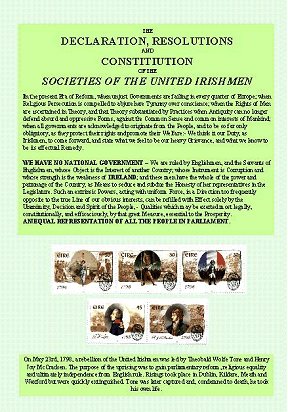
Click here to get the Constitution of the United Irishmen
A BIOGRAPHY OF WOLFE TONE
=========================

The famous and important Irish historical figure Wolfe Tone was born Theobald Wolfe Tone on 20th June 1763. His place in Irish history can scarcely be overstated as he is regarded as the father of modern Irish republicanism.

He was born in Dublin to a Protestant family and attended Trinity College, qualifying as a barrister at the age of 26, practicing in London. He soon turned his attention to Irish politics and wrote an essay attacking the ruling administration which became popular among the liberal 'Whigs' of the time. At the time the French Revolution had had a profound effect on not just French but on world politics. Ireland was no exception with the ideals of that revolution fuelling a desire for separation from English rule.

Whig stalwarts such as Henry Grattan however, wanted Catholic emancipation without breaking the tie to England. Tone was adamant that the Irish people should be governed by an Irish parliament and, although he was an Anglican he proposed co-operation among the various religions as a means to make progress on the issue of separation from England. In 1791 Wolfe Tone founded the Society of the United Irishmen, together with Napper Tandy and Thomas Russell. The moderate aims of this society (parliamentary reform) soon became overtaken with the desire for full independence from England and especially once Tones view of the necessity for armed insurrection took prominence. It was at this point that the difference between Henry Grattan and his pursuit of parliamentary reform without democratic consequence and Wolfe Tone's view of revolutionary democracy came into stark relief.

The English authorities were quick to realise the threat and sought to promote religious intolerance and sectarianism, thus dividing the Catholics and Presbyterians who otherwise were of the same Irish stock. The newly formed Orange Order was also a useful tool used by the English in stoking religious discord. By 1794 and after much political manoeuvring it became clear to Wolfe Tone that no political party would fully get behind their movement and they began to lobby for French military support in the form of an invasion.

Communications between the United Irishmen and the French were betrayed when the go-between, an English clergyman named William Jackson, was arrested and charged with treason. Given that England and France had been a war since 1793 any collaboration between the United Irishmen and the French would certainly have greatly alarmed the parliament in London. The organisation was effectively broken up by the English with several of the leaders fleeing the country. Wolfe Tone was able to use his connections to negotiate passage from the country and he duly emigrated to America, arriving in May, 1795. He had first stopped in Belfast however, and made what became known as the 'Cavehill compact' with Russell and McCracken, swearing:

'Never to desist in our efforts until we subvert the authority of England over our country and asserted our independence'.

He lived in Pennsylvania until 1796 but disliked the new American revolution, declaring that the birth class system of England had been replaced by one decided by wealth in the US. He travelled to Paris with Tandy to try to persuade the French to invade Ireland. He provided the necessary intelligence to the French who were impressed with his proposal. The result was an armada led by Louis Lazare Hoche consisting of 43 vessels under sail and 14,000 men. Much to Tone's disgust the French could not land off Bantry Bay due to severe weather and eventually returned to France. A further attempt at invasion by a Dutch expedition in 1797 also fell foul of the weather with Tone returning to Paris only to find that his greatest French ally, Hoche, had died of consumption.

Records of the time showed that membership of the United Irishmen numbered 280,000 volunteers, or about 5% of the entire population. Had the French force under Hoche been able to land at Bantry, and been joined by a popular native uprising, then the country would surely have been liberated from English rule.

By the winter of 1797/98, with hopes of a renewed French attempt fading, the United Irishmen were forced to adopt a go-it-alone military strategy focused on Dublin. Their organisation was strengthened in and around the capital and it also expanded in south Leinster. The planned insurrection was to have been a three-phased affair: the seizure of strategic positions within Dublin city co-ordinated with the establishment of a crescent of positions outside in north County Dublin, Meath, Kildare and Wicklow. The engagement of government forces in the counties beyond was designed to prevent reinforcement.

Disaster struck on 12th March 1798 with the arrest of most of the Leinster leadership. Further arrests on the very eve of the rising in May effectively decapitated the movement. The seizure of Dublin from within was aborted as the rebels waited for orders that never came.

United Irishmen positions outside the city succumbed one by one with only Wexford showing any success. A fortnight later (7-9 June), despite the mauling at the hands of Lake's forces the year before, the United Irishmen of Antrim and Down managed to rise up but they too were quickly defeated.

The Wexford insurgents met with a string of early successes but were ultimately prevented from spreading the insurrection beyond their own county by defeats at New Ross (5 June) and Arklow (9 June). Massive government forces began to move in for the decisive military showdown at Vinegar Hill, outside Enniscorthy (21 June). Although the insurgents suffered defeat, the bulk of their forces escaped encirclement and carried on the struggle for another month, one group in the Wicklow mountains and the other in a 'long march' into the midlands before being worn down and forced to surrender.

A month later (22 August) over a thousand French troops under General Humbert landed at Killala, County Mayo, but it was too little too late. Despite some initial successes, including a spectacular victory at Castlebar, Humbert and the United Irishmen who flocked to his standard were defeated at Ballinamuck, County Longford on 8th October.

The 1798 Uprising was a military catastrophe. The French and Irish forces were severely out-gunned in the field and in one battle 2,000 revolutionaries faced 30,000 English regulars. The captured French were shipped home, but the Irish were all executed after their surrender. It is estimated that 30,000 Irishmen were killed in fighting that terrible summer, many of the victims were peasants who faced cannon with pitchforks, and a great number of these were women.

Tone himself had sailed in a French raid at Donegal in October 1798 but here too his hopes were dashed. He was captured and taken to Dublin and court-marshalled. He requested that he be afforded the death of a soldier, to be shot, rather than hanged. His request denied he died in Provost's Prison in Dublin of a neck wound in November 1798 at the age of 35 years. History records his death as being a suicide but there remains some doubt.

The defeat of the United Irishmen signalled the end of Protestant Ascendancy in Ireland as the Act of Union of 1800 abolished the powerless parliament in College Green and moved all authority back to the parliament in London.

Some United Irishmen welcomed this development as the first step on the road to parliamentary reform as did many of the Catholic peasantry who envisaged their election in the English parliament. Daniel O'Connell secured Catholic Emancipation in 1829 by which time the context of separation from England had changed from being a wholly national issue to being a Catholic issue. The great famine of 1845 to 1849 destroyed the countryside and for those who survived and did not emigrate left a lasting legacy of hatred of English rule.

Wolfe Tone is remembered by republican groups as the father of their cause. When examining the timeline to Irish freedom it is certainly easy to view him as the political ancestor of O'Connell, the Young Irelanders, Parnell and Davitt, Pearse and Connolly, Collins and DeValera, on the ultimate path to independence.

He is commemorated annually at his graveside at Bodenstown, County Kildare.

'To subvert the tyranny of our execrable government, to break the connection with England, the never failing source of all our political evils, and to assert the independence of my country - these were my objects. To unite the whole people of Ireland, to abolish the memory of all past dissentions, and to substitute the common name of Irishman, in the place of the denominations of Protestant, Catholic, and Dissenter - these were my means.'

Wolfe Tone - An article provided by The Information about Ireland Site.

USAGE:
THIS ARTICLE MAY BE REPRODUCED ON YOUR WEB SITE OR IN YOUR
EZINE OR NEWSLETTER ONCE THE FOLLOWING COPYRIGHT AND 'LINK' TO THE
INFORMATION ABOUT IRELAND SITE ARE INCLUDED AND LEFT INTACT.

(C) Copyright http://www.ireland-information.com

Shutup Woman, Get on My Horse


Sinn Fein President Gerry Adams TD accompanied by senior party figures including Caral Ni Chuilin and Gerry Kelly visit the beleaguered nationalist Short Strand area of East Belfast to show solidarity with the Short Strand community following yet another sustained attack on their area by unionist mobs. During the visit the Sinn Féin delegation met with local Sinn Féin elected representatives Alex Maskey MLA and Councillors Niall Ó Donnghaile and Deirdre Hargey as well as local community leaders and many of the residents who were victims of the unionist mobs violence, insults and intimidation.
I think it’s sinful to see good food going to waste and these burgers could be offered to various charities once they meet the required food safety standards which we are told is not an issue with them,” Saint Vincent De Paul said, “People could be told what exactly they are being offered in terms of the possibility that the burgers contain horse meat and if people are happy to accept them, then they should be given to them,”  Mr Dempsey said he believed many families would happily accept the withdrawn burgers while he also believed that many of the 4,000 students still waiting for their third level maintenance grants would similarly be willing to accept them.

 Some 10 million burgers were withdrawn earlier this week by Monaghan based Silvercrest Foods after it was found by a Food Safety Authority of Ireland study to have produced a beef burger containing 29 per cent horse meat.