Monday, February 11, 2013

GARDA VIOLENCE AS PROTESTS ROCK IRISH COUNCIL MEETINGS


Eyewitness reports of Garda violence at South Dublin County Council

category national | bin tax/household tax | feature author Tuesday February 12, 2013 00:59author by twitter fan Report this post to the editors
Brutal force used on peaceful anti-property tax protesters
featured image
The long arm of the bond-holders
Press statement - Campaign Against Household & Water Taxes (CAHWT) 11 Feb 2013
Eyewitness reports of Garda violence at South Dublin County Council

19 year old protester hospitalised: plainclothes Garda ‘smashed my head on wall’

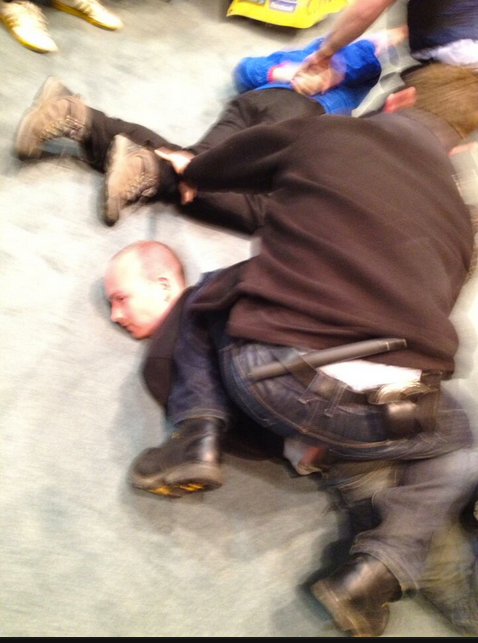
Campaigners against the property tax – who staged one of a number of peaceful protests at Councils today – have questioned why Gardai at South Dublin County Council used brutal and unnecessary force against them, including some plain clothes Gardai. Cannisters of pepper spray were also waved at locals who were manhandled and handcuffed. One is currently being kept in Tallaght Hospital for observation of his injuries.

Aaron Nolan (aged 19, now in hospital):
“I was standing in front of Shane Donnelly when one of the uniformed police pulled me to the ground. I stood up and tried to get in front of Shane again. A stocky man, with a light blue hoody, who I thought was one of the protesters, grabbed me and pushed me against the wall. He then grabbed my head with his two hands and smashed my head against the wall. I fell on the ground and when I was on the ground, he choked me with his two hands. I was dazed and unable to stand as he handcuffed me.”

Eddie Ericsson, Tallaght :
“Why does it seem like the police were prepared for a confrontation? Are tactics like this what is to be expected to intimidate normal working class people into accepting austerity?”

Pat Waine, Greenhills:
“The heat of working class anger was felt by Labour party councillors when anti-property tax protesters took the fight to the South Dublin Council Chamber. Ordinary householders peacefully protested at the Council meeting causing it to be abandoned.The police wielding pepper spray used heavy handed tactics to remove protesters. Householders were thrown to the ground and handcuffed in the council chamber in an appalling attempt by the police to bully protesters into submission. Our resistance to these unjust taxes will continue and intensify.”

Phil Foster, Tallaght:
“We were holding a peaceful protest in the council chamber when two Gardai arrived, followed by plain clothes and uniformed Gardai. They grabbed Paul Murphy (MEP) and Pat Waine and threw them to the floor. One Garda put his knee into Paul’s back and neck. He grabbed his hand and made a fist shape of it and pushed it into the floor to put immense pressure on Paul’s fingers and knuckles. Paul shouted out in pain. The other Garda had Pat’s hands handcuffed behind his back and was kneeing him in the back and ribs. I’ve never seen anything like it before, neither had any of the other people there.”

ends

Arrests in South Dublin County Council of peaceful protesters


author by twitter fanpublication date Tue Feb 12, 2013 00:40Report this post to the editors
There were several occupations of councils this evening. Fingal, South Dublin and Kilkenny.

A peaceful occupation of Fingal Council building in Swords, Dublin was held by activists of the Campaign Against Property Tax and Austerity (CAPTA). facebook.com/CAPTADublinWest
CAPTA Occupation of Fingal Council Building

author by twitter fanpublication date Tue Feb 12, 2013 00:54Report this post to the editors
Photos from Occupation of Kilkenny Borough Council tonight #OccupyPropertyTax #CAHWT

Kilkenny Borough Council occupation
At last the councillors feel the anger of people facing the property tax, the water tax and other austerity measures
By: Campaign Against the Household & Water Tax Carlow/Kilkenny
kilkenny_council_protest_cahwt_photo1_feb11th_2013.jpg
kilkenny_council_protest_cahwt_photo2_feb11th_2013.jpg
kilkenny_council_protest_cahwt_photo3_feb11th_2013.jpg


http://www.indymedia.ie/article/103267


Council meetings disrupted by protests in Dublin and Galway

Scuffles broke out between gardai and anti-household charge protesters who disrupted a meeting of South Dublin County Council this afternoon. Photograph: Tim O'BrienScuffles broke out between gardai and anti-household charge protesters who disrupted a meeting of South Dublin County Council this afternoon. Photograph: Tim O'Brien
KITTY HOLLAND and TIM O'BRIEN
Socialist MEP Paul Murphy was among six people arrested tonight as members of the Campaign Against the Household and Water Taxes (CAHWT) disrupted council meetings in Dublin, Galway and Kilkenny.
Mr Murphy was among five people arrested in Tallaght as about 30 members of the campaign occupied the chamber of South Dublin County Council. The council meeting had to be suspended while gardaí were called.
A protester Mick Murphy, who is a former member of the council, announced the interruption was orchestrated by the same group which last week invaded Cork City Hall.
In an exchange with the mayor Cathal King of Sinn Féin, who gave the protesters the option of joining the public gallery, Mr Murphy said the protesters would allow no work to be completed.
To chants of “Labour Party get off our backs, we wont pay your property tax” and “axe the tax or watch your vote collapse” Mr Murphy warned council meetings across the country were facing disruption from the protesters in coming weeks.
Councillors then left the room as protesters marched in a circle around their seats. Mr Murphy proposed a motion to his fellow protesters that they not leave the chamber “until we decide to”.
The chamber was then cleared by gardaí who told the protesters: “It is not open for discussion”.
The protest continued outside the chamber and four arrests were made, a Garda spokesman said.
In Swords in north Dublin over 20 campaigners staged a sit-down protest in the foyer of the Fingal County Council building, forcing an adjournment of the council meeting in the adjoining chamber.
Gardaí were called and protesters were refusing to leave until those arrested in Tallaght were released. They were released without charge shortly before 7 pm.
About 20 protesters staged a sit-down protest in the rotunda of Dublin City Hall for about an hour from 5.30 pm.
Gardaí were called when they hung a large banner from the East Wall branch of the CAHWT over the front of the building. No arrests were made and the protesters left peacefully at about 6.30 pm.
In Galway a planned protest at the City Hall was stopped by gardaí and one arrest was made under the Public Order Act.
The protests come two weeks after a meeting of Cork City Council had to be abandoned, on January 29th, when its chamber was occupied by anti property-tax protesters.
Socialist Party councillor in Fingal and spokeswoman for the campaign Ruth Coppinger, who had been in the chamber, left to speak to the protesters.
She said there were be further instances of civil disobedience over coming months.
“The campaign has been warning that there would be more effective protests like this. The politicians are refusing to listen, they have refused to come to meetings organised by the campaign so it seems we have to bring our voices to them.”
Another protest was held outside the meeting of Kildare Borough Council, while in Inchicore, about 35 people staged a protest outside the constituency office of Catherine Byrne TD (Fine Gael).
Ms Byrne’s daughter, councillor Clare Byrne, speaking by phone from the office as the protest continued outside, said gardaí were on-hand and there had been no repeat of the occupation of the office by protesters last week.
Her mother had said she would have to close the office following the occupation on February 4th. “Well we talked her out if that as a family,” said Clare Byrne. “She has to have an office here and the constituents need to know it will be here.”

POPE FIRED


Vatileaks scandal

From Wikipedia, the free encyclopedia
The Vatileaks scandal[1][2][3] is a scandal involving leaked Vatican documents, allegedly exposing corruption. The scandal first came to light in late January 2012 in a television programme aired in Italy under the name of The Untouchables (Gli intoccabili). Further information was released when Italian journalist Gianluigi Nuzzi published letters from Carlo Maria Viganò, formerly the second ranked Vatican administrator to the pope, in which he begged not to be transferred for having exposed alleged corruption that cost the Holy See millions in higher contract prices. Viganò is now the Apostolic Nuncio to the United States.
Over the following months the situation widened as documents were leaked to Italian journalists, uncovering power struggles inside the Vatican over its efforts to show greater financial transparency and comply with international norms to fight money laundering. Also in early 2012, an anonymous letter made the headlines for its warning of a death threat against Pope Benedict XVI.[2] The scandal escalated in May 2012 when Nuzzi published a book entitled His Holiness: The Secret Papers of Benedict XVIconsisting of confidential letters and memos between Pope Benedict and his personal secretary,[4] a controversial book that portrays the Vatican as a hotbed of jealousy, intrigue and underhanded factional fighting.[5] The book reveals details about the Pope's personal finances, and includes tales of bribes made to procure an audience with him.[6]

Contents

  [hide] 

[edit]Vatican internal investigation

Pope Benedict appointed a commission of cardinals to investigate the leaks in March 2012. The Vatican probed into the leaks is working along several tracks, Vatican magistrates pursued the criminal investigation and the Vatican secretariat of state pursued an administrative probe. The three cardinals appointed by Benedict acted in a supervisory role, looking beyond the narrow criminal scope of the leaks to interview broadly across the Vatican bureaucracy. They reported directly to the pope, and could both share information with Vatican prosecutors and receive information from them, according to Vatican spokesman the Rev. Federico Lombardi. The group was headed by Cardinal Julian Herranz, an Opus Dei prelate who headed the Vatican's legal office as well as the disciplinary commission of the Vatican bureaucracy before retiring.[1]
Paolo Gabriele, who has been the pope's personal butler since 2006, was alleged to have leaked the stolen information to Gianluigi Nuzzi. Gabriele was arrested 23 May after confidential letters and documents addressed to the pope and other Vatican officials were allegedly found in his Vatican apartment. Similar documents had been published in Italian media over the previous five months; many of them dealt with allegations of corruption, abuse of power and a lack of financial transparency at the Vatican.[7]
He was arrested by Vatican police, who claimed to have found classified documents in his apartment that he shared with his wife and three children.[4][8] Gabriele was released from custody in July 2012 and moved to house arrest.[9] Piero Antonio Bonnet, the Vatican's judge, had been instructed to examine the evidence of the case and to decide whether there is sufficient material to proceed to trial. Prior to conviction, Gabriele faced a maximum sentence of 8 years for the illegal possession of documents of a head of state.[10] The sentence was served in an Italian prison, due to an agreement between Italy and the Vatican.[9]
On 26 July, Pope Benedict held a meeting of the commission of cardinals. Included in attendance, were the head of the Vatican police, those judges involved in the case, and representatives of the Vatican secretariat of state, according to a report from Federico Lombardi.[11]

[edit]Papal response

On 30 May 2012, Pope Benedict made his first direct comments on the scandal in remarks at the end of his weekly general audience.[12] The Pope said the "exaggerated" and "gratuitous" rumours had offered a false image of the Holy See,[12] commenting "The events of recent days about the Curia and my collaborators have brought sadness in my heart...I want to renew my trust in and encouragement of my closest collaborators and all those who every day, with loyalty and a spirit of sacrifice and in silence, help me fulfill my ministry.

[edit]Trial of Paolo Gabriele

Paolo Gabriele was indicted by Vatican magistrates on 13 August 2012 for aggravated theft.[13] The first hearing of the trial of Paolo Gabriele and Claudio Sciarpelletti took place on 29 September 2012.[14]
Gabriele's trial began on 2 October 2012.[15] He claimed to have stolen the documents to fight "evil and corruption" and put the Vatican "back on track".[15] Multiple evaluations of Gabriele's mental health provided conflicting results: concluding in one report that, Gabriele suffered from a "fragile personality with paranoid tendencies covering profound personal insecurity"; yet another report found that Gabriele showed no adequate signs of a major psychological disorder nor posing any serious threat to himself or others.[16] Vatican police seized encrypted documents and confidential papers that the Pope had marked “to be destroyed” when they raided the apartment of his butler the court heard.[17]
On 6 October, Paolo Gabriele was found to be guilty of theft, and was sentenced to a reduced sentence of 18 months in an Italian prison. Gabriele was also ordered to pay legal expenses.[18][19] As of October 26, 2012, he was serving his sentence in the Vatican itself[20] but, Gabriele was pardoned by Benedict XVI on 22 December 2012.[21]

Sunday, February 10, 2013

BRITISH DONKEY SPAM AIDS WORRIES PATERSON


Horse meat scandal: 'More contaminated food likely to be found'

Horse meat could be found in even more British foods within days, ministers warned on Saturday.

 Britain has been eating scabby Romanian gypsy donkey..oh dear I do hope the British Government can try and sort this out without causing offence.

Telegraph claims horses in Romania affected by 'horse AIDS'.

Owen Paterson, the Environment Secretary, and the Food Standards Agency (FSA) said tests being held this weekend may well find more beef products contaminated with horse meat.
Officials at the FSA admitted that there have been no tests for horse meat content in British food for a decade, raising concerns that the scandal may have been hidden from the public for years.
Mr Paterson said retailers should remove products from shelves as soon there was any indication they might contain horse. Burgers and ready meals have already been withdrawn by Tesco, Findus and Aldi.
In a series of developments yesterday it emerged that:
• Twenty-eight local authorities have been instructed by the FSA to begin tests on a range of a limited number of beef products, including meat balls, burgers and lasagne ready meals;
• Mr Paterson said he believed there may be an “international criminal conspiracy”, while Scotland Yard met the FSA for talks but did not begin an investigation. Findus said it believed the contamination was “not accidental”;
• Horses in Romania — the source of the latest contamination — are “endemically” infected by a disease known as horse AIDS, although it does not pose a risk to humans;
• A French plant which handled horse meat sold in Britain as beef has previously been at the centre of a major E.coli discovery;
The latest developments came after Findus was forced to recall 18,000 packets of its frozen “beef” lasagne from supermarket shelves, and destroy another 200,000 held in storage, after it was discovered to be made up of between 60 and 100 per cent horse meat.
Aldi, the supermarket chain, also withdrew two of its ready meal lasagne and spaghetti ranges, which were found to contain between 30 and 100 per cent horse meat.
Mr Paterson ordered a summit in London yesterday with representatives of retailers and suppliers. After the summit, he issued the warning that more contamination was likely, saying there could be “bad results” from the tests now under way.
The 28 local authorities ordered to conduct tests have not been named but will be used as a sampling exercise to find the full scale of the contamination.
The tests will be the first in a decade. the FSA said it had previously only ordered tests on the basis of “intelligence” and none had been carried out since 2003, when Spanish-made salami was found to contain horse meat.
Mr Paterson said he feared the contamination was the result of crime and said: “This could be a question of gross incompetence but I’m now more concerned that there is actually an international criminal conspiracy here. This is a straight fraud. If a product says it’s beef and actually you are buying horse that is a fraud.”
He also said that retailers should products off the shelves as soon as there is a possible positive test for horse.
“Any retailer who becomes aware that a product has horse meat in it and withdraws it straight away will receive the full support of the Government,” he said.
Scotland Yard said it had met the FSA for discussions on possible criminal investigation but no inquiry had yet been launched.
However, one retailer warned that the complicated supply chains used by many suppliers made food safety hard to guarantee.
Dalton Philips, the chief executive of Morrisons, said that because the supermarket owned its own abbattoirs it could have absolute confidence in its products. “The truth is you have got to know your farmer.”
Fears over the safety of the horse meat are likely to be increased by the disclosure that Romania suffers from “endemic” infection of “equine anaemia”, or “horse AIDS”, which prompted a ban on live experts three years ago. Although it is not a danger to humans, experts said it could also suggest other health problems.
Meanwhile tests are taking place for the present of the horse painkiller bute, and Mr Patterson said that although no trace had yet been found, “we may discover that there may be other materials” in the horse meat.
Mr Paterson also suggested that retailers – rather than manufacturers - should ultimately take the responsibility for the content of the food they sell. The minister’s view may alarm corner shops and grocers who sell processed beef products, as they do not have the resources to test the content of food products.
Ministers have not ruled out actions against retailers in this country for failing to make adequate checks on their stock.
The horse meat crisis summit was held yesterday after Findus withdrew its meals last week. Yesterday it admitted that it first found traces of horse meat in its beef products on Tuesday 29 January.
However, it was not until Wednesday 6 January when Findus notified the FSA of the contamination, after it had carried out a range of tests including some DNA examinations of raw material at the factory where the meals were made in Luxembourg, which belongs to French food processor Comigel.
A spokesman for Findus said: “We are taking legal advice about the grounds for pursuing a case against our suppliers, regarding what we believe is their failure to meet contractual obligations about product integrity.
“The early results from Findus UK’s internal investigation strongly suggests that the horse meat contamination in beef lasagne was not accidental.”
It also emerged yesterday that Comigel last week told Findus that the contamination of its processed meat may stretch back to August last year.
However Findus said it was “not aware” of any issue of contamination with horse meat last year, adding: “We were only made aware of a possible August 2012 date through a letter dated 2 February 2013 from the supplier Comigel. By then we were already conducting a full supply chain traceability review and had pro-actively initiated DNA testing.”
Comigel, the French company which supplied meat to Findus and Aldi, has admitted that some of the horse in lasagne sold in Britain came from Romania, a country where equine infectious anaemia has become endemic.
Three years ago the European Union banned Romania from exporting horses with the disease and also banned live exports of all Romanian horses.
Romanian and Polish meat providers are supposed to comply with the same European-wide rules as British farmers, but it is up to authorities in individual members states to enforce these regulations. There is concern the Romanian authorities will have little resources or appetite to pursue suppliers responsible for contaminating British food.
By Robert Watts, Patrick Sawer and Laura Donnelly