Showing posts with label Internment. Show all posts

Tuesday, November 19, 2013

Irish Blog: #ReleaseMartinCorey

Irish Blog: #ReleaseMartinCorey: " END INTERNMENT, FREE Martin Corey, Internment, martin corey, News, Release Martin Corey, World News"

'via Blog this'


Thursday, November 7, 2013

Urban Dictionary: Scum State

IRELAND POLITICAL INTERNMENT DEBATE


Thursday, September 5, 2013

MASSACRE AGENTS MI5 RELEASED ON INTERNED 63 BIRTHDAY MARTIN COREY 63


The proof that Britain's Secret Services MI5 in British Occupied ireland, are hell bent on undermining the Irish Peace Process, can be found in the contrasting treatment of Orange Order Loyalist Stephen Irwin, perpetrator of the Greysteel Massacre and the internment without charge or trial of traditional irish Republican, Martin Corey. If the Irish Peace Process works, MI5 will be out of their multi-million pound, State of the Art Palace Barracks in Holywood, County Down, minus their multi million pound budget, the prize of their turf wars with competing Secret Service MI6.

Releasing a loyalist mass murderer early, to do so some more of their British State Terrorism, dirty work, coupled with provoking republicans, with the injustice of their internment without charge, trial and prejudiced secret evidence against Martin Corey, is precisely the same injustice, that fuelled the conflict for more than the last 40 years. As every interdenominational mongrel on an Irish street knows, enduring peace with such provocative injustice, is simply impossible

Orange Order mass murderer Stephen Irwin has been freed again from prison, for the second time, just before the 20th anniversary of his Greysteel massacre. Irwin 40 was released previously under the terms of the Good Friday Agreement but was imprisoned again 8 years ago, for visciously slashing a fellow football fan at a soccer match with a knife. He was told at that time, he would have to serve out his full sentence, for the eight murders at the Rising Sun Bar massacre. He was granted early release last week by the parole board and walked out of prison after commissioners ruled his release immediately. East Derry's John Dallat one of the very few Members of Stormont Parlaiment {SDLP MLA} who is not compromised to the British Secret Services, described it as “unbelievably insensitive” coming so soon, before the anniversary of the Greysteel massacre.


John said: “This will only fuel the widely-held belief that Irwin and his fellow killer Torrens Knight were and most likely still are on the payroll of British Secret Servic MI5 and that that affords them the kid glove treatment.I have it on excellent authority from a well placed source that both Irwin and Knight were agents and met their MI5 handlers at Ebrington and Shackleton Barracks when they were in operation.


People are not stupid and they know there are many unanswered questions about the Greysteel slaughter and the killing of four men in Castlerock earlier the same year that Torrens Knight also committed using the same weapon.Those questions will only be answered if an independent inquiry is held and access is given to files on Irwin and Knight.I am sure the relatives of those murdered and maimed in Greysteel 20 years ago will be sickened as I am that someone who was clearly unbelievably insensitive thought it was a good time to put this killer back on the streets.”


Sentence Review Commissioners contacted declined to comment. This purports to be Due Process in Peace Process Ireland, when on October 30, 1993, Stephen Irwin, Torrens Knight, Geoffrey Deeney and Brian McNeill, all fellow Orange Order members, went into the Rising Sun Bar in Greysteel armed.They massacred eight people, six Catholics and two Protestants. The victims were: John Burns, Moira Duddy, Joe McDermott, Victor Montgomery, James Moore, John Moyne, Stephen Mullan and Karen Thompson. One of the gang after release stated, his only regret, was that he didn't kill more. Irwin was given eight life sentences but was released after just a few years under the Good Friday Agreement.


Martiin Corey was born in the "Murder Triangle" of British Occupied Ireland and saw first hand the sectarian work of the"Glenanne gang." From being a teenage vigilante protecting his community, he volunteered for the IRA, the only defence his community had at 19. The name "Glenanne gang" is derived from a farm at Glenanne near Markethill, County Armagh, used as the Orange Order gang's arms dump and bomb-factory.Most of the Glenanne gang's attacks took place in parts of County Armagh and mid-Ulster, which later became known as the "murder triangle." The Orange Order loyalist extremists carried out sectarian attacks, from the beginning of the 1970s on a sectarian basis, against Irish Catholics, in a violent campaign, that eventually provoked a tit for tat reaction. Commanded by British Military Intelligence and RUC Special Branch, they also carried out attacks all over Ireland.


This gang of British State terrorists, included soldiers in the British Army, its Ulster Defence Regiment (UDR), British Police in the form of the Royal Ulster Constabulary (RUC), the loyalist Ulster Volunteer Force (UVF) some Ulster Defence Association (UDA) members. Former members alleged they were commanded from London and the one common bond, everyone belonged in the Orange order. The Pat Finucane Centre has listed 87 murders, as the crimes of the Glenanne gang, which includes the Dublin and Monaghan bombings, the Miami murders and the Reavey and O'Dowd murders. A sworn affidavit in the 2003 Barron Report by Glenanne gang member and RUC Special Patrol Group officer John Weir confirms this. The RUC Special Patrol Group, a specialised police unit tasked with counter-terrorism was instead engaged in sectarian murders


It is important to understand this background, in the context of Martin Corey volunteering to join the IRA and be the only protector of his totally defenceless community in Lurgan, being systematically murdered by British State terrorism and the later disbanded paramilitary police of the RUC. Martin was found guilty of shooting two of them in an IRA ambush almost 40 years ago. He served almost 20 years and was released unconditionally at that time. This then is the background to a heavily censored discussion on why Martin is interned almost 4 years again without charge and without trial.The censored debate in the pensive quill, followed an opening piece from Jim McIlMurray afriend of Martin's, on the the continued internment of Martin Corey' on hi s63rd birthday which went as follows:


" September 2, 2013, is the 63rd birthday of Martin Corey.


Today is also the date the Parole Commissioners were to commence Martin’s annual Parole hearing. We received communication on Friday, the 30th of August, informing us that this open hearing to review Martin’s ongoing detention would not commence on this date, with no alternative date being suggested or discussed with us.

Martin is entitled by law to an annual Parole hearing, and yet he has not received one in over two years.
A variety of reasons have been given for the delay, including blaming Martin himself for his "legal challenges" against his detention under Article 5 (4) (the right to have a court decide the lawfulness of his detention under the European convention of Human Rights).

Recent violations of Human Rights in the Middle East have received worldwide condemnation, including by the British government who stated that they 'will continue to play an active and forthright role in international institutions that promote and protect human rights.' They also emphasised the UK’s own commitment to strengthen human rights, both domestically and internationally.

The European Court of Human Rights ruled in 2012 that it was unacceptable to deny an annual parole hearing to anyone held in custody. This ruling ollowed a case of a man who waited 14 months for a parole hearing. Martin Corey has now waited 25 months.

The Secretary of State in a recent communication stated, 'an individual who served a life sentence
can be returned to prison if they pose a risk to the public or commits further offences.' Since Martin’s arrest in April 2010, he has never been charged with a crime, questioned by police regarding a crime, or given any explanation as to the risk he poses to the public.

Martin served 19 years in prison prior to his release in 1992. He has now served the equivalent of a
seven year sentence since his arrest in 2010.

Martin has not committed any crime. He poses no risk to the public and I am calling for his immediate release today.

I spoke with Martin this morning and he wishes to express his gratitude to those who sent messages and cards and also for their continued support in highlighting the ongoing injustice perpetrated upon him by
the British government.


Posted in: Martin Corey


Email This Blog This! Share to Twitter Share to Facebook


Newer PostOlder PostHome


10 comments:


Pauline says:


10:06 AM, September 02, 2013Reply


Martin Corey is a name that pops into my head almost daily. I can't understand why there isn't more of an outcry outside of the campaign for him. The man is held at the whim of a politician with no mandate in north on alleged advice from the parole commission that she employs and if she so chooses can dismiss. Held on the strength of evidence that neither he nor his legal team are give access to, which begs the fundamental question, how do you challenge what you can't see?

In England MPs have spoken out against the use of 'closed material' branding it the product of Tyrants and repressive regimes. This puts a question mark over the attitude of the Stormont Executive's position on the use of closed material evidence, and I believe that the parties and MLAs in Stormont whether holding ministerial positions or not should clarify their individual and party position on the use of such draconian measures. I would urge all interested parties to write to their MLA's and ask them do they support the use of closed material evidence and if not what they are doing about it?

A very dangerous precedent has been set here!


AM says:


10:45 AM, September 02, 2013Reply


The PSNI probably have it in for him given the conviction he has for killing two of their colleagues. They are getting their revenge because they can.

Now, that might be understandable in terms of sheer human emotions. But if human emotions hold a veto over what goes on in society, there would never be any progress, the jails would be packed and we would probably have the death penalty for offences considered trivial by modern era standards.

Martin Corey is being held for what a court said he did in the 1970s - for which he has served his time - not for anything a court said he has done in recent years. He is being held at the whim of a politician - political policing par excellence.


itsjustmacker says:


3:13 PM, September 02, 2013Reply


Firstly , Birthday Greetings to Martin , I have intentionally omitted "Happy".

Martin is being held on secret evidence , It stems from the HET/ex RUC Special Branch and MI5 ,That's the Brits way of getting their own way. Every Ex pow should be out onto the street enforce demanding his release , lest they forget , He is still a comrade. As Anthony stated, Martin served his time , How many ex RUC murderers are going to be arrested under the secret evidence scam, Dare I say it , "NONE" , nor , any Murdering British Soldier. Its heart rendering to say the least, so called ex comrades allowing a 63 year old pensioner still interned and they do nothing about it, I hope some of them, especially in the Fellons club are reading this and I hope they die in shame.


Fionnuala Perry says:


1:42 PM, September 03, 2013Reply


What happened to putting manners on the Brits?
Last night we went as a family to watch a play written by Rosaleen Watson about the short life and tragic death of Tom Williams.
Throughout the short and very moving drama there was an atmosphere of shock and disbelief that something as horrendous as Tom's eventual murder took place.
There was an atmosphere of past- tense, an atmosphere of having moved away from these awful times.There was almost a feeling of detachment an invisible line drawn to distinguish past from present.
I wondered as I left the prison was I the only person there who felt, all these years later nothing has changed they would hang us all over again if they could? Who knows?


itsjustmacker says:


4:16 PM, September 03, 2013Reply


Fionnuala:

"as I left the prison was I the only person there who felt, all these years later nothing has changed they would hang us all over again if they could?"

They wouldn't take a millisecond to hesitate.


Pauline says:


7:22 PM, September 03, 2013Reply


My husband's grandfather was interned in Crumlin Road Gaol with Tom Williams at the time he was executed. My husband would often remark that his grandfather never spoke of it, such was the impact it had on him. Any time the name of Tom Williams comes up you can be sure my husband will be muttering the following passage from Tom Williams' letter to Hugh McAteer. As he was reading this thread earlier he went into it!

''But shall we make the mistake of '21? no, no, tis men like you and your staff will see to it. That no farcical so called Treaty shall in no way be signed by a bunch of weak-kneed and willed Irishmen. Better that the waves of the mighty oceans sweep over Erin than take and divide our nation, murder her true sons again. Better would be that heavens would open and send fire to destroy Erin, than to
accept another Treaty like it''

Another point of interest is that Paddy McGrory the father of the current DPP was actually taking a case to Europe over the internment of my husbands grandfather and others around 1958, I think, how times have changed you definitely couldn't say like father like son.


Maitiu Connel says:


9:11 PM, September 03, 2013Reply


I simply find this a crime against human rights. At the weekend I was researching through a few articles / writings about loyalism and part of my results included recent UTV and BBC articles in which they stated openly, the names of well known UDA men and that they were leaders. The same man who openly speaks from time to time on the news with the title " UDA leader " under his name. How can these people be publicly named as leaders of an illegal terrorist group and never face arrest. Today we have 5 supposed PIRA men being charged with membership from 1997 - 2000. We watched Marian Price spend years in prison there for holding a piece of paper. It seems MI5 love to turn a blind eye to it's operators whilst still the Irish suffer.


frankie says:


10:56 PM, September 03, 2013Reply


I think you hit the nail on the head Anthony...Pure and simple bitterness.

Judges can't find a reason to hold him, cops aren't interested.

Unless, as several posters have mentioned before they (powers that be) are simply testing the water to see how far they can push the boundaries..


itsjustmacker says:


12:20 AM, September 04, 2013Reply


Maitiu Connel:

Those five are out on £250 bail , They are SF, That's unheard off in Nationalists terms, not that I would want to see them being remanded , I am just making a point , Its the same on both sides of the divide, Its not what you know , its who you know , but , there is more to this case than just being accused of being a member of PIRA.

Frankie:

I have always stated that. They are pushing as far as they want now because they won't bang up any Pro treaties. I was well pleased on the Anti Internment March , all the banners of those still Interned , Also those of Michael Campbell, and of course those of Martin Corey.


Snowtorch says:


9:05 AM, September 04, 2013Reply


If Shinners such as Padraig Wilson support the British rule of law then I'm sure he would have no problem facing due process and taking a spell on remand, after all Sinn Fein are fond of due process. However I think what's keeping them off remand is that Padraig Wilson had requested to go on the republican wing when it was looking like he was going to be locked up a few months ago. Now that wouldn't look to well for the shinners one of their leading members requesting to be housed with those they have condemned as criminals and traitors."


#ReleaseMartinCorey


#ReleaseMartinCorey

Monday, August 26, 2013

INTERNMENT : Which Side Are You On ? PROVO


Martin Galvin letter to the Irish News on 16 August 2013.
                                                              
   
The injustices which drew so many nationalists to the streets on Internment Day in Belfast must not be overlooked because of loyalist reaction. Internment Day had long been a day to march against British injustice. The symbolism was self-evident.

Internment went beyond imprisonment without charge or trial which began on August 9, 1971. British forces had shot down those who got in the way at Ballymurphy, hooded and tortured selected internees, and then given their final answer to Internment protests on “Bloody Sunday.” Compton and Widgery rubber-stamped it all.

Internment revealed Britain’s willingness to mete out and cover-up injustice whenever it served British interests. After Internment became untenable, it was replaced by Diplock Courts, forced confessions and a thinly veiled conveyor belt to the H-Blocks or Armagh.


As the first step in Britain’s new system, Republicans were arrested, denied bail on flimsy pretexts and taken off the streets for lengthy periods before trial. Often the charges were dismissed or case collapsed. Republicans during the 1970s coined the phrase ‘Internment by Remand’ to describe this tactic. Today the British have updated Internment by Remand. Some waited as long as three or four years to be acquitted.

For years, Internment Day marches were a launching pad for successive campaigns supporting Republican prisoners against each new British injustice. In recent times the Internment Day rallies were wound down then ended, perhaps in hopes that new structures including a compromised justice ministry and constabulary boards could be worked to end British repression from within.

There is no question that the number of Republicans wrongfully imprisoned today is dramatically less than in the past. However the plight of any Republican prisoners, who are victims of injustice and of their families, is not eased because there are fewer of them.

During past Internment Marches, Republican speakers repeatedly charged that British rule was irreformable and that nationalist politicians who joined the British system would end up as partners in its injustices. Perhaps those who taught me and so many others that truth were reminded of it on Internment Day. 


Sunday, August 25, 2013

Thursday, August 22, 2013

IRISH JOURNALISM IS NOT TERRORISM BRUTISH BOYCOTT STATE


 DEATH THREAT TO JOURNALIST AT INTERNMENT BRITISH OCCUPIED IRELAND


          http://www.releasemartincorey.com

Sunday, August 18, 2013

MARTIN COREY INTERNMENT HUMAN RIGHTS ACTIVIST SEEKS POLITICAL ASYLUM IN RUSSIA


10,000 Protest Internment 1971 - 2013 in Belfast

category international | rights and freedoms | news report author Saturday August 17, 2013 16:50author by brionOcleirigh - AllVoices Report this post to the editors
Release Martin Corey
The anti-internment march in Belfast on 9th August 2013, was a welcome display of disciplined unity, against a most serious abuse of human rights, that the establishment parties in Ireland, either wish to ignore or damn with feint protest, while at the same time professing to be democrats, socialists or republicans. Up to 10,000 marchers stewarded by a variety of Irish Republican Socialists, Republicans and human rights organisations, marched from Ardoyne in the north of Belfast, until they they were stopped for approximately 2 hours by PSNI jeeps and thousands of fascist, rioting UVF and Orange Order members near the city centre.
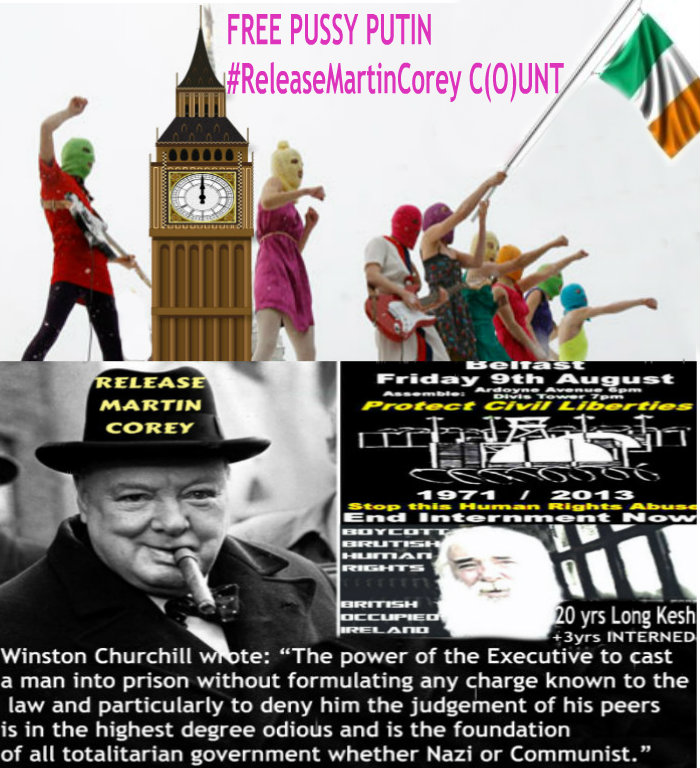
Free Pussy Putin Release Martin Corey Counts

When the human rights marchers pushed their way through the PSNI roadblock, they left the massed riot paramilitary police, with no choice but to clear a route for the protesters, to march through Carrick Hill, before joining with an anti-internment contingent waiting the arrival of comrades at Divis Street. Despite considerable delay, the people of West Belfast lined the march route cheering up to 10,000 anti-internment marchers, making a nonsense of counter revolutionary, press statements and disinformation earlier in the day, bizarrely condemning the 10,000 strong human rights march, as a 'dissident' parade! The march which was lined with well-wishers all along the route, as it made it's way through West Belfast to the Busy Bee Centre, a traditional rallying point for Republicans, where speeches were given by well known human rights figures.

In "THE POLITICS OF INTERNMENT 1971" John McGuffin wrote of the re-introduction of Internment in Occupied Ireland, as follows:

IN the mid-1960's people might have been forgiven for thinking that internment was a thing of the past. (True, the obnoxious Special Powers Acts were still on the Statute Book, but they were in abeyance). Such thinking was not to be right, however. The monolithic structure of Unionism proved incapable of reforming itself under the onslaught of the civil rights campaign. Terence O'Neill might have been able to save the Unionists with his pragmatic approach and his appreciation of the need for change, but their diehard 'not an inch' backwoodsmen would have none of it. And so the week of 12 – 16 August 1969 saw the old familiar pattern: a police force unable, and, in many cases unwilling,[1] to prevent the sectarian attack upon the Falls Road periphery, led in some cases by the B specials. That month was to see house burning, intimidation and murder – ten civilians dead, including a 9-year-old boy asleep in his bed, shot by a high-velocity Browning machine-gun used with murderous recklessness by the police in their Shorland armoured cars; 145 injured, hundreds of families burnt out of their homes, 90% of them Catholic. Free Derry was born that week. The barricades went up in Belfast. The first steps towards the irrevocable demise of Stormont were taken. And, predictably, men were detained, without charge or trial.

At 6.45 a.m. on 14 August, 28 Republicans were arrested and taken from their homes. As usual, no 'Loyalist' extremists or gunmen were arrested.
When the English Special Branch men arrived next month to sort out the RUC they asked for the files on all the 'terrorists'. They were handed the records, mostly out-of-date, on the IRA. "What about the UVF," they asked. "It doesn't exist," was the reply. "We have no records on Loyalists."
But this time it was not to be internment. The British army had had to be called in. Callaghan and Wilson had summoned Chichester Clark to Downing Street. The B men were 'phased out'. The Scarman Tribunal was set up. The Labour Government was tired of the old-fashioned traditional Unionist methods. Moreover, from behind the barricades a campaign was being mounted. Illegal radios proliferated. Street newspapers were born. The detainees were released after 17 to 20 days. The message should have been clear; internment should have no place in the 1970's.
But the Unionist hierarchy learn nothing from history. The gangling figure of Chichester Clark, the stand-in PM, shambled off into obscurity as 1970 and 1971 saw an escalation of the violence by the Provisional IRA, themselves a reaction to the attempted 'Loyalist' pogrom of 1969.

On 23 March 1971 Brian Arthur Deane Faulkner achieved his lifelong ambition and became PM. The English press warned that he was the 'last man in'. If he couldn't control the situation, direct rule was a certainty. But despite the obvious immensity of the task, Faulkner was confident.
This was the moment for which he had schemed, intrigued and betrayed, for so long. With a staggering record of disloyalty to previous PMs, he could hardly expect to be trusted or liked, but surely all could agree on his shrewdness and ability.

In fact, Faulkner's intelligence was always greatly over-rated by the media. And his biggest mistake was soon to come. The Sunday Times 'Insight' team claim[2]that "when he took over the issue was not whether internment was to come, but when and on what scale. By then Faulkner had been an advocate of internment inside Chichester Clark's Joint Security Committee, for six months." Whether this is true or not, and on balance it seems a reasonable statement, it is certain that Faulkner had completely failed to learn the lesson of how and when internment 'worked'. He had been Minister for Home Affairs in 1959 under Brookeborough, and, with the help of his trusty aide, the civil servant William Stout, he bad been responsible for the implementation of internment, which he apparently felt to be responsible for the defeat of the IRA border campaign. As is made clear already, this just was not so. The campaign failed, for lack of popular support, and, most important, the internees could languish in Crumlin because there was no campaign to get them released.

Nevertheless, one of Faulkner's first actions upon becoming Northern Ireland's last PM was to order the RUC Special Branch to work with the Director of Military Intelligence at Lisburn in drawing up a list of those Catholics who should be interned. The army were unhappy. General Tuzo, the GOC in Northern Ireland since February 1971, consistently opposed internment, believing, rightly, as it turned out, that they could not get the right people. But as the violence escalated, Faulkner became more and more insistent. On 9 July he telephoned Heath. "I must be able to intern now" he demanded. Accordingly, with some reluctance, a 'dry run' was agreed upon. At dawn on 23 July, 1,800 troops and RUC raided Republican houses throughout the province, searching for documents. They got enough to encourage them. The decision to intern was only a matter of time then, despite army objections.

The position was complicated by the mistrust and, in some cases, downright hostility between the army and the RUC. As the Sunday Times team put it: "The army believed the police list was politically motivated, and the police believed that the army's list showed inadequate local knowledge." Both were correct. Some sections of the army had favoured a small internment in the spring of 1971, with only 50 or 60 men being lifted. They had been overruled. Now the task was to be much greater.
The list had more than 500 names on it. Of these only 120 or 130 were gunmen or officers in the IRA. The vast majority were regarded either as 'Fellow-travelling sympathisers' or troublesome political activists – like PD socialists. The police contribution was the names and addresses of former internees. But Faulkner was determined. At the Joint Security Committee meeting at Stormont, Shillington, the Chief Constable, agreed with Tuzo that internment would not work. That made no difference. Faulkner secretly flew to London that afternoon. There he convinced the Cabinet. Tuzo could offer no alternative. Maudling was his usual indolent self. Whitelaw said nothing. Internment without trial was acquiesced to.

The date was set for 10 Augnst. On Sunday 7 August, however, Harry Thornton, an innocent building worker, was driving his car past Springfield Road barracks when it backfired. Soldiers opened up and killed him. His friend Murphy was dragged from the car, covered with Thornton's blood, and savagely beaten by police and army. Within minutes the people of Clonard went wild. The fighting went on all night but had died down the next day. But the army were taking no chances. At midnight on Sunday the order went out: operation internment was brought forward 24 hours. Brian Faulkner had unwittingly signed himself his own political death warrant – and that of Stormont, too.
Related Link: http://irishblog-irelandblog.blogspot.com/
Anti Internment Republican March Attacked By Loyalists


author by Brian Clarke - AllVoicespublication date Sun Aug 18, 2013 11:07Report this post to the editors
An Irish Human Rights activist and journalist covering the internment of Martin Corey in British Occupied Ireland, is seeking Political Asylum in Russia, after he received a threat, relayed by agents aligned with Britain's secret services. The journalist who wishes to remain anonymous for security reasons, has been told that he will be whacked or assassinated by a British paramilitary unit called Group 13, whose sole purpose is deniable assassination, operating in a world of shadows. Little is known about them, because they and their activities are exceptionally difficult to document. The Group is also suspected of being involved in the assassination of the Princess of Wales.

Author of “Enemies of the State,” Gary Murray, who researched Group 13 for a book but was prevented from writing it. During his research, he was dragged into the back of a van, and had a gun stuck to his mouth. He was told, it would be unwise to continue after which he decided to abandon writing the book.

Group 13 evolved from SAS soldiers and British Secret Service operatives, who were given hands on experience in the counter insurgency political laboratory of British Occupied Ireland, from the late nineteen seventies onward. Starting with Fredrick Holroyd, a Captain in British Army Intelligence, who focused on developing informers and human intelligence sources, connected with the IRA. Resulting viscous turf wars between MI5 and MI6, to control the highly lucrative“patch” of British Occupied Ireland complicated matters considerably.

Holroyd shed considerable light on Britain's dirty war and “Shoot to Kill” policies in Occupied Ireland, which resulted in the dysfunctional investigation of senior police officer, John Stalker. This was also covered in the feature film Hidden Agenda.To cover deployment in this politically sensitive area, they disguised themselves as “training teams,” with cover names like, the Royal Engineers, the Four Field Survey Troop, the Military Reconnaissance Force (MRF), and the 14th Intelligence unit.

All were SAS undercover units stationed principally at Castiledillon, Armagh. Right wing groups operating in the shadows of power, planned a right wing coup. These groups some based in Mid- Ulster, were given unofficial political cover for British State Terrorism, by the Tory Government of Margaret Thatcher, others named GB75, organised by David Sterling, founder of the SAS were operating alongside other groups who have close contact with British Secret Services, from which they still receive some unofficial cover.

Another mysterious group called Resistance and Psychological Operations Committee RPOC was based on material researched, during the torture of Martin Corey and his comrades, when tortured during Long Kesh internment in British Occupied Ireland. RPOC was a reflection of the Special Operations Executive SOE, a dirty tricks operation. RPOC have a clandestine underground movement, operating on a nod and a wink of the Conservative government, with forged close links to British Secret Services and also close links with the SAS. Little is known of the Tory SAS’s secret intelligence network, other than being tasked, with protecting the SAS, who’s lives may be under threat, as a result of their activities. The Irish journalist believes a contract has been put out on him, after this SAS secretive group had mopped on another freelance assassination team sent to kill other Irish human rights activists. “Mopping up” meaning killing members of the original assassination squad.

Elements within this group also evolved to become Group 13. Highly unofficial but desirable to players within the Tory government. Responsible for British political assassinations in Occupied Ireland and worldwide they have right wing agenda. The best known being the SAS in a “wet operation” murder of an unarmed IRA unit in Gibraltar, which led to the TV documentary Death on the Rock, based on eye-witnesses who testified, that the three members were gunned down in cold blood, which in the context of what was happening in Ireland during this period, was part of a shoot-to-kill-policy. meant to 'sanitize' the republican movement, prior to negotiations proper. Gene “Chip” Tatum a former CIA operative and former member of the international assassination team Pegasus, targeting influential international politicians and financiers, alleges that the British assassins, operated during the mid-eighties onward, under the direction of a high ranking British government official, who in turn answered only to Thatcher.

Connections between Group Thirteen and the United States intelligence community during the alleged assassination of Vincent Foster, associate and legal adviser to President Clinton, existed around a highly secret US assassination team, operating out of the National Security Agency NSA. This unit is called “I-3,” with the information on this unit, provided by a “former CIA agent with the CIA’s highest security clearance.” The NSA unit just happens to share a common name with “Group 13” and just happens to be in the same business?

Despite all the smoke and mirrors surrounding Group 13, significant information came to light after the Scott Enquiry into arms to Iraq. Gerald James a leading British munitions manufacturer has written of group 13 in his book In the Public Interest, blowing the lid off the British government's arming of Iraq’s Saddam Hussein. James believes his removal from the Board of Astra, was orchestrated by non-executive director Stephan Kock, a self acknowledged former Security and Intelligence officer in the employ of Midland Bank.

In written evidence presented to the House of Commons Trade and Industry Committee, James stated that he was told, that Kock was “… a former head of ‘Group 13.’ The organisation is a hit or contract squad for the Foreign Office and Secret Services.” The Foreign Office draws Group 13 operatives from the SAS and private security firms,” and “It’s duties involve ‘service to the nation.’” Polite language for British State terrorism. Kock had exceptionally senior level contacts inside British intelligence including ready access to the highest levels of the British government, including the British Prime Minister.

Dr. Gerald Bull - designer of the Supergun , who was shot outside his apartment in Brussels, a few months before his assassination, writing to a colleague, stated he was “advised in a letter of an imminent accident.” He identified the origin of the threat as being the British Foreign Office. This then is the background of the application to Russia for political asylum by the Irish journalist.

Under Article 14 of the Universal Declaration of Human Rights which states that "Everyone has the right to seek and to enjoy in other countries asylum from persecution." The United Nations 1951 Convention Relating to the Status of Refugees and the 1967 Protocol Relating to the Status of Refugees guides national legislation concerning political asylum. Under these agreements, a refugee is a person who is outside their own country's territory owing to fear of persecution on protected grounds. Protected grounds include race, caste, nationality, religion, political opinions and membership and/or participation in any particular social group or social activities. Rendering true victims of persecution to their persecutor is a particularly odious violation of a principle called non-refoulement, part of the customary and trucial Law of Nations.These are the accepted terms and criteria as principles and a fundamental part in the 1951 United Nations Convention Relating to the Status of Refugees non-refoulement order

Unofficially he has been told that it is expected he will be allowed a temporary Russian visa while an asylum application is formally considered. Hopefully,Vladimir Putin will refuse to hand him over to the British.The Irish journalist hopes to make a permanent home in Nicaragua, in South America but the UK has ordered all countries to hand him over to the UK. In order to get asylum, the journalist has to prove a well-founded fear, which in his case means he has at least a 10 percent chance of being murdered by the British, for highlighting the Human Rights Abuse of internment without trial in British Occupied Ireland.

Then he has to give an account of political opinion, race, religion, nationality or group membership. In the case of political opinion, it will in his case be as a human rights activist, in the Police Dictatorship and British State Terrorism of British Occupied Ireland, where political assassination or internment without trial, are regularly used, against all Irish political dissidents of conscience. Several other countries including Spain, Ireland and Ecuador, have said that his asylum requests can’t be processed, because he is presently not in their country currently. However he feels that Group 13 operate openly there anyway. On Friday Daniel Ortega looked like the best option. However currently Russia offer superior quality Human Rights, despite the imprisonment of Pussy Riot. along with having considerably more diplomatic clout than the British, who besides interning Irish political prisoners of conscience, have also kidnapped international whistle blowers of war crimes, such as Julian Assange.
Related Link: http://irishblog-irelandblog.blogspot.com/
author by W. Finnertypublication date Sun Aug 18, 2013 13:19Report this post to the editors
Thanks for the "Group 13" information Brion.

It's the first time I've ever heard of them (by that particular name).

"It is the number that carries the most occult significance.  Throughout Europe it has historically been regarded as an ill omen.  In Norse mythology, the number 13 often signifies death.  Today, in the United Kingdom, there exists a paramilitary unit called Group13.  The sole purpose of this ultra secretive unit is deniable assassination and it operates in the world of shadows.  So little is known about them, that it is exceptionally hard to document its activities with any certainty."

The above excerpt has come from:
http://www.deepblacklies.co.uk/group_13.htm

Google List #1:
"British paramilitary unit called Group 13 ..."
http://tinyurl.com/ma8puoh

Google List #2:
"Murder of Human Rights Lawyers Pat Finucane and Rosemary Nelson, government corruption, crime, cover ups, and IMPUNITY, Ireland ..."
http://tinyurl.com/kuv6ynp

=== === ===

Monday, August 12, 2013

GERRY ADAMS ATTACKS ON 10,000 HUMAN RIGHTERS & OLD FENIAN MARTIN COREY WRONG


Some Provisional Sinn Fein supporters are currently very angry with Gerry Adams latest outburst, attacking more than 10,000 human rights demonstrators, who marched against internment at the weekend in Belfast and who were also commemorating, more than 42 years of internment without trial, as human rights activists have done annually, for almost a hundred years in Ireland.

People are now calling Gerry Adams' party, British Sinn Fein, because of the extent of  their collaboration with the British, particularly with regard to internment without trial, censorship and prevention of free political expression. Some say, British Sinn Fein are now more British, than the British themselves. The following statement of a Sinn Feiner from County Limerick, is an example of the growing dissatisfaction within Adams's party ranks, when he said of the anti internment protest, "Well done on your dignified march at the weekend to highlight an important issue. I've always been a SF supporter but your analysis of Gerry Adams is spot on. Their rhethoric these days is the same as that of The Workers Party about 30 years ago."


The political negativity or doom and gloom of Provisional Sinn Fein, is in marked contrast, to the very positive vibe around the Anti-Internment March at the weekend. While Provisional propaganda called it the 'Dissident March in the Irish News, with a frontal assault, attacking Republican Unity, the Organizing Committee, Stewards and Participants, despite extreme provocation also from Loyalist extremists, remained united and disciplined.


While it was disappointing  for traditional Irish republicans, to see Adams' party align themselves divisively, with the sectarian fascist thugs of the orange order, who attempted to prevent the march going through Belfast, it is also not helpful to republican unity, for any band, despite the extreme provocation, to be playing "Take it Down from the Mast" entertaining, drunken alcoholics in any felons club, who were afraid to march themselves. It is unhelpful whatever the level of collaboration. 


This is history repeating itself, as during the hunger strikes, when the stickies started fighting among themselves, as the principles of the hunger strikers started to shine through. Unfortunately good people were badly misled and betrayed, some paying the ultimate price, as both officials and provisionals consigned themselves to the dustbin of history. 


This Rally was the Phoenix rising, from the ashes of both, once proud traditions, once again. Unity must be the watchword and lesson from that experience, with the Irish people of no property,  being the only guarantors to be trusted, after the experience of so many betrayals, from native gombeen men, political careerist carpetbaggers, morphing into active alcoholic felons, riding on the backs of other Irish men and women's wounds.


Both Adams and the Loyalist thugs failed miserably on the 9th of August 2013, while demonstrating how prejudiced and bigoted their hatred for human rights' activists, socialists and genuine traditional Irish republicanism really is. The 10,000 strong marchers, succeeded not alone in commemorating the anniversary of internment with respect but also highlighted the continued injustices in British Occupied Ireland today. Praise goes to the steadfastness of the marchers, along with the continued humanity and loyalty of everyone involved in the anti Internment events, which is in marked contrast to highly paid collaborators of ongoing internment 42 years later.


During the Hunger strike rallies, Adams and his felons, regularly rallied around West Belfast, shouting that Gerry Fitt is a Brit, before he was burned out of his home. Seamus Lynch of the Belfast stickies gave Adams a lot of stick about it at the time. Adams and British Sinn Fein, are walking the well worn path of the Fitts and Lynchs, who stood all idly by as their Irish brothers and sisters bled. They are again walking into the same political oblivion collaborating in the internment of old republicans like Martin Corey, who has served 23 years for the Irish Cause. British Sinn Fein are in effect administering internment and damning internees with feint protest.

After the deaths of the 10 hunger strikers, Adams and his Chameleon republican careerists, replaced the SDLP, who boycotted Stormont on political principle unlike Adam's party. They also stole their middle class agenda and middle class British salaries. Now their Gaelic Chameleon Lord Mayor, from their Gaelic Chameleon  party or was that Official Sinn Fein? wants to be addressed as Lord Millar of Belfast, while professing republican principles more akin to the entreprenuerial spirit of the Republican Bush Family of Texas. Nevertheless it is important for Ireland's sake, not to resent British Sinn Feiners as individuals, but instead what Brit Feiners, are doing to the traditional Noble Spirit of Republicanism and Ireland, like their collaborating opportunists in Fianna Fail and the blue shirts before them.


Eamon de Valera, covertly co-operated with Britain to crush the IRA. Papers reveal that De Valera and entire cabinet in the late 1930s, former IRA members, asked London to help smear the IRA's Chief of staff as a communist agent. De Valera's government executed more IRA members than Britain and borrowed Albert Pierrepoint, to hang one of them.During the war, more than 1,500 were interned, while several died on hunger strike in Irish jails. Gerry Adams hasn't hung anyone yet with his own hands that we are aware of but he has hung Martin Corey out to dry with more than 3 years interned, who alreadygave almost 20 years of his life, as a Provisional IRA volunteer imprisoned in Long Kesh. There are many more currently interned by remand in Maghaberry, while British Sinn Fein share power administering it in Stormont.


Unlike the SDLP,. British Sinn Fein will not do a principled boycott of Stormont like their predecessors the SDLP, a) Because they are too fond of the Queen's shilling, B)Because they are the political sock puppets of MI5, politically blackmailed. When British SS MI5 say jump, British Sinn Fein say how high! George Orwell described their mentality as follows: “Now I will tell you the answer to my question. It is this. The Party seeks power entirely for its own sake. We are not interested in the good of others; we are interested solely in power, pure power. What pure power means you will understand presently. We are different from the oligarchies of the past in that we know what we are doing. All the others, even those who resembled ourselves, were cowards and hypocrites. The German Nazis and the Russian Communists came very close to us in their methods, but they never had the courage to recognize their own motives. They pretended, perhaps they even believed, that they had seized power unwillingly and for a limited time, and that just around the corner there lay a paradise where human beings would be free and equal. We are not like that. We know what no one ever seizes power with the intention of relinquishing it. Power is not a means; it is an end. One does not establish a dictatorship in order to safeguard a revolution; one makes the revolution in order to establish the dictatorship. The object of persecution is persecution. The object of torture is torture. The object of power is power. Now you begin to understand me.” 


Now I have been warned, by someone, who professes to have strong connections with the British and American intelligence community, that I will be whacked, I.e. murdered, for campaigning against internment or divulging anymore Provisional Sinn Fein not so secrets activity, as a former Chairperson of Newry Sinn Fein before they went totally British. There is nothing personal in any of this towards any member of British Sinn Fein and I wish all of them well in their private lives outside politics. I would however strongly advise Gerry Adams and ask his fellow travelers, including his alcoholic felons, that for once, just once, to put their communities and dysfunctional Ireland first, before they go on their merry way into the dustbin of Irish history, like Gerry Fitt and the Stickies. 


They need to sit down and work out a common strategy, with all the groups involved in the Anti Internment Rally at the weekend and work towards republican unity, instead of undermining it. That is if they can convince them, at this late stage with something positive like ending internment once and for all in Ireland. and building a lasting peace with justice for everyone, including the loyalists. Can we for once stick together and put Ireland's interests first, like our Republican martyrs of yesteryear. None of us are an island and none but a fool or child, can see the ultimate self destruction of selfishness and self-centredness, we must rebuild community Ireland.


Saturday, August 10, 2013

THE POLITICS OF INTERNMENT 1971 - #ReleaseMartinCorey


‘Internment’ by John McGuffin (1973)


Chapter 7
THE POLITICS OF INTERNMENT 1971


IN the mid-1960's people might have been forgiven for thinking that internment was a thing of the past. (True, the obnoxious Special Powers Acts were still on the Statute Book, but they were in abeyance). Such thinking was not to be right, however. The monolithic structure of Unionism proved incapable of reforming itself under the onslaught of the civil rights campaign. Terence O'Neill might have been able to save the Unionists with his pragmatic approach and his appreciation of the need for change, but their diehard 'not an inch' backwoodsmen would have none of it. And so the week of 12 – 16 August 1969 saw the old familiar pattern: a police force unable, and, in many cases unwilling,[1] to prevent the sectarian attack upon the Falls Road periphery, led in some cases by the B specials. That month was to see house burning, intimidation and murder – ten civilians dead, including a 9-year-old boy asleep in his bed, shot by a high-velocity Browning machine-gun used with murderous recklessness by the police in their Shorland armoured cars; 145 injured, hundreds of families burnt out of their homes, 90% of them Catholic. Free Derry was born that week. The barricades went up in Belfast. The first steps towards the irrevocable demise of Stormont were taken. And, predictably, men were detained, without charge or trial.
     At 6.45 a.m. on 14 August, 28 Republicans were arrested and taken from their homes. As usual, no 'Loyalist' extremists or gunmen were arrested.
     When the English Special Branch men arrived next month to sort out the RUC they asked for the files on all the 'terrorists'. They were handed the records, mostly out-of-date, on the IRA. "What about the UVF," they asked. "It doesn't exist," was the reply. "We have no records on Loyalists."
     But this time it was not to be internment. The British army had had to be called in. Callaghan and Wilson had summoned Chichester Clark to Downing Street. The B men were 'phased out'. The Scarman Tribunal was set up. The Labour Government was tired of the old-fashioned traditional Unionist methods. Moreover, from behind the barricades a campaign was being mounted. Illegal radios proliferated. Street newspapers were born. The detainees were released after 17 to 20 days. The message should have been clear; internment should have no place in the 1970's.
But the Unionist hierarchy learn nothing from history. The gangling figure of Chichester Clark, the stand-in PM, shambled off into obscurity as 1970 and 1971 saw an escalation of the violence by the Provisional IRA, themselves a reaction to the attempted 'Loyalist' pogrom of 1969.
     On 23 March 1971 Brian Arthur Deane Faulkner achieved his lifelong ambition and became PM. The English press warned that he was the 'last man in'. If he couldn't control the situation, direct rule was a certainty. But despite the obvious immensity of the task, Faulkner was confident.
     This was the moment for which he had schemed, intrigued and betrayed, for so long. With a staggering record of disloyalty to previous PMs, he could hardly expect to be trusted or liked, but surely all could agree on his shrewdness and ability.
     In fact, Faulkner's intelligence was always greatly over-rated by the media. And his biggest mistake was soon to come. The Sunday Times 'Insight' team claim[2]that "when he took over the issue was not whether internment was to come, but when and on what scale. By then Faulkner had been an advocate of internment inside Chichester Clark's Joint Security Committee, for six months." Whether this is true or not, and on balance it seems a reasonable statement, it is certain that Faulkner had completely failed to learn the lesson of how and when internment 'worked'. He had been Minister for Home Affairs in 1959 under Brookeborough, and, with the help of his trusty aide, the civil servant William Stout, he bad been responsible for the implementation of internment, which he apparently felt to be responsible for the defeat of the IRA border campaign. As is made clear already, this just was not so. The campaign failed, for lack of popular support, and, most important, the internees could languish in Crumlin because there was no campaign to get them released.
     Nevertheless, one of Faulkner's first actions upon becoming Northern Ireland's last PM was to order the RUC Special Branch to work with the Director of Military Intelligence at Lisburn in drawing up a list of those Catholics who should be interned. The army were unhappy. General Tuzo, the GOC in Northern Ireland since February 1971, consistently opposed internment, believing, rightly, as it turned out, that they could not get the right people. But as the violence escalated, Faulkner became more and more insistent. On 9 July he telephoned Heath. "I must be able to intern now" he demanded. Accordingly, with some reluctance, a 'dry run' was agreed upon. At dawn on 23 July, 1,800 troops and RUC raided Republican houses throughout the province, searching for documents. They got enough to encourage them. The decision to intern was only a matter of time then, despite army objections.
     The position was complicated by the mistrust and, in some cases, downright hostility between the army and the RUC. As the Sunday Times team put it: "The army believed the police list was politically motivated, and the police believed that the army's list showed inadequate local knowledge." Both were correct. Some sections of the army had favoured a small internment in the spring of 1971, with only 50 or 60 men being lifted. They had been overruled. Now the task was to be much greater.
     The list had more than 500 names on it. Of these only 120 or 130 were gunmen or officers in the IRA. The vast majority were regarded either as 'Fellow-travelling sympathisers' or troublesome political activists – like PD socialists. The police contribution was the names and addresses of former internees. But Faulkner was determined. At the Joint Security Committee meeting at Stormont, Shillington, the Chief Constable, agreed with Tuzo that internment would not work. That made no difference. Faulkner secretly flew to London that afternoon. There he convinced the Cabinet. Tuzo could offer no alternative. Maudling was his usual indolent self. Whitelaw said nothing. Internment without trial was acquiesced to. The date was set for 10 Augnst. On Sunday 7 August, however, Harry Thornton, an innocent building worker, was driving his car past Springfield Road barracks when it backfired. Soldiers opened up and killed him. His friend Murphy was dragged from the car, covered with Thornton's blood, and savagely beaten by police and army. Within minutes the people of Clonard went wild. The fighting went on all night but had died down the next day. But the army were taking no chances. At midnight on Sunday the order went out: operation internment was brought forward 24 hours. Brian Faulkner had unwittingly signed himself his own political death warrant – and that of Stormont, too.