Showing posts with label political. Show all posts
Showing posts with label political. Show all posts
Thursday, November 7, 2013


Sunday, August 18, 2013
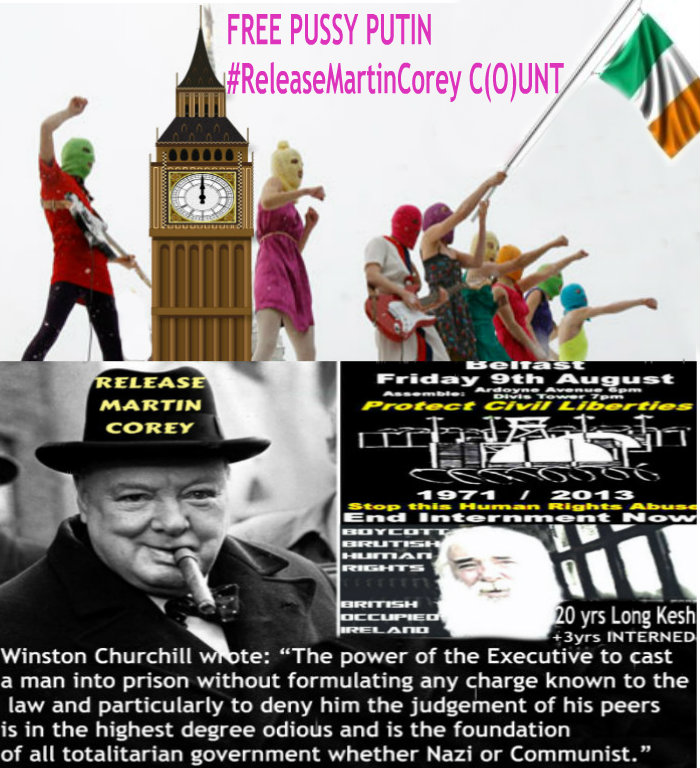
MARTIN COREY INTERNMENT HUMAN RIGHTS ACTIVIST SEEKS POLITICAL ASYLUM IN RUSSIA

10,000 Protest Internment 1971 - 2013 in Belfast
 international | rights and freedoms | news report
  Saturday August 17, 2013 16:50
 by brionOcleirigh - AllVoices
Release Martin Corey
The anti-internment march in Belfast on 9th August 2013, was a welcome display of disciplined unity, against a most serious abuse of human rights, that the establishment parties in Ireland, either wish to ignore or damn with feint protest, while at the same time professing to be democrats, socialists or republicans. Up to 10,000 marchers stewarded by a variety of Irish Republican Socialists, Republicans and human rights organisations, marched from Ardoyne in the north of Belfast, until they they were stopped for approximately 2 hours by PSNI jeeps and thousands of fascist, rioting UVF and Orange Order members near the city centre.
When the human rights marchers pushed their way through the PSNI roadblock, they left the massed riot paramilitary police, with no choice but to clear a route for the protesters, to march through Carrick Hill, before joining with an anti-internment contingent waiting the arrival of comrades at Divis Street. Despite considerable delay, the people of West Belfast lined the march route cheering up to 10,000 anti-internment marchers, making a nonsense of counter revolutionary, press statements and disinformation earlier in the day, bizarrely condemning the 10,000 strong human rights march, as a 'dissident' parade! The march which was lined with well-wishers all along the route, as it made it's way through West Belfast to the Busy Bee Centre, a traditional rallying point for Republicans, where speeches were given by well known human rights figures.
In "THE POLITICS OF INTERNMENT 1971" John McGuffin wrote of the re-introduction of Internment in Occupied Ireland, as follows:
IN the mid-1960's people might have been forgiven for thinking that internment was a thing of the past. (True, the obnoxious Special Powers Acts were still on the Statute Book, but they were in abeyance). Such thinking was not to be right, however. The monolithic structure of Unionism proved incapable of reforming itself under the onslaught of the civil rights campaign. Terence O'Neill might have been able to save the Unionists with his pragmatic approach and his appreciation of the need for change, but their diehard 'not an inch' backwoodsmen would have none of it. And so the week of 12 – 16 August 1969 saw the old familiar pattern: a police force unable, and, in many cases unwilling,[1] to prevent the sectarian attack upon the Falls Road periphery, led in some cases by the B specials. That month was to see house burning, intimidation and murder – ten civilians dead, including a 9-year-old boy asleep in his bed, shot by a high-velocity Browning machine-gun used with murderous recklessness by the police in their Shorland armoured cars; 145 injured, hundreds of families burnt out of their homes, 90% of them Catholic. Free Derry was born that week. The barricades went up in Belfast. The first steps towards the irrevocable demise of Stormont were taken. And, predictably, men were detained, without charge or trial.
At 6.45 a.m. on 14 August, 28 Republicans were arrested and taken from their homes. As usual, no 'Loyalist' extremists or gunmen were arrested.
When the English Special Branch men arrived next month to sort out the RUC they asked for the files on all the 'terrorists'. They were handed the records, mostly out-of-date, on the IRA. "What about the UVF," they asked. "It doesn't exist," was the reply. "We have no records on Loyalists."
But this time it was not to be internment. The British army had had to be called in. Callaghan and Wilson had summoned Chichester Clark to Downing Street. The B men were 'phased out'. The Scarman Tribunal was set up. The Labour Government was tired of the old-fashioned traditional Unionist methods. Moreover, from behind the barricades a campaign was being mounted. Illegal radios proliferated. Street newspapers were born. The detainees were released after 17 to 20 days. The message should have been clear; internment should have no place in the 1970's.
But the Unionist hierarchy learn nothing from history. The gangling figure of Chichester Clark, the stand-in PM, shambled off into obscurity as 1970 and 1971 saw an escalation of the violence by the Provisional IRA, themselves a reaction to the attempted 'Loyalist' pogrom of 1969.
On 23 March 1971 Brian Arthur Deane Faulkner achieved his lifelong ambition and became PM. The English press warned that he was the 'last man in'. If he couldn't control the situation, direct rule was a certainty. But despite the obvious immensity of the task, Faulkner was confident.
This was the moment for which he had schemed, intrigued and betrayed, for so long. With a staggering record of disloyalty to previous PMs, he could hardly expect to be trusted or liked, but surely all could agree on his shrewdness and ability.
In fact, Faulkner's intelligence was always greatly over-rated by the media. And his biggest mistake was soon to come. The Sunday Times 'Insight' team claim[2]that "when he took over the issue was not whether internment was to come, but when and on what scale. By then Faulkner had been an advocate of internment inside Chichester Clark's Joint Security Committee, for six months." Whether this is true or not, and on balance it seems a reasonable statement, it is certain that Faulkner had completely failed to learn the lesson of how and when internment 'worked'. He had been Minister for Home Affairs in 1959 under Brookeborough, and, with the help of his trusty aide, the civil servant William Stout, he bad been responsible for the implementation of internment, which he apparently felt to be responsible for the defeat of the IRA border campaign. As is made clear already, this just was not so. The campaign failed, for lack of popular support, and, most important, the internees could languish in Crumlin because there was no campaign to get them released.
Nevertheless, one of Faulkner's first actions upon becoming Northern Ireland's last PM was to order the RUC Special Branch to work with the Director of Military Intelligence at Lisburn in drawing up a list of those Catholics who should be interned. The army were unhappy. General Tuzo, the GOC in Northern Ireland since February 1971, consistently opposed internment, believing, rightly, as it turned out, that they could not get the right people. But as the violence escalated, Faulkner became more and more insistent. On 9 July he telephoned Heath. "I must be able to intern now" he demanded. Accordingly, with some reluctance, a 'dry run' was agreed upon. At dawn on 23 July, 1,800 troops and RUC raided Republican houses throughout the province, searching for documents. They got enough to encourage them. The decision to intern was only a matter of time then, despite army objections.
The position was complicated by the mistrust and, in some cases, downright hostility between the army and the RUC. As the Sunday Times team put it: "The army believed the police list was politically motivated, and the police believed that the army's list showed inadequate local knowledge." Both were correct. Some sections of the army had favoured a small internment in the spring of 1971, with only 50 or 60 men being lifted. They had been overruled. Now the task was to be much greater.
The list had more than 500 names on it. Of these only 120 or 130 were gunmen or officers in the IRA. The vast majority were regarded either as 'Fellow-travelling sympathisers' or troublesome political activists – like PD socialists. The police contribution was the names and addresses of former internees. But Faulkner was determined. At the Joint Security Committee meeting at Stormont, Shillington, the Chief Constable, agreed with Tuzo that internment would not work. That made no difference. Faulkner secretly flew to London that afternoon. There he convinced the Cabinet. Tuzo could offer no alternative. Maudling was his usual indolent self. Whitelaw said nothing. Internment without trial was acquiesced to.
The date was set for 10 Augnst. On Sunday 7 August, however, Harry Thornton, an innocent building worker, was driving his car past Springfield Road barracks when it backfired. Soldiers opened up and killed him. His friend Murphy was dragged from the car, covered with Thornton's blood, and savagely beaten by police and army. Within minutes the people of Clonard went wild. The fighting went on all night but had died down the next day. But the army were taking no chances. At midnight on Sunday the order went out: operation internment was brought forward 24 hours. Brian Faulkner had unwittingly signed himself his own political death warrant – and that of Stormont, too.
Anti Internment Republican March Attacked By Loyalists
 printable version


 Digg this
 del.icio.us
 Furl
Furl Reddit
 Technorati
 Facebook
Sunday, June 2, 2013
Julian Assange POLITICAL BRITISH NTERNMENT Martin Corey

Assange Talks About Possible Holder Prosecution
By DSWright
As Attorney General Holder faces possible perjury charges Julian Assange, the publisher of Wikileaks, discussed his case with Amy Goodman of Democracy Now. Amy Goodman asked Assange to comment on the AP spying scandal as well as a Fox News reporter, James Rosen, being listed on a warrant signed by AG Holder that lists the reporter as a possible co-conspirator in violations of the Espionage Act.
By DSWright
As Attorney General Holder faces possible perjury charges Julian Assange, the publisher of Wikileaks, discussed his case with Amy Goodman of Democracy Now. Amy Goodman asked Assange to comment on the AP spying scandal as well as a Fox News reporter, James Rosen, being listed on a warrant signed by AG Holder that lists the reporter as a possible co-conspirator in violations of the Espionage Act.
JULIAN ASSANGE: Well, let’s look at this phenomena from two aspects. Don’t be deceived by what appears to be small maneuvers by the Department of Justice to go after AP, to go after Rosen, to go after us, etc. We have over here the bulk surveillance industry run by the National Security Agency that already has all these records. It has them all already. The National Security Agency—and this has come out in one court case after another—was involved in a project called Stellar Wind to collect all the calling records of the United States, every record of everyone calling everyone over years. And the result of that lay out the entire community and political structure, based upon who people are friends with. You can infer that by who calls who, and what the status is by the relative flow of calls around the country, to suck out the entire community structure of the United States. That has already been done. Those calling records already enter into the national security complex.What we’re talking about here are mechanisms to use that information in a court case, and therefore it has to be clean. This is the dirty team; this is the clean team. And so, these are maneuvers to pull people into court cases that will become public to set a deterrent against national security journalism. And the most pernicious aspect of that is the abuse of the Espionage Act and other mechanisms to try and conflate the activities of a source with the activities of a journalist or a publisher, and to try and say that whenever a journalist deals with a source, they’re in fact engaged in a conspiracy. And if there’s an allegation—of course, allegations can be very easily made, placed on the table, just invented from thin air—that a source’s behavior affects national security and is therefore espionage, and therefore, extend that allegation over to the journalist and to the source—and to the publisher. In the case of Rosen, they have done that in order to get at Rosen’s emails and other records, to then back reflect onto the source or onto other sources. You know, it is simply a disgrace. It is unethical conduct. It is politically worrying conduct. It is chilling conduct. And it is—why is it being done? Because they believe they can get away with it. It is part of advancing the frontier of the national security state to roll on over the First Amendment and every other traditionally accepted U.S. value.
If Holder has an ongoing prosecution against Assange and Wikileaks it may not only have a chilling effect on journalism but invalidate his statement to the House Oversight Committee on having “never heard of” prosecuting the press for disclosure of material.
While a journalist has never been prosecuted under the Espionage Act, does Holder consider Assange a journalist? What about the New York Times and McClatchy, both published the Cablegate memos. Was Assange a source, a co-publisher, or both? Hopefully Holder will chose to clarify the Justice Department’s actual press policy and will do so on the record instead of elitist backstage double dealing.
This article was originally published at FDL
Saturday, June 1, 2013
IRELAND'S POLITICAL INTERNMENT EXPERIENCE

In the wake of the internment of Marian Price, which I believe over the last two years, can generally be agreed, to have been a form of internment because it lacked a proper, transparent trial, in a timely manner. I also believe it can be generally agreed by reasonable informed people, to have been a major setback, to what is known as the peace process in Ireland. I personally have neither been a proponent of this process or have believed it will achieve traditional Irish republican aspirations but I accept very reluctantly, it is a reality, delivered by a leadership with elements of competency, without wholesale fratricidal, blood letting.
There is an old expression, that the three long term curses of the Irish, are the English, drink and religion. From bitter personal experience I would agree, that recovery is not an overnight process, no more than a lasting peace based on justice is. The main problem accompanying the above three curses, are that to live or survive in such an environment, requires a lot of secrecy lies and generally many unhealthy, dishonest, subservient habits.
The current British occupation in Ireland, requires a considerable amount of draconian secrecy, under their Official Secrets Act and all the variations that ensues, with secret internment without trial, secret courts, and a feral secret service. This form of repression in Ireland has always been met with resistance, including physical force. To sustain resistance over any given time also requires considerable secrecy, 'rough justice,' along with violence to oppose the British Imperial violence of invasion, None of this is compatible with the necessary basic justice, that is a critical requirement of peace. Those who call for peace without this basic justice, are disingenuous and often do so from a vested interest, class based privilege. However equally, it must be also said, that after 800 years of traditional struggle, we have made little progress with our methods towars our goals.
It has been stated by experienced genuine revolutionaries, that we have a moral responsibility, to try every possible means of resistance, before the last resort of armed struggle. It is my own experience, reluctant opinion and conclusion, from bitter personal experience, that a long term campaign of guerrilla warfare, is not sustainable, successfully, in the culture of the small island of often socially incestuous, contemporary, Ireland. There are a myriad of reasons which at this point in time, would to take too long to explain this peoperly.It does however merit, considerable honest debate and discussion by genuine people, particularly of no property in Ireland.
Experience is the best teacher, but a fool will learn from no other. - Benjamin Franklin
This appears to be a very harsh statement but again from I personal experience, I have to agree. So what then is a serious alternative, to physical force politics, state terrorism and reactionary violence. I personally believe that in this age of the internet, in the absence of overbearing malign censorship,we have a tool to win our aspirations, albeit slowly and with considerable patience. Patience is for me, the best definition of the often abused word of love. Love is patient. There are many examples is Irish history, of heroic love for our island expressed by our sons and daughters. Probably the most famous recent, well known example being the death of twelve Irish hunger strikers in the present phase of struggle, there being a total of twenty two altogether. Our success depends on coming from love rather than hate, again easier said than done in an outside, mentored political environment of tit for tat divide and conquer.
It is difficult to refuse to rise to the bait of provocation and infuriating for me personally at times, as someone who sees religion, as a big part of the problem, to recognize that certain truths expressed in the Good Book, correspond perfectly with my own experience of baby steps towards the solution. The Book states, that no greater love had anyone, than to lay down their life for their friend. It also states that the truth will set us free. I believe personally, that under present circumstances, despite draconian censorship and repression, we have responsibility to try the truth rather than live by the sword. Many say the truth is is the most powerful thing on the face of this planet and personally from my own experience, I would have to agree.
Many will say on a class basis, that all of thsi it is easy to say, for someone relatively comfortable, than to have such patience, in the face of murderous imperialism and dire poverty on their doorstep. From personal experience I agree but we do have an alternative and I believe a moral responsibility, for those with potential leadership qualities, to seriously try, before resorting to armed struggle. Contemporary experience demonstrates, that terrorism begets terrorism, be it British state terrorism or reactionary violence. Having stated all of this, I believe there is a tipping point in any mass movement, with a mandate of overwhelming mass support, where there a responsibility lies with the leadership, to take the levers of power for the people, with as little bloodshed as possible.
The Truth will Set us Free in a Society as Sick as its Secrets
For those of you out there who disagree, and wish to demonstrate to me the errors of my ways, you are very welcome to do so. In the meantime I will do my best with these attempts on the internet to walk the talk. I believe every element of traditional Irish republicanism, even the Gerry Adams' flock can teach me something, so I will be quoting you. I have to say, as a non-member of Republican Sinn Fein that their traditional document, 'Eire Nua' is the best blueprint I have found, as a democratic way forward to the solution.
Going back again to the Marian Price saga, I believe Gerry Adams made a very rational remark, in the wake of Marian's release from internment. “The logic of today’s release is that Martin Corey should also befreed," Provisional Sinn Fein leader Gerry Adams. In the interest of not inflaming passions further and making a serious effort to underpin a serious Peace Process with justice, the onus is on all of us, not to just pay lip service a superficial peace. This will require serious commitment, patience, tenacity and many volunteers.
To remain honest with you, it is my belief , that the status of British Occupied Ireland, cannot sustain itself in the contest of the small island of Ireland, without supremacist outsiders, engineering the cancer of sectarianism heaped on top of their class based system of inherited privilege and monarchy. I challenge them to prove me wrong. In the meantime I will try to walk the talk by quoting below an article from Wikipedia about the experience of internment being used in Ireland, in the context of trying to learn with Martin Corey's current internment without a proper trial. - Brian Clarke
Operation Demetrius
- From Wikipedia, the free encyclopedia
- sh nationalist resistance". An Phoblacht. 9 August 2007.
- ^ a b c Malcolm Sutton's Index of Deaths from the Conflict in Ireland: 1971. Conflict Archive on the Internet (CAIN)
- ^ a b c d e f Coogan, Tim Pat. The Troubles: Ireland's ordeal 1966-1996 and the search for peace. Palgrave, 2002. p.152
- ^ "Violence ebbing in Northern Ireland". The Milwaukee Journal, 13 August 1971.
- ^ Internment - Summary of Main Events. Conflict Archive on the Internet (CAIN)
- ^ Hamill, D. Pig in the Middle: The Army in Northern Ireland. London, Methuen, 1985.
- ^ The Parker Report, March 1972. Conflict Archive on the Internet (CAIN)
- ^ a b Ireland v. the United Kingdom Paragraph 101 and 135
- ^ Security Detainees/Enemy Combatants: U.S. Law Prohibits Torture and other Cruel, Inhuman or Degrading Treatment or Punishment Footnote 16
- ^ Weissbrodt, David. Materials on torture and other ill-treatment: 3. European Court of Human Rights (doc) html: Ireland v. United Kingdom, 1976 Y.B. Eur. Conv. on Hum. Rts. 512, 748, 788-94 (Eur. Comm’n of Hum. Rts.)
- ^ IRELAND v. THE UNITED KINGDOM - 5310/71 (1978) ECHR 1 (18 January 1978)
Operation Demetrius
Part of The Troubles and Operation Banner

The entrance to Compound 19, one of the sections of Long Kesh internment camp
Location Northern Ireland
Objective Arrest of suspected Irish republicanparamilitaries
Date 9–10 August 1971
04:00 – ? (UTC+01:00)
Executed by
 British Army Royal Ulster Constabulary
Outcome 342 people arrested and interned
7,000 civilians displaced
Casualties (see below)
[show]
v
t
e
The Troubles
Operation Demetrius was a British Army operation in Northern Ireland on 9–10 August 1971, during The Troubles. It involved the mass arrest andinternment (without trial) of 342 people suspected of being involved with Irish republican paramilitaries (the Provisional IRA and Official IRA). Armed soldiers launched dawn raids throughout Northern Ireland, sparking four days of rioting that killed 20 civilians, two Provisional IRA members and two British soldiers. About 7,000 people fled their homes, of which roughly 2,500 fled south of the border. No loyalist paramilitaries were included in the sweep and many of those who were arrested had no links with republican paramilitaries, which caused much anger. The policy of internment was to last until December 1975 and during that time 1,981 people were interned.[1] Its introduction, and the abuse of those interned, led to numerous protests and a sharp increase in violence. The interrogation techniques used on the internees were described by the European Commission of Human Rights in 1976 as "torture", but theEuropean Court of Human Rights ruled on appeal in 1978 that while the techniques were "inhuman and degrading", they did not constitute torture.[2]
Contents [hide]
1 Planning
2 Legal basis
3 The operation and its immediate aftermath
4 Long-term effects
5 Effects on domestic and international law
5.1 Parker Report
5.2 European Commission of Human Rights
5.3 European Court of Human Rights
6 References
Planning [edit]
Internment was re-introduced on the orders of the then Prime Minister of Northern Ireland, Brian Faulkner. The policy of internment had been used a number of times during Northern Ireland's (and the Republic of Ireland's) history.
In the case brought to the European Commission of Human Rights by the Irish Government against the United Kingdom, it was conceded that Operation Demetrius was planned and implemented from the highest levels of the British Government and that specially trained personnel were sent to Northern Ireland to familiarize the local forces in what became known as the 'five techniques', described by opponents as "a euphemism for torture".[3]
On the initial list of those to be arrested, which was drawn up by RUC Special Branch and MI5, there were 450 names, but only 350 of these were able to be arrested. Key figures on the lists, and many who never appeared on them, were warned before the swoop began. It included leaders of the non-violent civil rights movement such as Ivan Barr and Michael Farrell. But, as Tim Pat Coogan noted,
What they did not include was a single Loyalist. Although the UVF had begun the killing and bombing, this organisation was left untouched, as were other violent Loyalist satellite organisations such as Tara, the Shankill Defence Associationand the Ulster Protestant Volunteers. It is known that Faulkner was urged by the British to include a few Protestants in the trawl but he refused.[4]
It was agreed to introduce internment at a meeting between Faulkner and UK Prime Minister Edward Heath in August 5, 1971. The British cabinet recommended, “balancing action”, such as the arrest of loyalist militants, the calling in of weapons held by (generally unionist) rifle clubs in Northern Ireland and the indefinite ban on parades, particularly those by the Orange Order. However Faulkner argued that a ban on parades was unworkable, the gun clubs posed no security risk and there was no evidence of loyalist terrorism. It was eventually agreed that there would be a six-month ban on parades but no targeting of loyalists and that internment would go ahead on August 9, in an operation carried out by the Army.[5]
Legal basis [edit]
The internments were initially carried out under Regulations 11 and 12 of 1956 and Regulation 10 of 1957 (the Special Powers Regulations), made under the authority of the Special Powers Act. The Detention of Terrorists Order of 7 November 1972, made under the authority of the Temporary Provisions Act, was used after direct rule was instituted.
The operation and its immediate aftermath [edit]
 The HMS Maidstone, a prison ship docked at Belfast where many internees were sent
Operation Demetrius began on Monday 9 August at about 4AM.
The operation was in two parts:
(1) Arrest and movement of the detainees to one of three regional holding centers: Girdwood in Belfast, Ballykinler in County Down, or Magilligan in County Londonderry.
(2) The process of identification and questioning, leading either to release of the detainee or movement into detention at Crumlin Road prison or aboard the HMS Maidstone, aprison ship in Belfast Harbor.[6]
In the first wave of raids across Northern Ireland, 342 people were arrested.[7] Many of those arrested reported that they and their families were assaulted, verbally abused and threatened by the soldiers. There were claims of soldiers smashing their way into houses without warning and firing rubber bullets through doors and windows. Many of those arrested also reported being ill-treated during their detention. They complained of being beaten, verbally abused, threatened, harassed by dogs, denied sleep, and starved. Specific humiliations included being forced to run a gauntlet of baton-wielding soldiers, having their heads forcefully shaved, being kept naked, being burnt with cigarettes, having a sack placed over their heads for long periods, having a rope kept around their necks, having the barrel of a gun pressed against their heads, being dragged by the hair, being trailed behind armored vehicles while barefoot, and being tied to armored trucks as a human shield.[8][9]
The operation sparked an immediate upsurge of violence, which was said to be the worst since the August 1969 riots.[7] The British Army came under sustained attack from Irish nationalist/republican rioters and gunmen, especially in Belfast. According to journalistKevin Myers: "Insanity seized the city. Hundreds of vehicles were hijacked and factories were burnt. Loyalist and IRA gunmen were everywhere".[10] People blocked roads and streets with burning barricades to stop the British Army entering their neighborhoods. InDerry, barricades were again erected around Free Derry and "for the next 11 months these areas effectively seceded from British control".[11] Between 9 and 11 August, 24 people were killed or fatally wounded: 20 civilians (14 Irish Catholics, 6 Protestants), two members of the Provisional IRA, shot dead by the British Army, and two members of the British Army, shot dead by the Provisional IRA.[12]
 A mural commemorating those killed in theBallymurphy Massacre during Operation Demetrius
Of the civilians killed, 17 were killed by the British Army and the other three were killed by unknown attackers.[12] In West Belfast's Ballymurphy housing estate, 11 Irish Catholic civilians were killed by the British Army between 9 and 11 August in an episode that has become known as the Ballymurphy Massacre. Another flashpoint was Ardoyne in North Belfast, where soldiers shot dead three people on 9 August.[12] Many Protestant families fled Ardoyne and about 200 burnt their homes as they left, lest they "fall into Catholic hands".[13] Protestant and Catholic families fled "to either side of a dividing line, which would provide the foundation for the permanent peaceline later built in the area".[10] Catholic homes were burnt in Ardoyne and elsewhere too.[13] About 7000 people, most of them Catholic, were left homeless.[13] About 2500 Catholic refugees fled south of the border, where newrefugee camps were set up.[13]
By 13 August, media reports indicated that the violence had begun to wane, seemingly due to exhaustion on the part of the IRA and security forces.[14]
On 15 August, the nationalist Social Democratic and Labour Party (SDLP) announced that it was starting a campaign of civil disobedience in response to the introduction of internment. By 17 October, it was estimated that about 16,000 households were withholding rent and rates for council houses as part of the campaign of civil disobedience.[7]
On 16 August, over 8000 workers went on strike in Derry in protest at internment. Joe Cahill, then Chief of Staff of the Provisional IRA, held a press conference during which he claimed that only 30 Provisional IRA members had been interned.[7]
On 22 August, in protest against internment, about 130 non-Unionist councillors announced that they would no longer sit on district councils. The SDLP also withdrew its representatives from a number of public bodies.[7] On 19 October, five Northern Ireland Members of Parliament (MPs) began a 48-hour hunger strike against internment. The protest took place near 10 Downing Street in London. Among those taking part were John Hume, Austin Currie, and Bernadette Devlin.[7] Protests would continue until internment was ended in December 1975.
Long-term effects [edit]
,_August_2009.JPG) Anti-internment mural in the Bogside area of Derry
Anti-internment mural in the Bogside area of DerryThe backlash against internment contributed to the decision of the British Government under Prime Minister Edward Heath to suspend the Northern Ireland Government and replace it with direct rule from Westminster, under the authority of a British Secretary of State for Northern Ireland.
Following the resignation of the Government of Northern Ireland and the prorogation of theParliament of Northern Ireland in 1972, internment was continued by the direct ruleadministration until 5 December 1975. During this time a total of 1,981 people were interned: 1,874 were from a Catholic or Irish nationalist background, while 107 were from a Protestant or Ulster loyalist background.[15]
Historians generally view the period of internment as inflaming sectarian tensions in Northern Ireland, while failing in its goal of arresting key members of the IRA. Many of the nationalists arrested had no links whatsoever with the IRA, but their names appeared on the list of those to be arrested through bungling and incompetence. The list's lack of reliability and the arrests that followed, complemented by reports of internees being abused, led to more people identifying with the IRA in the nationalist community and losing hope in other methods. After Operation Demetrius, recruits came forward in huge numbers to join the Provisional and Official wings of the IRA.[13] Internment also led to a sharp increase in violence. In the eight months before the operation, there were 34 conflict-related deaths in Northern Ireland. In the four months following it, 140 were killed.[13] A serving officer of the British Royal Marines declared:
It (internment) has, in fact, increased terrorist activity, perhaps boosted IRA recruitment, polarised further the Catholic and Protestant communities and reduced the ranks of the much needed Catholic moderates.[16]
In terms of loss of life, 1972 was the most violent of the Troubles. The fatal march on Bloody Sunday (30 January 1972) in Derry, when 14 unarmed civil rights protesters were shot dead by British paratroopers, was an anti-internment march.
Effects on domestic and international law [edit]
Parker Report [edit]
When the interrogation techniques used on the internees became known to the public, there was outrage at the Government, especially from the Irish nationalist community. In answer to the anger from the public and Members of Parliament, on 16 November 1971 (just over a month after the start of the operation), the British Government commissioned a committee of inquiry chaired by Lord Parker (theLord Chief Justice of England) to look into the legal and moral aspects of the 'five techniques'.
The "Parker Report"[17] was published on 2 March 1972 and found the five techniques to be illegal under domestic law:
10. Domestic Law ...(c) We have received both written and oral representations from many legal bodies and individual lawyers from both England and Northern Ireland. There has been no dissent from the view that the procedures are illegal alike by the law of England and the law of Northern Ireland. ... (d) This being so, no Army Directive and no Minister could lawfully or validly have authorized the use of the procedures. Only Parliament can alter the law. The procedures were and are illegal.
On the same day (2 March 1972), United Kingdom Prime Minister Edward Heath stated in the House of Commons:
[The] Government, having reviewed the whole matter with great care and with reference to any future operations, have decided that the techniques ... will not be used in future as an aid to interrogation... The statement that I have made covers all future circumstances.[18]
As foreshadowed in the Prime Minister's statement, directives expressly forbidding the use of the techniques, whether alone or together, were then issued to the security forces by the Government.[18] These are still in force and the use of such methods by UK security forces would not be condoned by the Government.
European Commission of Human Rights [edit]
The Irish Government, on behalf of the men who had been subject to the five techniques, took a case to the European Commission on Human Rights (Ireland v. United Kingdom, 1976 Y.B. Eur. Conv. on Hum. Rts. 512, 748, 788-94 (Eur. Comm’n of Hum. Rts.)). The Commission stated that it
...unanimously considered the combined use of the five methods to amount to torture, on the grounds that (1) the intensity of the stress caused by techniques creating sensory deprivation "directly affects the personality physically and mentally"; and (2) "the systematic application of the techniques for the purpose of inducing a person to give information shows a clear resemblance to those methods of systematic torture which have been known over the ages...a modern system of torture falling into the same category as those systems applied in previous times as a means of obtaining information and confessions.[19][20]
European Court of Human Rights [edit]
The Commissions findings were appealed. In 1978, in the European Court of Human Rights (ECHR) trial Ireland v. the United Kingdom(Case No. 5310/71),[21] the facts were not in dispute and the judges court published the following in their judgement:
These methods, sometimes termed "disorientation" or "sensory deprivation" techniques, were not used in any cases other than the fourteen so indicated above. It emerges from the Commission's establishment of the facts that the techniques consisted of:
(a) wall-standing: forcing the detainees to remain for periods of some hours in a "stress position", described by those who underwent it as being "spreadeagled against the wall, with their fingers put high above the head against the wall, the legs spread apart and the feet back, causing them to stand on their toes with the weight of the body mainly on the fingers";
(b) hooding: putting a black or navy coloured bag over the detainees' heads and, at least initially, keeping it there all the time except during interrogation;
(c) subjection to noise: pending their interrogations, holding the detainees in a room where there was a continuous loud and hissing noise;
(d) deprivation of sleep: pending their interrogations, depriving the detainees of sleep;
(e) deprivation of food and drink: subjecting the detainees to a reduced diet during their stay at the centre and pending interrogations.
These (a to e) were the 'five techniques' referred to above. The court ruled:
167. ... Although the five techniques, as applied in combination, undoubtedly amounted to inhuman and degrading treatment, although their object was the extraction of confessions, the naming of others and/or information and although they were used systematically, they did not occasion suffering of the particular intensity and cruelty implied by the word torture as so understood. ... 168. The Court concludes that recourse to the five techniques amounted to a practice of inhuman and degrading treatment, which practice was in breach of [the European Convention on Human Rights] Article 3 (art. 3).
On 8 February 1977, in proceedings before the ECHR, and in line with the findings of the Parker Report and UK Government policy, the Attorney-General of the United Kingdom stated:
The Government of the United Kingdom have considered the question of the use of the 'five techniques' with very great care and with particular regard to Article 3 (art. 3) of the Convention. They now give this unqualified undertaking, that the 'five techniques' will not in any circumstances be reintroduced as an aid to interrogation.
References [edit]
^ Joint Committee on Human Rights, Parliament of the United Kingdom (2005). Counter-Terrorism Policy And Human Rights: Terrorism Bill and related matters: Oral and Written Evidence. Counter-Terrorism Policy And Human Rights: Terrorism Bill and related matters 2. The Stationery Office. p. 110.
^ http://www.worldlii.org/eu/cases/ECHR/1978/1.html
^ Parker, Tom. Frontline: "Is torture ever justified?". PBS.
^ Coogan, Tim Pat. The Troubles: Ireland's ordeal 1966-1996 and the search for peace. London: Hutchinson. p.126Internment - Summary of Main Events
^ The Irish Story - Internment is introduced in Northern Ireland
^ The Compton Report, November 1971. Conflict Archive on the Internet (CAIN)
^ a b c d e f Internment: A chronology of the main events.Conflict Archive on the Internet (CAIN)
^ Danny Kennally and Eric Preston. Belfast August 1971: A Case to be Answered. Independent Labour Party, 1971.Conflict Archive on the Internet (CAIN).
^ Danny Kennally and Eric Preston. Belfast August 1971: A Case to be Answered. Chapter: Treatment of Arrested. Independent Labour Party, 1971. Conflict Archive on the Internet(CAIN).
^ a b McKittrick, David. Lost Lives: The stories of the men, women and children who died through the Northern Ireland Troubles. Mainstream, 1999. p.80
^ "Blunt weapon of internment fails to cru
Thursday, October 4, 2012
British Political Internment Madness to Induce Suicide of Marian Price
British Political Internment Madness to Induce Suicide of Marian Price
international | crime and justice | news report Thursday October 04, 2012 08:39 by BrianClarkeNUJ
Secret Trials and Experiments
Issues of mental health and insanity due to solitary confinement and other extreme forms of Sensory Deprivation date back to the 19th century and were widely researched by a variety of academics and scholars at that time.Some of these early prison experiments indicated that many prisoners preferred the lash over solitary confinement, because it did not induce permanent damage and would not incite madness like solitary confinement. Mental instability has been linked to solitary confinement since the 1860s. Prison records of the Danish institute of 1870-1920 demonstrate, that inmates showed signs of mental illnesses in isolation, revealing that knowledge of this has been around for more than a hundred years before the British started serious experiment on Irish political internees, who later became known as "The Guineapigs" after an internee John McGuffuin, wrote a book about it by that title .
Issues of mental health and insanity due to solitary confinement and other extreme forms of Sensory Deprivation date back to the 19th century and were widely researched by a variety of academics and scholars at that time.Some of these early prison experiments indicated that many prisoners preferred the lash over solitary confinement, because it did not induce permanent damage and would not incite madness like solitary confinement. Mental instability has been linked to solitary confinement since the 1860s. Prison records of the Danish institute of 1870-1920 demonstrate, that inmates showed signs of mental illnesses in isolation, revealing that knowledge of this has been around for more than a hundred years before the British started serious experiment on Irish political internees, who later became known as "The Guineapigs" after an internee John McGuffuin, wrote a book about it by that title .
The British as result of these Sensory Deprivation torture experiments, became the world's leading experts on the matter and refined it down to their sick art. The British are very aware as result of these experiments, on how to induce various forms of specific psychosis and are still perfecting their dark arts, on their latest internees of political conscience, which includes Marian Price. The experiments are also used to induce a psychotic state, to later discredit political prisoners, such as the Price sisters when eventually they are released. The British experiments are often supplemented with different drugs, secretly administered in the food of Irish political prisoners. On other occasions the British use the induced psychotic state to induce the suicide of political dissidents.
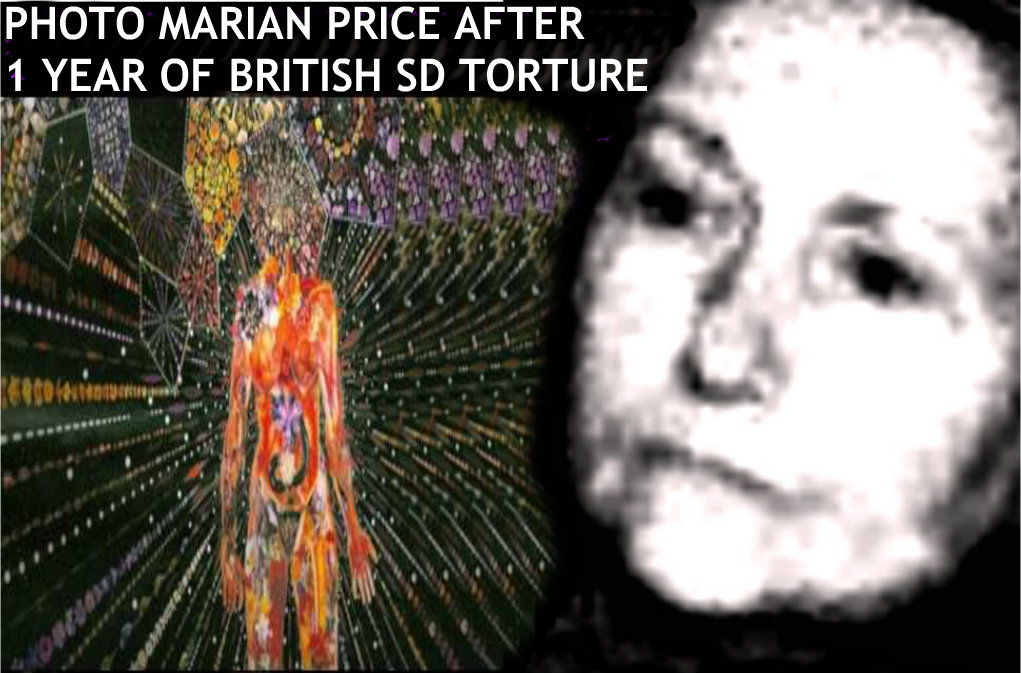
Solitary internment without trial in British Occupied Ireland, which Marian Price has endured now, for more than one year on this occasion, coupled with more than six months of force feeding previously, has left Marian Price permanently, distraught and physically damaged and in seriously bad health. The Irish internees of this special form of torture in which political dissident internees are isolated from any human contact, is sometimes used as a form of punishment beyond incarceration for Irish political prisoners, as well as conducting further experiments in their dark sadistic British art. Some previous interned Irish political prisoners or the original Guineapigs of Sensory Deprivation, prior to the latest form of selective internment, suffered subsequent seriously bad health, death and suicide.
On June 5, 1975 Sean McKenna died. On his death certificate the cause of death was 'heart attack'. At the funeral oration Ruari O'Bradaigh, President of Sinn Fein said: "Before 1971 Sean McKenna was a strong, healthy man, but after suffering at the hands of the enemy, the great tortures to which he was subjected, his time was marked. He started to die for Ireland at 4 am. on August 9, 1971 when he was interned and tortured." At the time of his internment Sean McKenna, at 42 was the oldest of the Guineapigs. He was also one of those worst-affected. Following the experiment he was kept interned at Long Kesh, in a very bad state, for two years before being transferred to various psychiatric hospitals and finally released, only to die a year later.
Professor Robert J. Daly of Cork University, who carried out a five year study of many of the Guineapigs, examined McKenna four months before his death reporting him physically fit. "He had a feeling of impending fatal illness and had gross symptoms of anxiety." Professor Daly also spoke of three of the other Guineapigs. "One 29 year old hooded man has developed Hodgkin's disease, of which there was no evidence prior to his arrest.Hodgkin's disease is a rare form of cancer. It is still not curable but can be treated. Another man has had surgical treatment for carcinoma of the skin which developed on one of his scars which he received on his leg while being 'interrogated in depth'. A fourth man has had colonic resection for suspected Chron's disease. He developed intense and chronic diarrhoea some three months after the 'interrogation in depth'. All the hooded men report disability to a greater or lesser extent and this has included outpatient and inpatient psychiatric treatment as well as treatment for medical illness."
British Army training in 'psyops' or psychological operations, torture and sensory deprivation has continued with Marian Price, despite the British Government giving an 'assurance' that such methods would never be used again, when they were found guilty of torture in Ireland, at the International Court of Human rights in Strasbourg. The end result of the 'Guineapigs' experiment, like so many other experiment being conducted in British Occupied Ireland, is that the British are now regarded as experts at this form of torture and are regularly invited to give demonstrations and seminars, at places such as Fort Bragg, Carolina, and Fort Huachuca, Arizona and Bad Tolz in West Germany.They also instructed the fascist P.I.D.E. Portuguese secret police until they discovered to their disgust and embarrassment after an Army coup, they had unbeknownst to themselves, been giving lessons of Kitsonian counter-insurgency techniques and torture, to guerrillas in Latin American, who had infiltrated the Portugese Army and the British torture courses.
Besides the psychological harm the British have inflicted on Marian Price the sensory deprivation will have a severe negative impact on her mental state and may lead to mental illnesses such as depression, permanent change in her brain physiology, along with an induced existential crisis, that will probably lead to her premature death. Women are more far more likely to become depressed because of paranoid feelings of and imagined lack of support by their families outside prison. The extreme form of solitary confinement, Sensory Deprivation and isolation suffered by Marian will be felt by the larger Irish community as a whole. The unreasonable amount of time Marian has spent in solitary confinement will probably mean that Marian will suffer from serious mental illnesses even if the British ever release her.
The British plan as result of their experiments on Irish political guineapigs, with new legislation this Autumn and more secret courts in England to place prisoners in solitary confinement based on sexual orientation, race and religion. This form of psychological torture and its negative psychological effects were described by one leading judge to rule that “Solitary confinement or Sensory deprivation units are virtual incubators of psychoses seeding illness in otherwise healthy inmates.” This author has received uncorroborated evidence more than one year ago, that the British plan with regard to the torture of Marian Price, is to induce her suicide, with the use of Sensory Deprivation. This has already been achieved with other prisoners of political conscience.
The British as result of these Sensory Deprivation torture experiments, became the world's leading experts on the matter and refined it down to their sick art. The British are very aware as result of these experiments, on how to induce various forms of specific psychosis and are still perfecting their dark arts, on their latest internees of political conscience, which includes Marian Price. The experiments are also used to induce a psychotic state, to later discredit political prisoners, such as the Price sisters when eventually they are released. The British experiments are often supplemented with different drugs, secretly administered in the food of Irish political prisoners. On other occasions the British use the induced psychotic state to induce the suicide of political dissidents.
Solitary internment without trial in British Occupied Ireland, which Marian Price has endured now, for more than one year on this occasion, coupled with more than six months of force feeding previously, has left Marian Price permanently, distraught and physically damaged and in seriously bad health. The Irish internees of this special form of torture in which political dissident internees are isolated from any human contact, is sometimes used as a form of punishment beyond incarceration for Irish political prisoners, as well as conducting further experiments in their dark sadistic British art. Some previous interned Irish political prisoners or the original Guineapigs of Sensory Deprivation, prior to the latest form of selective internment, suffered subsequent seriously bad health, death and suicide.
On June 5, 1975 Sean McKenna died. On his death certificate the cause of death was 'heart attack'. At the funeral oration Ruari O'Bradaigh, President of Sinn Fein said: "Before 1971 Sean McKenna was a strong, healthy man, but after suffering at the hands of the enemy, the great tortures to which he was subjected, his time was marked. He started to die for Ireland at 4 am. on August 9, 1971 when he was interned and tortured." At the time of his internment Sean McKenna, at 42 was the oldest of the Guineapigs. He was also one of those worst-affected. Following the experiment he was kept interned at Long Kesh, in a very bad state, for two years before being transferred to various psychiatric hospitals and finally released, only to die a year later.
Professor Robert J. Daly of Cork University, who carried out a five year study of many of the Guineapigs, examined McKenna four months before his death reporting him physically fit. "He had a feeling of impending fatal illness and had gross symptoms of anxiety." Professor Daly also spoke of three of the other Guineapigs. "One 29 year old hooded man has developed Hodgkin's disease, of which there was no evidence prior to his arrest.Hodgkin's disease is a rare form of cancer. It is still not curable but can be treated. Another man has had surgical treatment for carcinoma of the skin which developed on one of his scars which he received on his leg while being 'interrogated in depth'. A fourth man has had colonic resection for suspected Chron's disease. He developed intense and chronic diarrhoea some three months after the 'interrogation in depth'. All the hooded men report disability to a greater or lesser extent and this has included outpatient and inpatient psychiatric treatment as well as treatment for medical illness."
British Army training in 'psyops' or psychological operations, torture and sensory deprivation has continued with Marian Price, despite the British Government giving an 'assurance' that such methods would never be used again, when they were found guilty of torture in Ireland, at the International Court of Human rights in Strasbourg. The end result of the 'Guineapigs' experiment, like so many other experiment being conducted in British Occupied Ireland, is that the British are now regarded as experts at this form of torture and are regularly invited to give demonstrations and seminars, at places such as Fort Bragg, Carolina, and Fort Huachuca, Arizona and Bad Tolz in West Germany.They also instructed the fascist P.I.D.E. Portuguese secret police until they discovered to their disgust and embarrassment after an Army coup, they had unbeknownst to themselves, been giving lessons of Kitsonian counter-insurgency techniques and torture, to guerrillas in Latin American, who had infiltrated the Portugese Army and the British torture courses.
Besides the psychological harm the British have inflicted on Marian Price the sensory deprivation will have a severe negative impact on her mental state and may lead to mental illnesses such as depression, permanent change in her brain physiology, along with an induced existential crisis, that will probably lead to her premature death. Women are more far more likely to become depressed because of paranoid feelings of and imagined lack of support by their families outside prison. The extreme form of solitary confinement, Sensory Deprivation and isolation suffered by Marian will be felt by the larger Irish community as a whole. The unreasonable amount of time Marian has spent in solitary confinement will probably mean that Marian will suffer from serious mental illnesses even if the British ever release her.
The British plan as result of their experiments on Irish political guineapigs, with new legislation this Autumn and more secret courts in England to place prisoners in solitary confinement based on sexual orientation, race and religion. This form of psychological torture and its negative psychological effects were described by one leading judge to rule that “Solitary confinement or Sensory deprivation units are virtual incubators of psychoses seeding illness in otherwise healthy inmates.” This author has received uncorroborated evidence more than one year ago, that the British plan with regard to the torture of Marian Price, is to induce her suicide, with the use of Sensory Deprivation. This has already been achieved with other prisoners of political conscience.
Subscribe to:
Posts (Atom)
View Comments Titles Only
save preference
Comments (2 of 2)
Jump To Comment: 1 2Author of “Enemies of the State,” Gary Murray, who researched Group 13 for a book but was prevented from writing it. During his research, he was dragged into the back of a van, and had a gun stuck to his mouth. He was told, it would be unwise to continue after which he decided to abandon writing the book.
Group 13 evolved from SAS soldiers and British Secret Service operatives, who were given hands on experience in the counter insurgency political laboratory of British Occupied Ireland, from the late nineteen seventies onward. Starting with Fredrick Holroyd, a Captain in British Army Intelligence, who focused on developing informers and human intelligence sources, connected with the IRA. Resulting viscous turf wars between MI5 and MI6, to control the highly lucrative“patch” of British Occupied Ireland complicated matters considerably.
Holroyd shed considerable light on Britain's dirty war and “Shoot to Kill” policies in Occupied Ireland, which resulted in the dysfunctional investigation of senior police officer, John Stalker. This was also covered in the feature film Hidden Agenda.To cover deployment in this politically sensitive area, they disguised themselves as “training teams,” with cover names like, the Royal Engineers, the Four Field Survey Troop, the Military Reconnaissance Force (MRF), and the 14th Intelligence unit.
All were SAS undercover units stationed principally at Castiledillon, Armagh. Right wing groups operating in the shadows of power, planned a right wing coup. These groups some based in Mid- Ulster, were given unofficial political cover for British State Terrorism, by the Tory Government of Margaret Thatcher, others named GB75, organised by David Sterling, founder of the SAS were operating alongside other groups who have close contact with British Secret Services, from which they still receive some unofficial cover.
Another mysterious group called Resistance and Psychological Operations Committee RPOC was based on material researched, during the torture of Martin Corey and his comrades, when tortured during Long Kesh internment in British Occupied Ireland. RPOC was a reflection of the Special Operations Executive SOE, a dirty tricks operation. RPOC have a clandestine underground movement, operating on a nod and a wink of the Conservative government, with forged close links to British Secret Services and also close links with the SAS. Little is known of the Tory SAS’s secret intelligence network, other than being tasked, with protecting the SAS, who’s lives may be under threat, as a result of their activities. The Irish journalist believes a contract has been put out on him, after this SAS secretive group had mopped on another freelance assassination team sent to kill other Irish human rights activists. “Mopping up” meaning killing members of the original assassination squad.
Elements within this group also evolved to become Group 13. Highly unofficial but desirable to players within the Tory government. Responsible for British political assassinations in Occupied Ireland and worldwide they have right wing agenda. The best known being the SAS in a “wet operation” murder of an unarmed IRA unit in Gibraltar, which led to the TV documentary Death on the Rock, based on eye-witnesses who testified, that the three members were gunned down in cold blood, which in the context of what was happening in Ireland during this period, was part of a shoot-to-kill-policy. meant to 'sanitize' the republican movement, prior to negotiations proper. Gene “Chip” Tatum a former CIA operative and former member of the international assassination team Pegasus, targeting influential international politicians and financiers, alleges that the British assassins, operated during the mid-eighties onward, under the direction of a high ranking British government official, who in turn answered only to Thatcher.
Connections between Group Thirteen and the United States intelligence community during the alleged assassination of Vincent Foster, associate and legal adviser to President Clinton, existed around a highly secret US assassination team, operating out of the National Security Agency NSA. This unit is called “I-3,” with the information on this unit, provided by a “former CIA agent with the CIA’s highest security clearance.” The NSA unit just happens to share a common name with “Group 13” and just happens to be in the same business?
Despite all the smoke and mirrors surrounding Group 13, significant information came to light after the Scott Enquiry into arms to Iraq. Gerald James a leading British munitions manufacturer has written of group 13 in his book In the Public Interest, blowing the lid off the British government's arming of Iraq’s Saddam Hussein. James believes his removal from the Board of Astra, was orchestrated by non-executive director Stephan Kock, a self acknowledged former Security and Intelligence officer in the employ of Midland Bank.
In written evidence presented to the House of Commons Trade and Industry Committee, James stated that he was told, that Kock was “… a former head of ‘Group 13.’ The organisation is a hit or contract squad for the Foreign Office and Secret Services.” The Foreign Office draws Group 13 operatives from the SAS and private security firms,” and “It’s duties involve ‘service to the nation.’” Polite language for British State terrorism. Kock had exceptionally senior level contacts inside British intelligence including ready access to the highest levels of the British government, including the British Prime Minister.
Dr. Gerald Bull - designer of the Supergun , who was shot outside his apartment in Brussels, a few months before his assassination, writing to a colleague, stated he was “advised in a letter of an imminent accident.” He identified the origin of the threat as being the British Foreign Office. This then is the background of the application to Russia for political asylum by the Irish journalist.
Under Article 14 of the Universal Declaration of Human Rights which states that "Everyone has the right to seek and to enjoy in other countries asylum from persecution." The United Nations 1951 Convention Relating to the Status of Refugees and the 1967 Protocol Relating to the Status of Refugees guides national legislation concerning political asylum. Under these agreements, a refugee is a person who is outside their own country's territory owing to fear of persecution on protected grounds. Protected grounds include race, caste, nationality, religion, political opinions and membership and/or participation in any particular social group or social activities. Rendering true victims of persecution to their persecutor is a particularly odious violation of a principle called non-refoulement, part of the customary and trucial Law of Nations.These are the accepted terms and criteria as principles and a fundamental part in the 1951 United Nations Convention Relating to the Status of Refugees non-refoulement order
Unofficially he has been told that it is expected he will be allowed a temporary Russian visa while an asylum application is formally considered. Hopefully,Vladimir Putin will refuse to hand him over to the British.The Irish journalist hopes to make a permanent home in Nicaragua, in South America but the UK has ordered all countries to hand him over to the UK. In order to get asylum, the journalist has to prove a well-founded fear, which in his case means he has at least a 10 percent chance of being murdered by the British, for highlighting the Human Rights Abuse of internment without trial in British Occupied Ireland.
Then he has to give an account of political opinion, race, religion, nationality or group membership. In the case of political opinion, it will in his case be as a human rights activist, in the Police Dictatorship and British State Terrorism of British Occupied Ireland, where political assassination or internment without trial, are regularly used, against all Irish political dissidents of conscience. Several other countries including Spain, Ireland and Ecuador, have said that his asylum requests can’t be processed, because he is presently not in their country currently. However he feels that Group 13 operate openly there anyway. On Friday Daniel Ortega looked like the best option. However currently Russia offer superior quality Human Rights, despite the imprisonment of Pussy Riot. along with having considerably more diplomatic clout than the British, who besides interning Irish political prisoners of conscience, have also kidnapped international whistle blowers of war crimes, such as Julian Assange.
It's the first time I've ever heard of them (by that particular name).
"It is the number that carries the most occult significance. Throughout Europe it has historically been regarded as an ill omen. In Norse mythology, the number 13 often signifies death. Today, in the United Kingdom, there exists a paramilitary unit called Group13. The sole purpose of this ultra secretive unit is deniable assassination and it operates in the world of shadows. So little is known about them, that it is exceptionally hard to document its activities with any certainty."
The above excerpt has come from:
http://www.deepblacklies.co.uk/group_13.htm
Google List #1:
"British paramilitary unit called Group 13 ..."
http://tinyurl.com/ma8puoh
Google List #2:
"Murder of Human Rights Lawyers Pat Finucane and Rosemary Nelson, government corruption, crime, cover ups, and IMPUNITY, Ireland ..."
http://tinyurl.com/kuv6ynp
=== === ===